Banner
SILHOUETTE — *the impact pose. recognizable from outline alone. good character art reads at thumbnail.*
Listen along — Banner
Loading audio…
Press play to listen along. The line being read lights up as you go.
Show full transcript
Loading transcript…
Chapter 5 — Banner and the Outline That Tells the Story
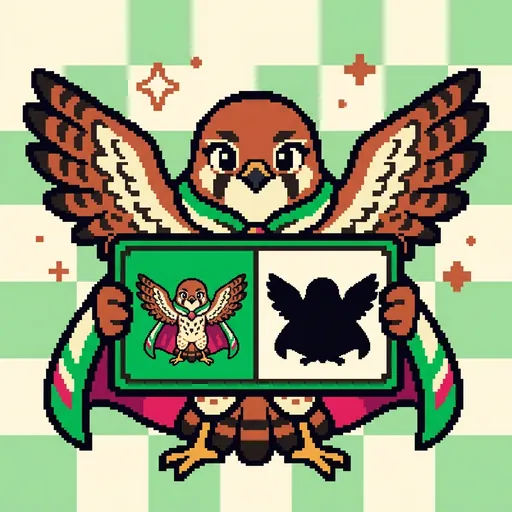
Banner zipped through the air. She was a kestrel-tween, small and quick. Her feathers were warm russet, with bold, dark tips on her wings. She wore a chunky herald-cape. It billowed behind her. In one claw, she carried her special silhouette-test-card.
This card was Banner’s favorite thing. One side showed a character in full color. The other side showed the exact same character. But it was just a black outline. No details at all. Banner loved to say, “Recognizable from outline alone.” She’d add, “If it works as silhouette, it works as art.”
Banner was very patient. Especially about silhouettes. She believed that good character art worked even when it was tiny. You could tell what it was just from its shape. Most new artists added tiny details first. That was backwards, Banner thought.
A strong outline made a strong character. If the shape was boring, no amount of fancy colors could save it. But a cool shape? Even simple colors looked great. This was super important for pixel art. When a sprite was super small, like 16x16 pixels, there was no room for details. The outline was the character.
Banner’s whole job was to show everyone this secret. She made sure people designed the outline first. She celebrated art you could spot in a flash.
“The impact pose,” Banner would say. She’d hold up her card. “Recognizable from outline alone.” She’d tap the black silhouette. “If your character’s shape looks like every other character’s shape, it needs work.” Even if it was super tiny.
Banner taught her friends how to make great silhouettes. First, the silhouette test. You filled your character with black. Then you looked only at its outline. Was it easy to tell what it was? Was it special? Next, the iconic-pose strategy. You drew your character in a pose that made its shape stand out. A hero with a sword raised high. A bad guy with arms crossed. A wise old wizard holding a staff. The pose told you who they were. Then, you emphasized special features. A tall hat? Spiky hair? A weird weapon? Big ears? These things changed the outline. Banner said, “Lean into them!” After that, thumbnail readability. You looked at your character when it was super small. Like a tiny picture on a screen. Could you still tell who it was? “That’s the threshold,” Banner would say. “That’s how you know it’s good.” She also taught the pixel-art extreme. At 16x16 pixels, every single pixel mattered. Details inside the shape were a luxury. The outline was a must-have.
Banner came from the High-Tower Village. Her family had been the banner-bearers there for ages. They were kestrels, just like her. Their distinctive wing-spread shapes had been the village’s symbols for generations. They learned a lot over many years. “The silhouette IS the herald,” they’d say. “If the silhouette is strong, the herald is strong.” Banner carried that lesson with her.
She walked to PixelForge when she was thirteen. Palette, her mentor, had asked her a question. “What is the silhouette?” Banner had answered right away. “The impact pose. Recognizable from outline alone. Good character art reads at thumbnail size.” Palette had smiled. “You are appointed,” she said.
Now, in her own workshop, Banner loved to show off. Her workshop was bright. It had drawing tablets and screens everywhere. She picked up her silhouette-test-card. “Watch this,” she said.
She showed the full-color side of the card. “Here’s a hero,” she explained. “He has a sword and a shield.” The hero looked brave. He wore shiny armor.
Then she flipped the card. It showed only the black outline. “Black-only outline,” she pointed out. “See? Still looks like an armored figure. Sword raised. Shield in front. That’s a strong silhouette.” It was easy to tell who it was.
Next, she showed a different character. “This one looks okay in full color,” Banner admitted. The character had a nice blue tunic. It had a friendly face. But then Banner flipped the card. The silhouette was just a blob. It was round and lumpy. You couldn’t tell what it was. “Blob,” Banner sighed. “Indistinctive silhouette. That means a forgettable character.” She shook her head.
Banner grabbed a stylus. She opened a new drawing program. She started to change the blob character. First, she drew a tall, pointy hat. It stuck up like a wizard’s hat. Then she added a long, swishy coat. It flared out at the bottom. She gave the character a big, round shield. It looked like a giant button.
She quickly made a new silhouette. She filled the new drawing with black. “Now look,” she said, holding it up. The shape was totally different. You could see the pointy hat. You could see the swishy coat. The big shield made a clear side shape. “Now it’s distinctive,” she announced. “Much better.”
Banner tapped her chest. “I am Banner,” she said. “The main thing I teach is the silhouette.” She held up her card again. “First, you test the outline. Do that before adding details. Lean into what makes your character special. And always check if you can tell who it is at tiny sizes. That’s the most important thing.”
She spoke gently. “Don’t pile on all the tiny bits first. Design starts big. Then it gets smaller. Strong shape first. Make it look good second. Add tiny details last. That’s the right order.”
“Recognizable from outline alone,” Banner said, her voice clear. “If it works as silhouette, it works as art.”
The PixelForge ensemble
Banner is part of PixelForge's distributed-narrative cast. Each character embodies a different curricular primitive; together they teach the full subject.
-
Speck
The single pixel — the atomic unit of pixel art; every image is a grid of these
-

Shade
The palette ramp — a small set of colors arranged from darkest to lightest (the foundation of pixel-art shading and form)
-
Grid
The tilemap grid — pixels snapped to repeating units that form tiles, tilesets, and game maps
-
Tween
The in-between frame — the animation frame that sits between two keyframes, giving motion its smoothness
-
Stipple
Dithering — scattering two colors in a checker pattern so your eye blends them into a third; how pixel artists fake a smooth gradient with a tiny palette
-
Feather
Anti-aliasing — tucking a few in-between pixels along a jagged edge so a curve reads smooth instead of like a staircase
-
Sheen
Light source and form shading — choosing where the light comes from, then placing highlights and shadows so a flat shape turns round
-
Rim
Selective outlining — drawing the edge only where a sprite would get lost, so it pops from the background without looking boxed-in
-
Cycle
Color-cycling animation — making water and fire flow by shifting which colors sit in the palette slots, without moving a single pixel
-

The Sprite
A finished character sprite coming to life — how placed pixels, a color ramp, chosen light, a clean outline, and smoothed edges layer together into one whole little hero