
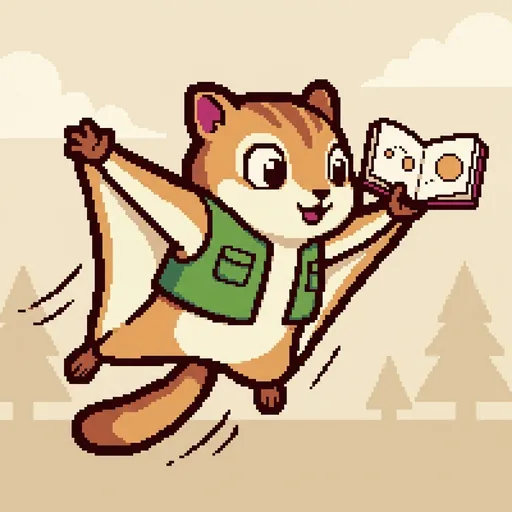
Tween
TWEEN — the in-between frame that carries motion from one pose to the next
Listen along — Tween
Loading audio…
Press play to listen along. The line being read lights up as you go.
Show full transcript
Loading transcript…
Chapter 4 — Tween and the Frame in the Middle
High in the canopy village of Pixelforge, on a branch that swayed like a slow breath, a flying-squirrel named Tween was drawing a picture of himself falling.
He drew it one small page at a time. First page: Tween crouched on the branch, ready. Last page: Tween landed soft on the moss below. And then, in between those two, he drew page after page after page — Tween tipping forward, Tween spreading his glide-flaps, Tween sinking, Tween slowing, Tween reaching with his toes. Each page barely different from the one before it.
A young beetle crawled up beside him and peered at the stack. “You already drew the start and the end,” she said. “Why bother with all the ones in the middle? They’re almost the same.”
“Because the middle is where the moving happens,” Tween said. He flipped the whole stack fast with his thumb, and the little drawn squirrel leapt — a smooth, whole glide, start to finish, no gaps. The beetle gasped.
“See? The first page and the last page are just two frozen moments,” Tween said. “The in-betweens are what turn two frozen moments into one real motion.”
Tween had learned that the hard way, when he was small.
His family had been glide-watchers for the canopy village for as long as anyone could remember, sitting on the high branches counting the way older squirrels crossed the forest gaps. The first time little Tween tried to draw a glide, he drew only two pictures: launch, and landing. Then he flipped between them, back and forth, and the squirrel just blinked from one place to the other — snap, snap — like a broken thing.
“It’s jumping around,” he’d said, frustrated, his chest tight and hot. “It looks wrong and I don’t know why. I did the important parts. I drew the start and I drew the end.”
His grandmother had settled beside him, an old squirrel with fur the color of dried leaves. She hadn’t told him he’d done it wrong. She’d just asked, quietly, “When your cousin glides across the gap — does she teleport? One second here, next second there?”
“No,” Tween said. “She… slides. Smoothly.”
“So where’s the smooth part in your drawing?”
Tween looked down at his two pages and felt the answer land in his stomach before his head caught up. The smooth part was the part he’d skipped. The boring middle — the frames where it looked like almost nothing was happening — that was the whole thing. That was where the gliding lived.
He didn’t fix it that day. But the jittery, wrong feeling had a name now: missing the in-between. And somehow, knowing that made it possible to keep going.
He walked to Pixelforge at twelve, because a place that made pictures move ought to understand the frames nobody notices.
Palette, the old mentor who ran the workshops, met him at the gate with paint under her claws. She didn’t ask him to prove he could draw. She asked one thing. “What is a tween?”
Tween didn’t answer with words. He pulled out two loose pages — a squirrel crouched, a squirrel landed — and held them up, one in each paw. “This is the start,” he said, waggling the left. “This is the end,” waggling the right. Then he set them down and, working fast, sketched six more pages and slid them into the gap between. He flipped the finished stack, and the squirrel leapt clean and true.
“The start and the end were always there,” Tween said. “But they don’t move until somebody fills in the middle. The in-betweens aren’t extra. They’re the motion itself.”
Palette watched the little drawn squirrel glide, again and again, in the flipping pages. “You belong here,” she said.
Tween’s workshop was full of stacks of paper that were secretly alive.
A boy came in one grey afternoon, slumped and cross. He dropped a thin stack on the bench. “I made a walk cycle,” he said. “But it looks like my guy is stomping and glitching. And I already spent forever on it. Feels like I wasted the whole day.”
Tween knew that slump. He’d felt it on the branch, years ago.
“Flip it for me,” he said. The boy flipped. The little drawn figure lurched — snap, snap — legs teleporting from one wide stride straight to the next.
“You drew the big poses,” Tween said gently. “The step out, the step down. Those are your keyframes — the important moments.” He tapped the gap between two pages. “But look here. Between one stride and the next, you jumped straight across. There’s no in-between. So your eye can’t follow the leg from here to there — it just sees it snap. That’s the glitch.”
He took a few blank pages and, quick and easy, drew the missing middle: the foot lifting, swinging, reaching, settling. He slid them into the gaps and handed the fatter stack back. “Now flip.”
The boy flipped. The figure walked — a real, rolling, smooth-footed walk. He flipped it again just to watch. “It’s so much better,” he breathed. “But I barely added anything!”
“You added the part that was missing,” Tween said. “Same as before — the start poses, the end poses, all still yours. You didn’t waste the day. You just hadn’t filled the in-betweens yet.” He smiled. “Two poses is a picture. The frames between them are what make it move. A jump, a glide, a walk, a wave goodbye — all of it lives in the middle, in the frames that seem like nothing’s happening. That’s where the smoothness comes from.”
Later, when the workshop had emptied and the light had gone gold, the boy came back with one more question. He was quieter now, his stack of walk-frames held careful against his chest.
“When it’s just the in-between frames,” he said, “and each one looks so tiny and boring and almost-the-same… how come those are the ones that matter?”
Tween thought about the branch. About the two snapping pages and the tight, hot feeling in his chest, and his grandmother’s quiet voice asking where the smooth part had gone.
“Because smooth isn’t one big thing,” Tween said. “It’s a hundred small ones, laid gently side by side. Any single in-between frame looks like nothing — barely a difference from its neighbor. But that barely is the secret. When each little step is small and close and kind to the one before it, your eye stops seeing separate pictures and starts seeing one whole motion.” He flipped the boy’s walk cycle once more, slow this time, and they both watched the figure stroll. “The frames that feel like nothing are the ones doing the holding. Skip them and everything jitters. Draw them, one gentle in-between at a time, and it all comes together and flows.”
The boy nodded slowly, and Tween watched the cross, wasted feeling lift off the boy’s shoulders — the same way, years ago, his own had. And Tween felt glad, warm all the way through, because he knew the boy would never again look at a boring in-between frame and think it didn’t count.
The PixelForge ensemble
Tween is part of PixelForge's distributed-narrative cast. Each character embodies a different curricular primitive; together they teach the full subject.
-

Speck
The single pixel — the atomic unit of pixel art; every image is a grid of these
-

Shade
The palette ramp — a small set of colors arranged from darkest to lightest (the foundation of pixel-art shading and form)
-
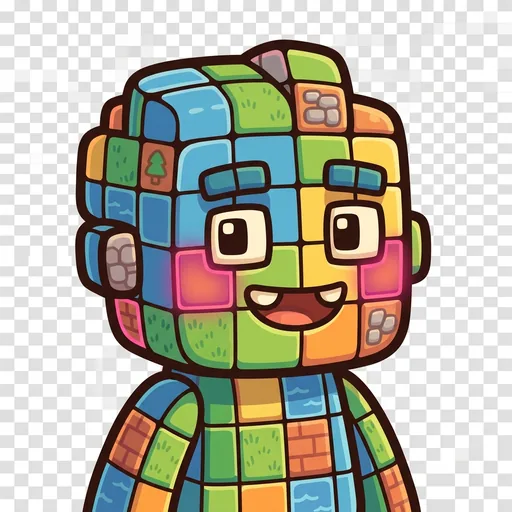
Grid
The tilemap grid — pixels snapped to repeating units that form tiles, tilesets, and game maps
-
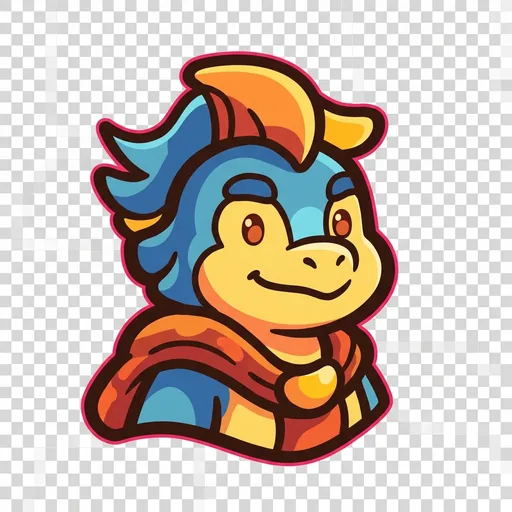
Banner
The impact pose — the heroic / dramatic silhouette that reads instantly at thumbnail size (the principle that good character art is recognizable from its outline alone)
-
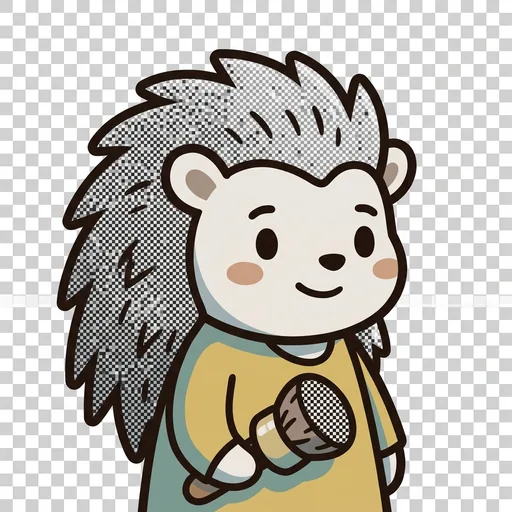
Stipple
Dithering — scattering two colors in a checker pattern so your eye blends them into a third; how pixel artists fake a smooth gradient with a tiny palette
-
Feather
Anti-aliasing — tucking a few in-between pixels along a jagged edge so a curve reads smooth instead of like a staircase
-
Sheen
Light source and form shading — choosing where the light comes from, then placing highlights and shadows so a flat shape turns round
-
Rim
Selective outlining — drawing the edge only where a sprite would get lost, so it pops from the background without looking boxed-in
-

Cycle
Color-cycling animation — making water and fire flow by shifting which colors sit in the palette slots, without moving a single pixel
-

The Sprite
A finished character sprite coming to life — how placed pixels, a color ramp, chosen light, a clean outline, and smoothed edges layer together into one whole little hero