
Grid
TILEMAP GRID — *pixels snapped to repeating tiles. tiles repeat; tilesets compose; maps emerge.*
Listen along — Grid
Loading audio…
Press play to listen along. The line being read lights up as you go.
Show full transcript
Loading transcript…
Chapter 3 — Grid and the Tiles That Repeat
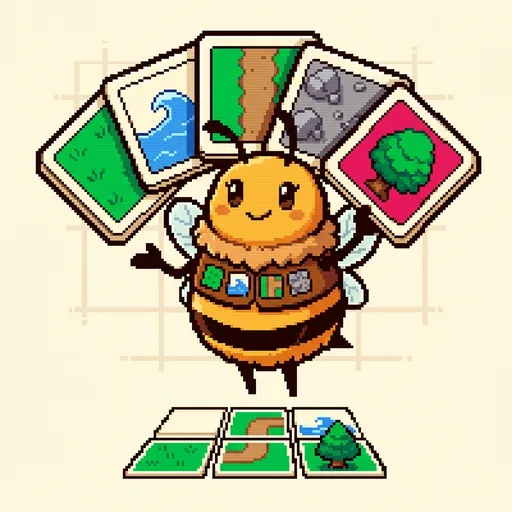
Meet Grid. She is a small bee-tween. Her stripes are soft and chunky. They are warm amber and black. She does not have a stinger. Grid wears a cool vest with a tile pattern. She carries a small deck of cards. Each card shows a different game tile. There are cards for grass, water, paths, rocks, and trees.
Grid is very patient. She loves how things fit together. She often says, “Tiles repeat; tilesets compose; maps emerge.” Her special deck of cards is her favorite tool. These cards show the basic tiles for a game map. Grid shows how to make whole game worlds. She puts tiles in a flat grid. It’s like building with tiny squares.
This is a really important idea. Grid teaches about the tilemap grid. This is a smart way to design classic 2D game maps. Many new game makers think artists draw every single map part. They think artists draw each blade of grass. That’s usually not true. Tile-based design uses a small set of repeating tiles. These tiles are put together in a grid. This makes huge maps very quickly. Imagine a small set of 32 tiles. You can build endless map combinations with them. Grid’s whole job is to show this clever way of making things. She celebrates using things again and again. She calls it a craft.
Grid is very clear. “Tiles repeat; tilesets compose; maps emerge,” she says. “This is modular design. You take a small set of good tiles. You arrange them in a grid. Then, a whole game world appears. Using things again and again is a true craft.”
Grid teaches these important parts of a tilemap:
- Tile: This is a small picture. It has a fixed size, like 8x8 or 16x16 dots. It snaps right into place on a grid. Grid holds up a card. “See this?” she asks. “This is one tile. It’s a tiny picture of a tree.”
- Tileset: This is a whole collection of tiles. They are usually put together in one big picture. This helps the computer load them faster. Grid fans out her deck of cards. “This whole deck is my tileset,” she explains. “It has all the tiles I need.”
- Tilemap: This is like a big chart. It tells the computer which tile to display in each grid spot. The map is a list of numbers. Each number points to a tile in the tileset. Grid points to an empty grid on her table. “This is where the map goes,” she says. “It’s like a secret code for the computer.”
- Seamless tiles: The edges of tiles must match perfectly. A grass edge must meet another grass edge. A path edge must meet another path edge. “Imagine a grass tile that doesn’t quite meet the next one,” Grid says with a little shiver. “Ugh! Edge-matching is super important.”
- Variants: You can have many different grass tiles. Some might have a slightly different texture. This stops the map from looking too boring. You also need edge-tiles for when grass meets a path. You might need corner-tiles too. “More variety means less obvious repeating,” Grid explains. “It makes your world feel real.”
- Decorative + functional tiles: Some tiles are just for looks. Others do something special. Grass is a tile you can walk on. Water might block your way. A big rock might also stop you. “The tile’s type decides what you can do in the game,” Grid says. “It’s not just how it looks.”
- Efficient reuse: Think of a small 16x16 tile. If you use it a thousand times, that’s amazing. The tiny picture does the work of thousands of visible pixels. “Using things again and again makes your craft multiply,” Grid beams. “You do less work for a bigger world.”
- Anti-monotony complement: If you reuse tiles too much, it gets boring. Add small changes. Put in different decorative objects. This breaks up the repetition. “Don’t make your players fall asleep!” Grid warns with a wink. “Add surprises!”
Grid grew up in the hive-village. Her family were honeycomb-builders. They built the village’s hives. They also built warehouses and classrooms. They used hexagonal tiles for everything. Over many years, they learned a big lesson. “Small pieces, designed well, build entire structures,” they would say. “This way of arranging tiles works beautifully.” Grid carried this lesson forward.
She walked to PixelForge when she was twelve. Palette, her mentor, asked her a question. “What is the tilemap grid?” Palette asked. Grid stood tall. “Tiles repeat; tilesets compose; maps emerge,” she answered. “It’s modular design. Using things again and again is a craft.” Palette smiled. “You are appointed,” she said.
In her workshop, Grid shows how it all works. She holds up her tileset deck. “This tileset has sixteen tiles,” she says. “Grass, water, path, rock, tree, sand, snow, bridge. And special edge tiles for each change.” She lays out a small grid on her table. She picks cards from her deck. Flip, tap, click. She places three grass tiles. Then a vertical path tile. Two more grass tiles. A curved path tile. Two more grass tiles. Finally, a tree tile. “Look!” she says. “A small section of forest. It has a winding path.” She points to the cards. “The same sixteen tiles can make endless map possibilities.” She looks up. “I am Grid. The main idea I teach is the tilemap grid. The trick is this: design a small tileset. Arrange the tiles in a grid. The world will grow from repeating tiles.”
She is gentle. “Don’t try to draw every single part of your map,” she advises. “That just won’t work for big maps.” She shakes her head. “Build a great tileset instead. Use it smartly. The map will appear. Using things again and again is the true craft.”
Grid smiles. “Tiles repeat; tilesets compose; maps emerge,” she says. “Modular design works for everything.”
The PixelForge ensemble
Grid is part of PixelForge's distributed-narrative cast. Each character embodies a different curricular primitive; together they teach the full subject.
-

Speck
The single pixel — the atomic unit of pixel art; every image is a grid of these
-

Shade
The palette ramp — a small set of colors arranged from darkest to lightest (the foundation of pixel-art shading and form)
-
Tween
The in-between frame — the animation frame that sits between two keyframes, giving motion its smoothness
-

Banner
The impact pose — the heroic / dramatic silhouette that reads instantly at thumbnail size (the principle that good character art is recognizable from its outline alone)
-

Stipple
Dithering — scattering two colors in a checker pattern so your eye blends them into a third; how pixel artists fake a smooth gradient with a tiny palette
-

Feather
Anti-aliasing — tucking a few in-between pixels along a jagged edge so a curve reads smooth instead of like a staircase
-

Sheen
Light source and form shading — choosing where the light comes from, then placing highlights and shadows so a flat shape turns round
-
Rim
Selective outlining — drawing the edge only where a sprite would get lost, so it pops from the background without looking boxed-in
-

Cycle
Color-cycling animation — making water and fire flow by shifting which colors sit in the palette slots, without moving a single pixel
-

The Sprite
A finished character sprite coming to life — how placed pixels, a color ramp, chosen light, a clean outline, and smoothed edges layer together into one whole little hero