
Sharer
COVALENT BOND — *cooperative, balanced; equal partnership.* The bond-type that forms when two atoms share electrons in their overlapping outer shells. H₂O, CH₄, NH₃, O₂, N₂ — most molecular compounds.
Press play to listen along. The line being read lights up as you go.
Show full transcript
Loading transcript…
- Salt - Element - Ion gate-allow-text-pattern: '^([A-Z][a-z]?[0-9]?)+([-=≡][A-Z][a-z]?[0-9]?)*$' ---
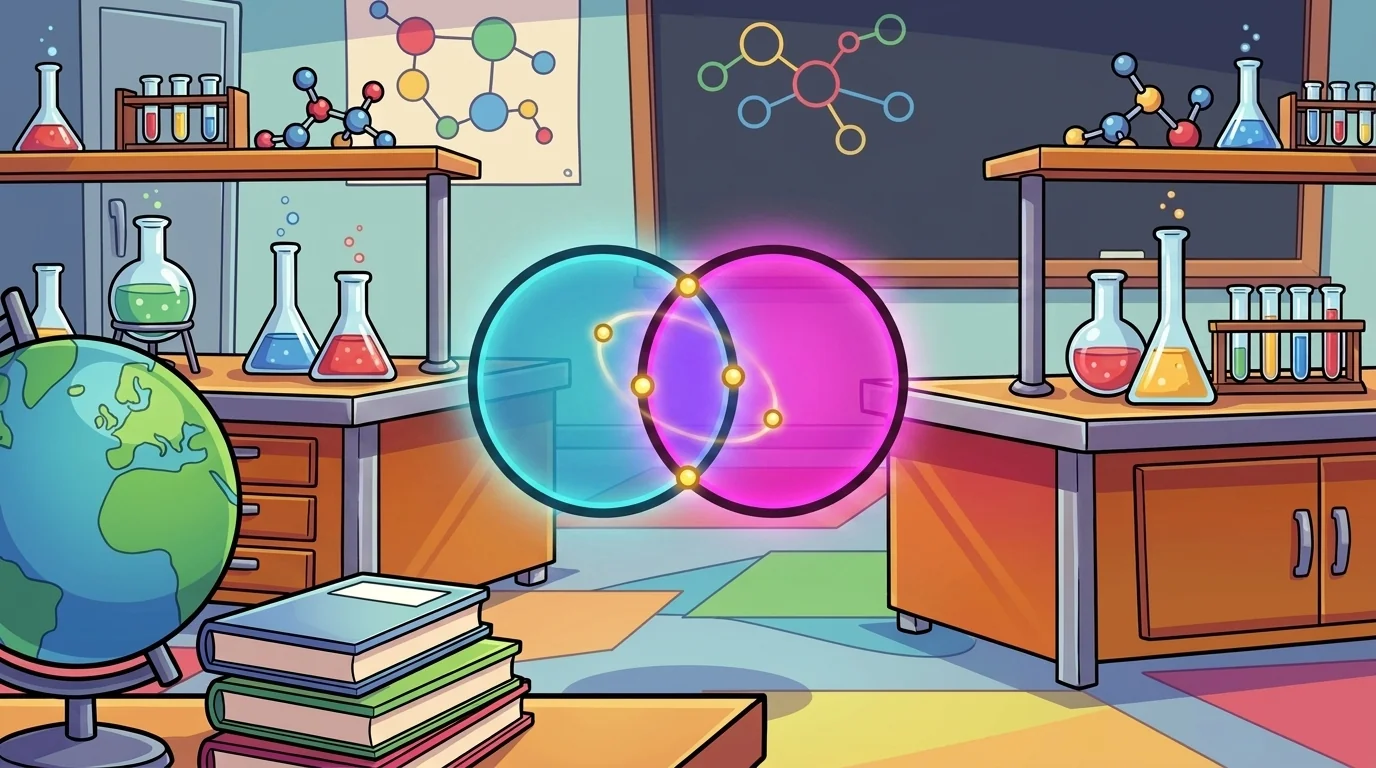
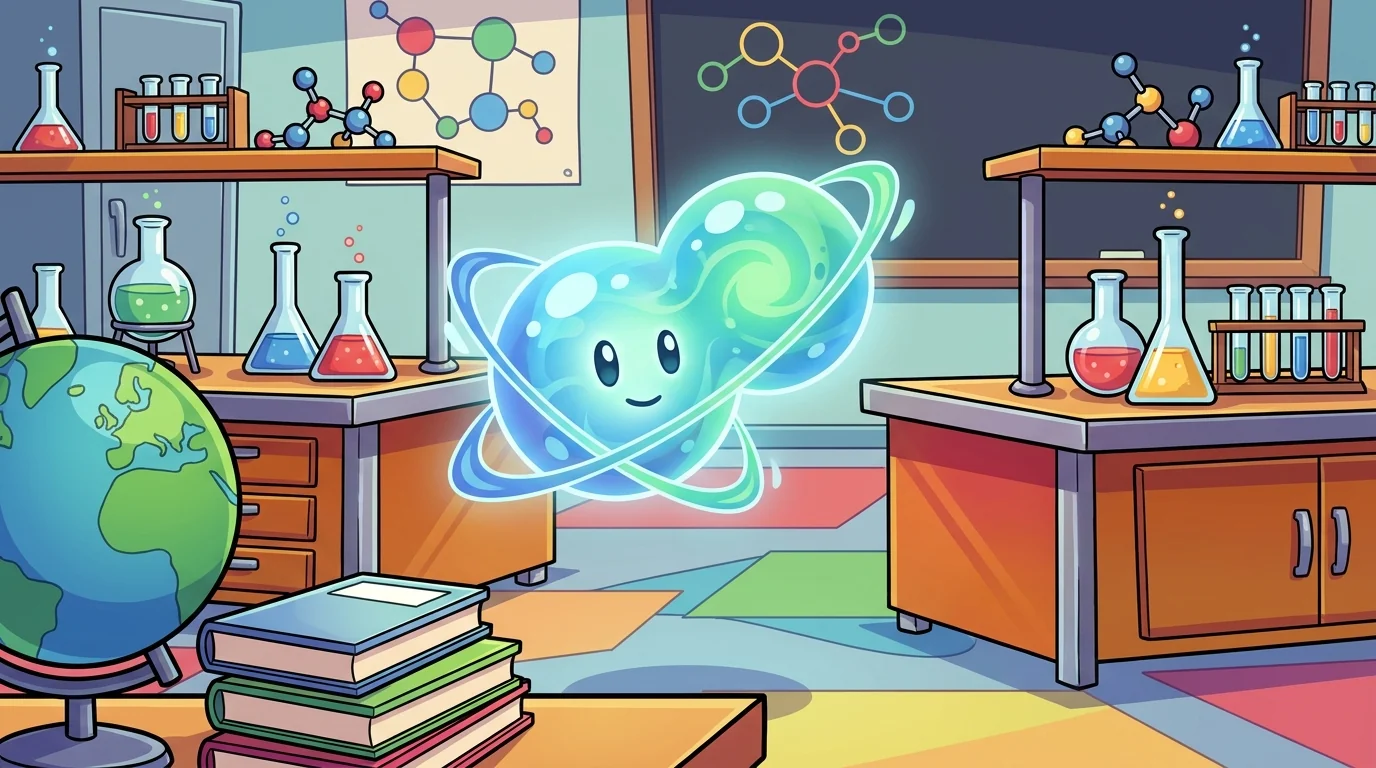
Sharer wasn't an animal. Sharer wasn't a person with a face. Sharer was just a shape. A very special shape. It was two small circles, painted bright. They overlapped a little bit. In that overlap zone, tiny bright dots floated. Those dots were shared electrons. They moved between the two atom-positions. That was the whole figure. No face. No personality. Just the energy-shape of shared electrons.
This shape was super important. Sharer showed everyone the covalent bond. What is a covalent bond? Imagine two atoms. Each atom gives one electron. They put these electrons into a shared pair. This pair sits right in the middle. It's in the overlap zone of their outer shells. Both atoms can reach these electrons. Neither atom takes the electron. They both share it. This shared electron-pair holds the two atoms together. That's the covalent bond.

Covalent bonds come in different strengths. They can be single. That means one shared pair. They can be double. That means two shared pairs. Or they can be triple. That means three shared pairs. The more pairs shared, the stronger the bond. The atoms also get closer together. Triple bonds are the strongest covalent bonds. Nitra's N₂ atmospheric pair is a good example.
Sometimes, atoms share perfectly. This happens when both atoms pull equally. Like H–H in hydrogen gas. Or C–C in a diamond. They share the electrons 50/50. These are equal covalent bonds.
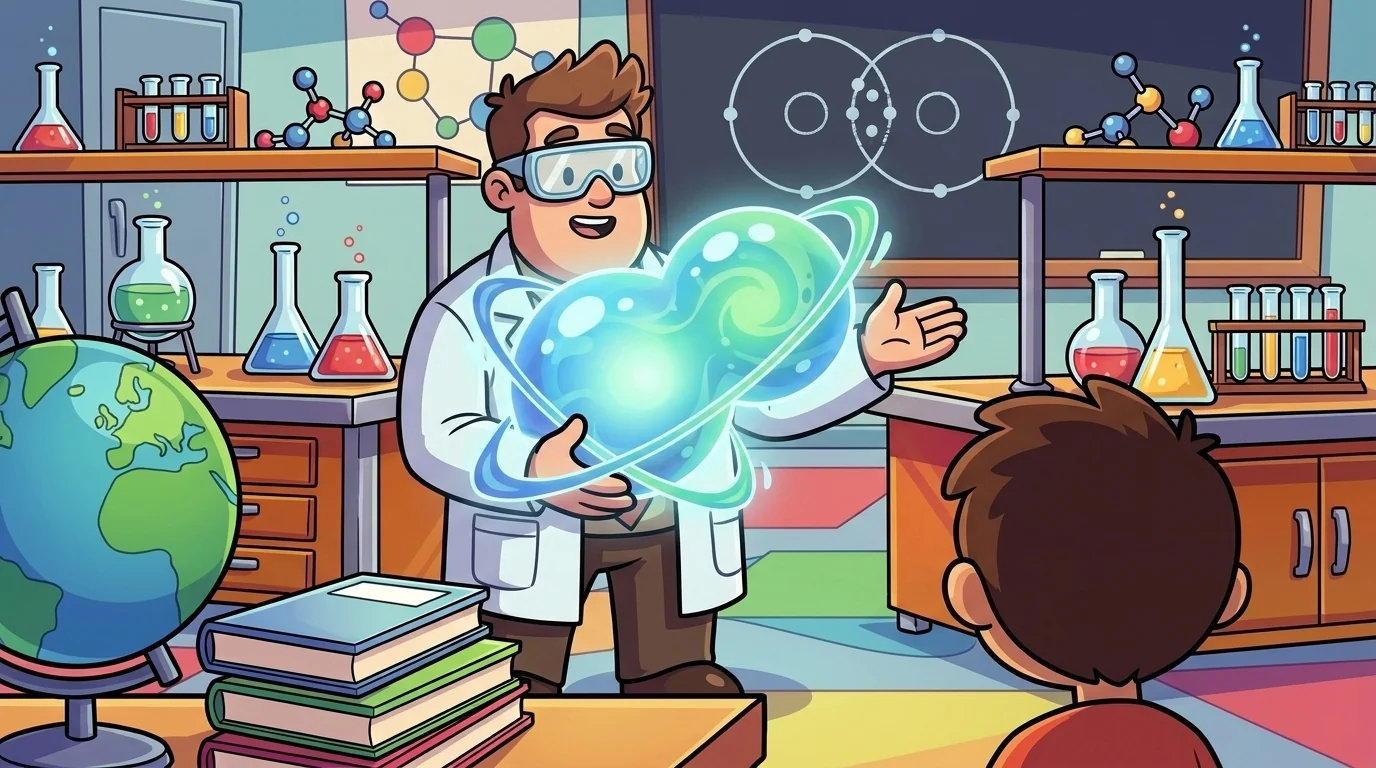
Beaker introduced Sharer to the class. "This is Sharer!" he boomed. He held up the glowing shape. "Sharer is the covalent bond. See? No face. Sharer is not a being. Sharer is a force. It's the force between atoms. Atoms that share electrons. Look at the overlapping circles. Two atoms. One shared pair. That's the whole figure. The force is the figure."
In ChemQuest classrooms, Sharer often appeared. It would pop up next to cast members. They would be forming covalent bonds. Most often, Hydra and Oxy would stand together. Sharer would appear between them. This showed how water, H₂O, was made. Or Carbo and Hydra would join up. Sharer would show the methane, CH₄, bond. Sometimes Carbo would link with another Carbo. Sharer would show a carbon chain.
Beaker always made sure to explain the difference. "Tugger is full transfer," he'd say. "That's an ionic bond. Sharer is a shared pair. That's a covalent bond. Both are bonds. But they are different kinds of forces."
Sharer's lessons were important. Beaker taught them for Sharer. A covalent bond means shared electrons. They sit in overlapping spaces. It's not about taking. It's about sharing. Bonds can be single, double, or triple. One, two, or three shared pairs. More pairs mean a stronger bond. The atoms are also closer. Sharing can be equal or unequal. Equal sharing is like H–H or C–C. The atoms pull the same. Unequal sharing is like O–H or N–H. One atom pulls harder. This makes polar covalent bonds. Polar covalent bonds are still sharing. But the sharing is uneven. Polar bonds make polar molecules. Water is a polar molecule. It acts differently from nonpolar molecules. Methane is nonpolar.
Covalent compounds are usually molecules. They are separate little groups. They don't form big lattices. They often have lower melting points. They usually don't conduct electricity. Remember the big rule: shared, not transferred. For covalent bonds, both atoms hold the electrons. For ionic bonds (Tugger's job), one atom takes them all. This difference is key.
Beaker often pointed to Sharer. "Sharer has no face," he said. "That's the lesson. The shared bond is a force. It's not a person."
The ChemQuest ensemble
Sharer is part of ChemQuest's distributed-narrative cast. Each character embodies a different curricular primitive; together they teach the full subject.
-

Hydra
Hydrogen (H) — lightweight, ubiquitous, always paired up; buddy-system enthusiast
-

Carbo
Carbon (C) — connects to anything; the social atom; backbone of life
-

Oxy
Oxygen (O) — eager bonder; electronegative; the hungry grabber
-

Nitra
Nitrogen (N) — triple-bond loyal; slow-to-warm; locks in deeply once bonded
-
Sodi
Sodium (Na) — generous, impulsive; always giving away electrons
-

Chlora
Chlorine (Cl) — sharp, focused; the collector who finishes what Sodi starts
-

Helio
Helium (He) — noble gas; peaceful, floaty, complete; the contented onlooker
-

Sulfa
Sulfur (S) — earthy, dramatic; the stinky uncle of volcanoes and proteins
-

Phossa
Phosphorus (P) — energetic, restless; the spark of ATP and matches
-

Magna
Magnesium (Mg) — bold, ceremonial; burns bright white; chlorophyll core
-

Silica
Silicon (Si) — patient, geometric; the architect who builds quietly
-

Alumi
Aluminum (Al) — practical, modest; the workhorse of cans and foil
-

Tugger
Ionic bond — forceful, decisive; full electron transfer; opposites attract
-

Streamer
Metallic bond — flowing, communal; delocalized electron sea
-

Whisperer
Hydrogen bond — subtle, persistent; water's superpower; DNA pairing