
Tugger
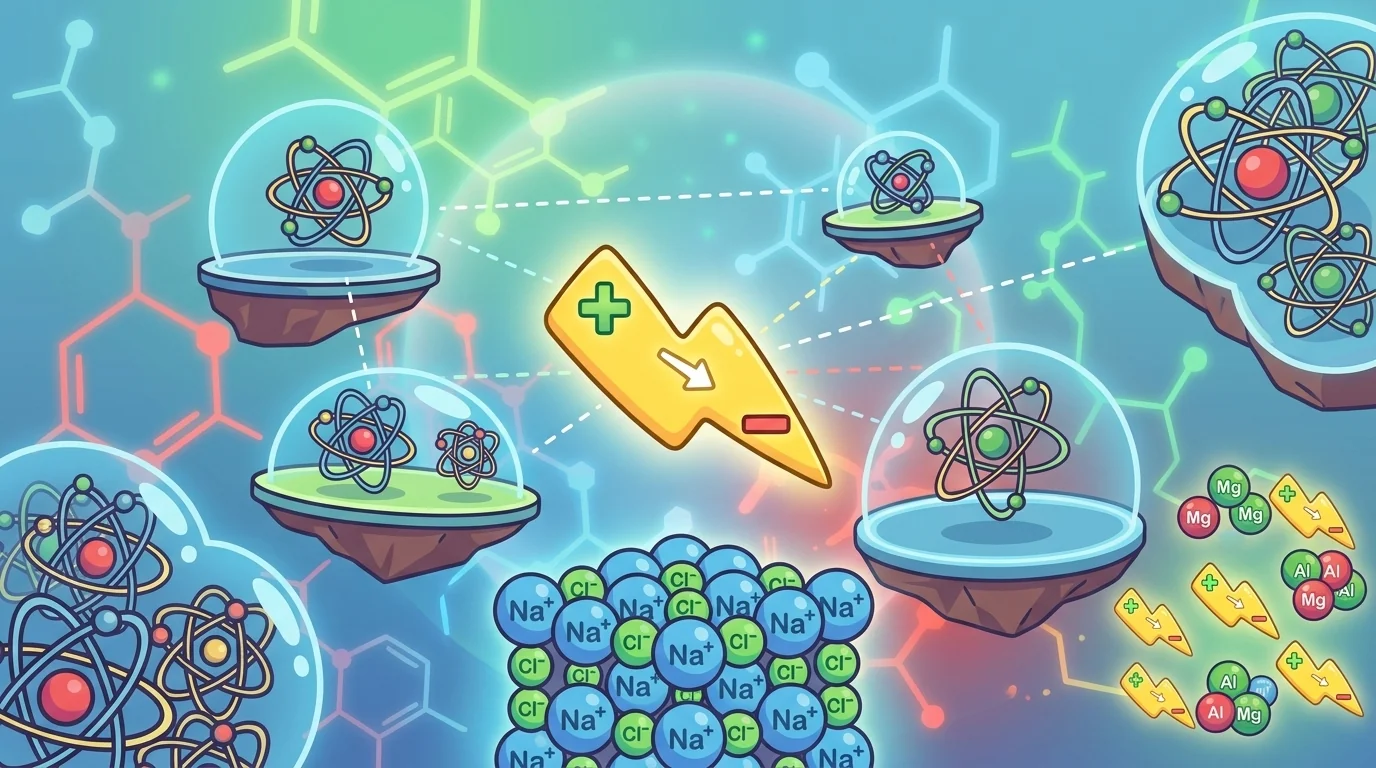
IONIC BOND — *forceful, decisive; full electron transfer; opposites attract.* The bond-type that forms when one atom completely gives an electron to another. NaCl, MgCl₂, Al₂O₃ — most salts.
Press play to listen along. The line being read lights up as you go.
Show full transcript
Loading transcript…
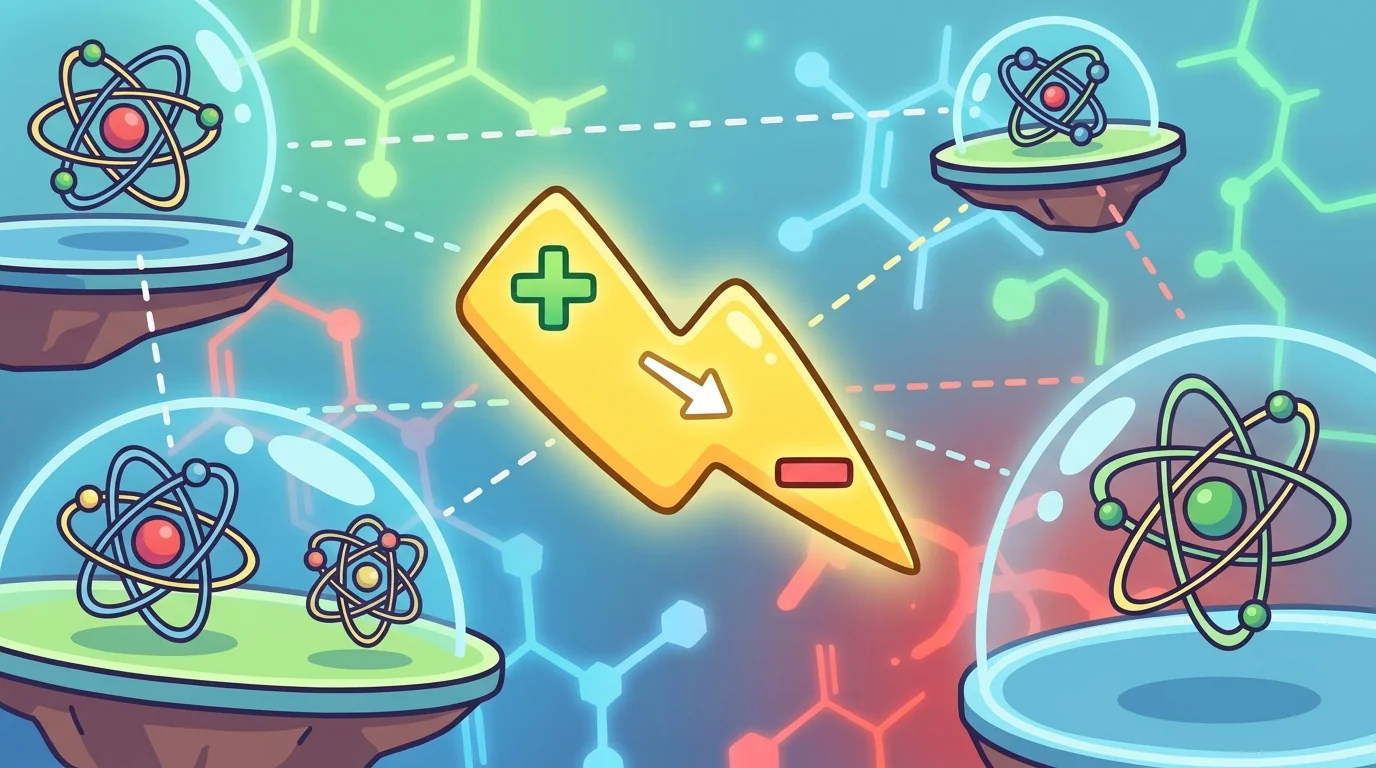
Meet Tugger. Tugger is not an animal. Tugger is not a person. Tugger is a shape. It looks like a small lightning bolt. One end has a bright plus sign (+). The other end has a bright minus sign (−). You can see a tiny arrow too. It shows electrons moving from the plus to the minus. That's all Tugger is. No face. No arms or legs. Just a shape that shows energy.
This is super important. The ChemQuest team has four special characters. They show different kinds of bonds. These bond characters are not like the element characters. The elements are animal-tweens. They have personalities. But the bond characters are just shapes. They show forces. They don't have personalities at all. This is on purpose. Bonds are forces between atoms. They are not living things. Giving them faces would make us think wrong things about chemistry. The way we designed the characters shows what bonds really are.
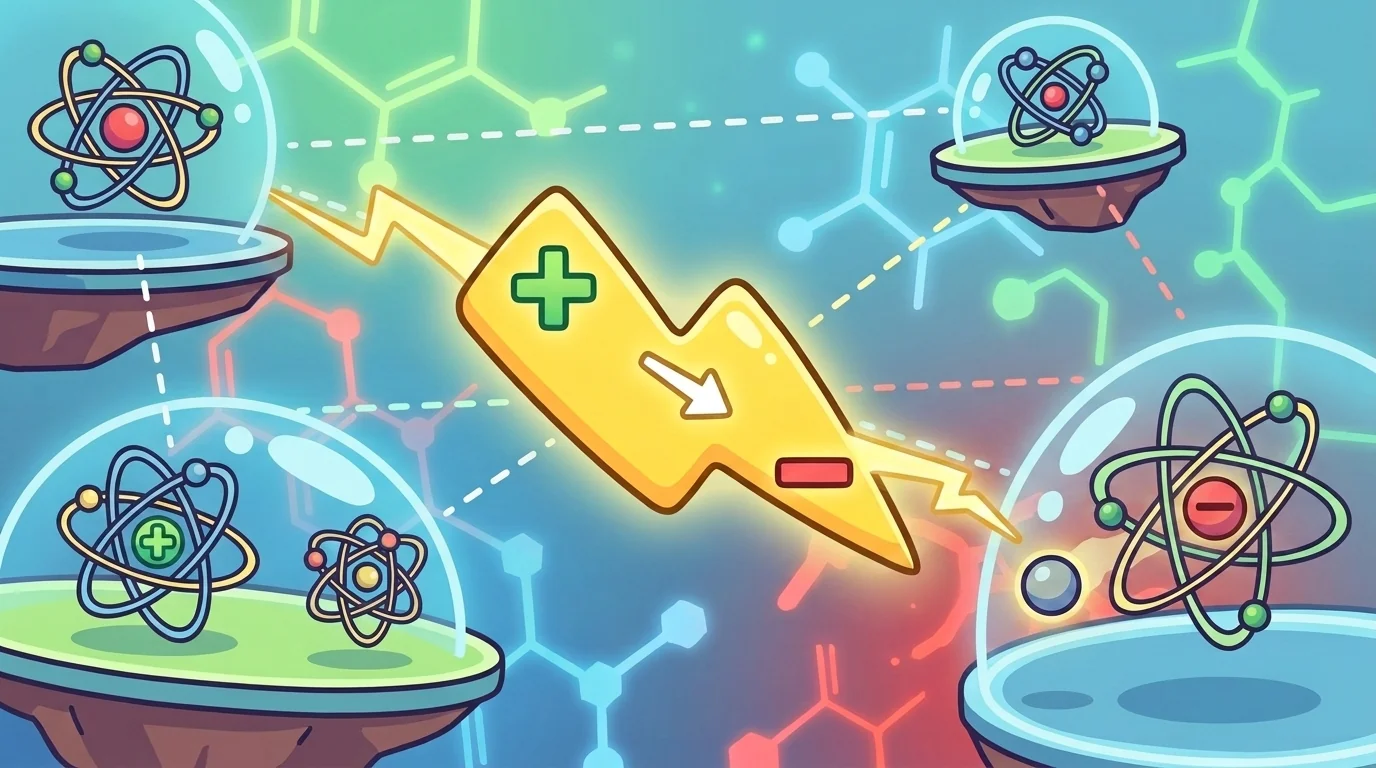
This is also super important. Tugger shows us the ionic bond. An ionic bond happens when one atom gives an electron away. It gives the electron completely to another atom. The atom that gives becomes positive (+). The atom that takes becomes negative (−). These two opposite-charged atoms then pull on each other. It’s like when you rub a balloon on your hair. Then the balloon can pick up tiny bits of paper. That pulling force holds them together. That strong pull is the ionic bond.
Think about regular table salt. Its chemical name is NaCl. Sodi gives her electron to Chlora. Sodi becomes Na⁺. Chlora becomes Cl⁻. Then Na⁺ and Cl⁻ pull on each other. Zap! That's an ionic bond. It makes table salt. This bond is very strong. It’s a full transfer. No half-measures here. That's why Tugger looks like a lightning bolt. The electron moves fast and completely. It's like a sudden lightning strike.
It’s key to remember this. Tugger is all about the force of the bond. Not about Tugger as a character. The other ChemQuest friends and Beaker, our mentor, introduce Tugger like this:
"This is Tugger," Beaker says. "Tugger is the ionic bond. Tugger has no face. Tugger is not a person. Tugger is the strong force between atoms. It happens after one atom gives an electron to another. Look at the lightning-bolt shape. See the plus sign at one end? See the minus sign at the other? The arrow shows the electron moving. That's the whole figure. The force is the figure."
(Tugger doesn't have a family story. The bond characters don't have life stories. They are not people. This matches their abstract design.)
In our ChemQuest classroom, Tugger often appears. Tugger stands right next to Sodi and Chlora. They are a perfect example of an ionic bond. Tugger connects them on the workbench. One end of the lightning bolt touches Sodi. Sodi becomes the positive Na⁺. The other end touches Chlora. Chlora becomes the negative Cl⁻.
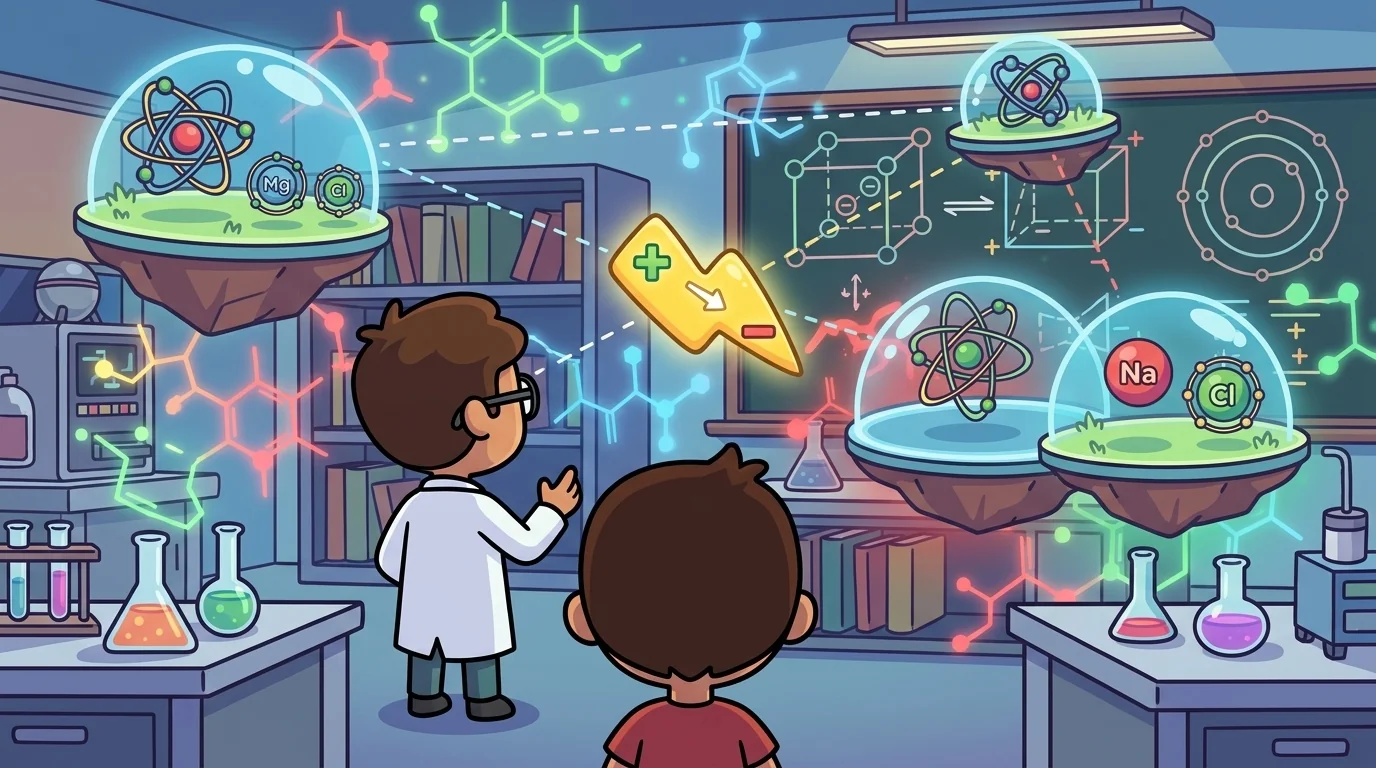
Beaker explains it clearly. "When you see Tugger between two characters," he says, "that's an ionic bond. It’s a full electron transfer. Plus and minus. Lightning-strike chemistry. The bond is the force."
Beaker teaches us about Tugger. He explains these important things:
An ionic bond means a full electron transfer. It's not sharing. One atom gives. The other atom takes. The giving atom turns positive. The taking atom turns negative. Opposite-charged atoms pull on each other. This is called electrostatic attraction. Think of magnets. Opposites attract. Likes repel. We learn about common ionic compounds. Like NaCl, which is table salt. Or MgCl₂, magnesium chloride, used in some medicines. CaCl₂, calcium chloride, which melts ice. Al₂O₃, aluminum oxide, found in rubies. MgO, magnesium oxide, used in antacids. KBr, potassium bromide, used in some photography. Ionic compounds are usually hard, solid crystals. The atoms line up in neat 3D patterns. Strong forces hold them together. Ionic compounds dissolve in water. They break apart into ions. For example, salt in water becomes Na⁺ ions and Cl⁻ ions. That's why salty water can carry electricity. Ionic bonds are usually very strong. They need lots of heat to melt. They can be brittle, like a dropped sugar cube. They carry electricity when melted or dissolved. * Remember the full-transfer rule. For ionic bonds, one atom takes all the electrons. For covalent bonds, atoms share. Sharer is the character for covalent bonds. Knowing the difference is key.
Beaker often reminds us. "Tugger has no face," he says. "That's the main lesson. The bond is a force. It's not a person. Respect it for what it is."
Sometimes students ask if ionic bonds are hard to understand. Beaker smiles. He speaks for Tugger.
"Not hard at all," he says. "Full transfer. Plus and minus. Opposites attract. Tugger is the force. Not the figure."
The lightning-bolt shape glows. It catches the light. Another ionic compound waits to form.
The ChemQuest ensemble
Tugger is part of ChemQuest's distributed-narrative cast. Each character embodies a different curricular primitive; together they teach the full subject.
-

Hydra
Hydrogen (H) — lightweight, ubiquitous, always paired up; buddy-system enthusiast
-

Carbo
Carbon (C) — connects to anything; the social atom; backbone of life
-

Oxy
Oxygen (O) — eager bonder; electronegative; the hungry grabber
-

Nitra
Nitrogen (N) — triple-bond loyal; slow-to-warm; locks in deeply once bonded
-
Sodi
Sodium (Na) — generous, impulsive; always giving away electrons
-

Chlora
Chlorine (Cl) — sharp, focused; the collector who finishes what Sodi starts
-

Helio
Helium (He) — noble gas; peaceful, floaty, complete; the contented onlooker
-

Sulfa
Sulfur (S) — earthy, dramatic; the stinky uncle of volcanoes and proteins
-

Phossa
Phosphorus (P) — energetic, restless; the spark of ATP and matches
-

Magna
Magnesium (Mg) — bold, ceremonial; burns bright white; chlorophyll core
-

Silica
Silicon (Si) — patient, geometric; the architect who builds quietly
-

Alumi
Aluminum (Al) — practical, modest; the workhorse of cans and foil
-

Sharer
Covalent bond — cooperative, balanced; equal partnership
-

Streamer
Metallic bond — flowing, communal; delocalized electron sea
-

Whisperer
Hydrogen bond — subtle, persistent; water's superpower; DNA pairing