
Sharer
COVALENT BOND — *cooperative, balanced; equal partnership.* The bond-type that forms when two atoms share electrons in their overlapping outer shells. H₂O, CH₄, NH₃, O₂, N₂ — most molecular compounds.
Press play to listen along. The line being read lights up as you go.
Show full transcript
Loading transcript…
One moment the lab table was empty. Then, a soft glow pulsed there, drawing every eye to its quiet appearance. It wasn't an animal, nor a faced figure like some of the other primitives they had seen. Sharer appeared as two perfect circles, painted a deep, calm blue, overlapping just slightly in the center. In that shimmering space between them, tiny bright dots, like miniature stars, floated and danced with an almost hypnotic rhythm. These were the shared electrons, the very heart of Sharer's purpose. Sharer had no face, no arms, no legs; it was simply that elegant, abstract shape, a pure representation of the energy of sharing, made visible for all to see.
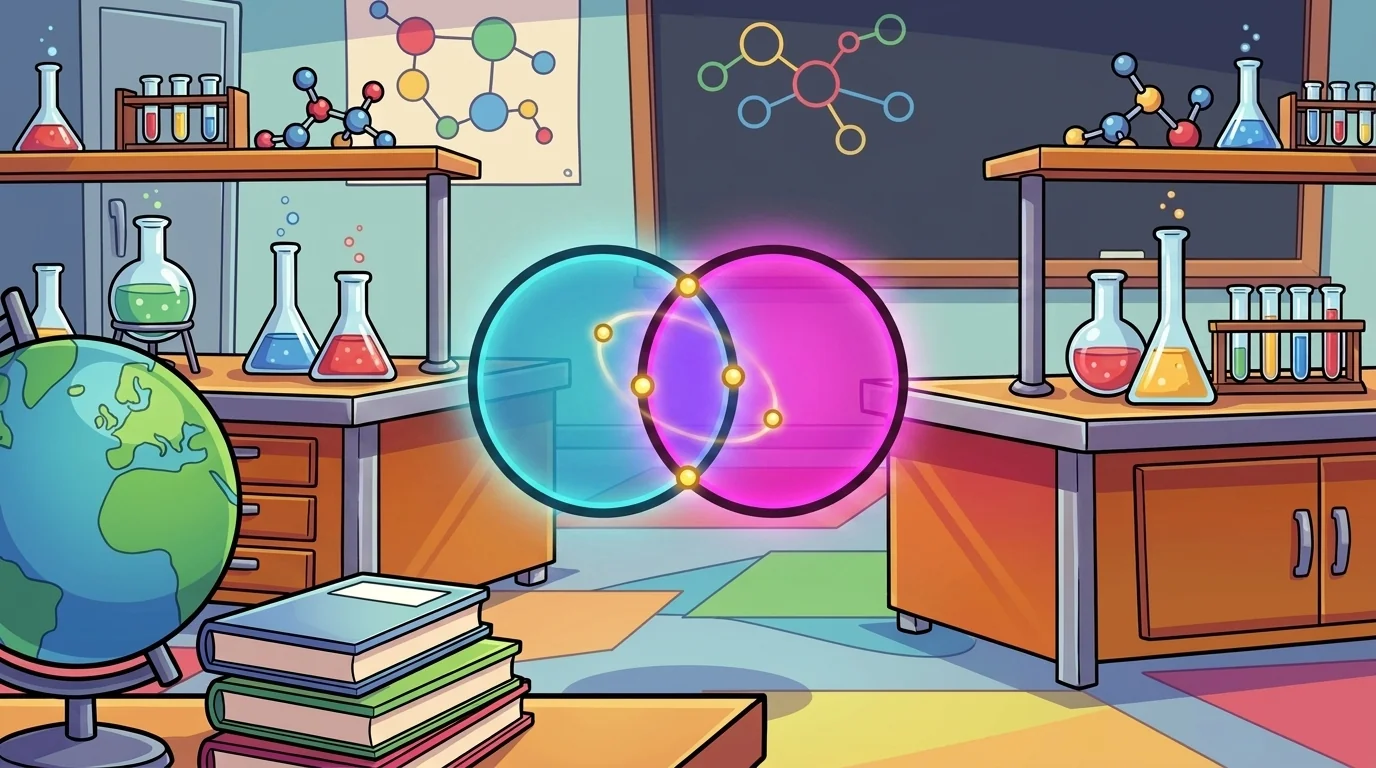
Beaker tapped a stylus on the table, her voice calm and clear. "This is Sharer. Sharer is the *covalent bond*." She gestured to the glowing circles. "See how the circles overlap? Imagine those are two atoms. Each atom contributes one electron to that shared space. Those electrons don't belong to just one atom. They belong to both. They share them." As she spoke, two element figures, Hydra and Oxy, shimmered into view. Sharer pulsed gently between them. The tiny dots, the electrons, zipped back and forth, equally available to Hydra and Oxy. "That shared pair," Beaker continued, "that's what holds them together. That's the covalent bond."
Sharer was everywhere in the world, Beaker explained. Most molecules relied on this kind of sharing. She showed them water, H₂O. Two Hydras and one Oxy appeared, and Sharer formed twice, linking each Hydra to the Oxy. Then came methane, CH₄. A Carbo figure appeared, surrounded by four Hydras. Four Sharers pulsed into existence, each connecting Carbo to a Hydra. "Think of it," Beaker said. "Most things around you, most of what makes up life itself – proteins, sugars, fats, even your DNA – they all rely on Sharer. On these shared connections."
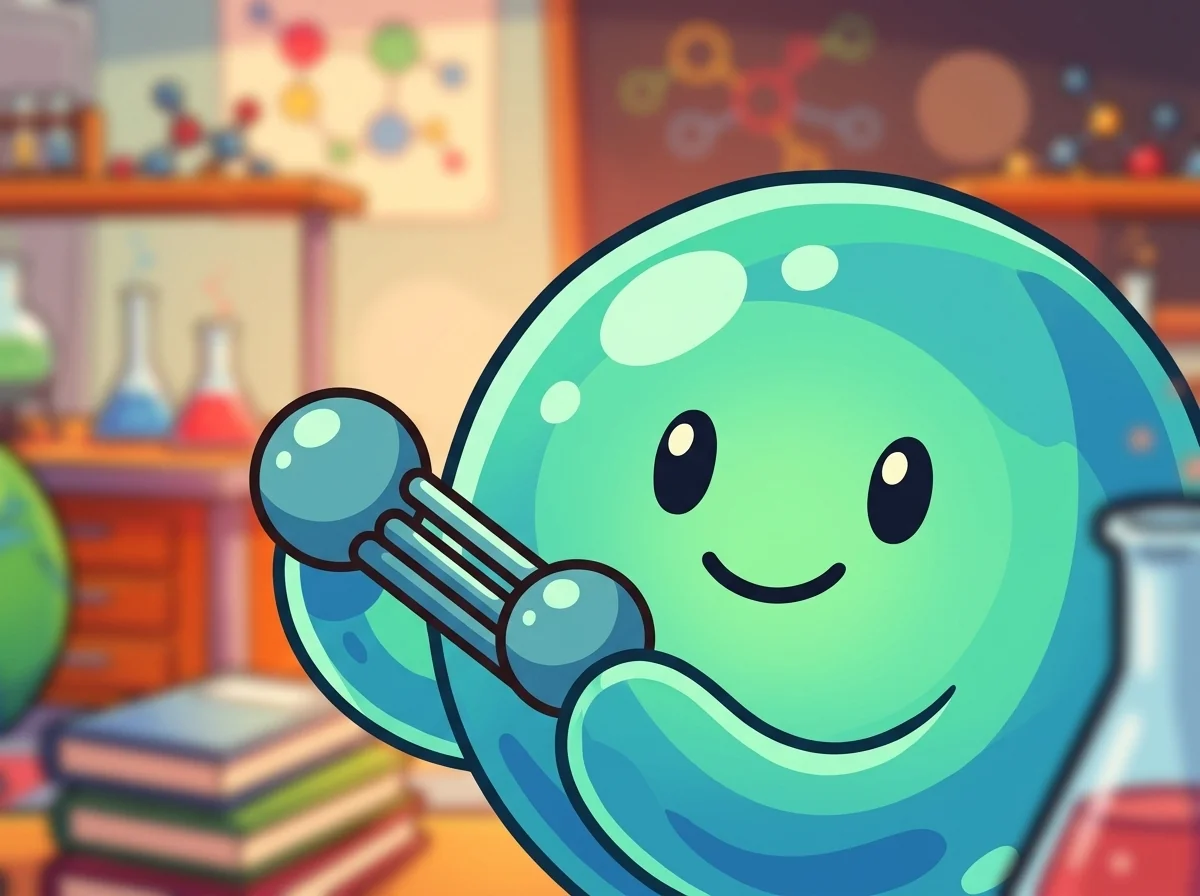
Sharer wasn't always just one pair of dots, Beaker demonstrated. Sometimes, two pairs of electrons would appear in the overlap zone. Beaker called this a double bond. She showed them molecular oxygen, O₂. Two Oxy figures appeared, and between them, Sharer glowed with four bright dots. "Two pairs shared," Beaker noted. "That's a stronger connection, holding the atoms closer." Then, for molecular nitrogen, N₂, Sharer pulsed with six dots. "Three pairs," Beaker said. "That's a triple bond. It's the strongest kind of sharing, pulling atoms very close together."
Sometimes, the sharing was perfectly even. Beaker showed them two Hydras. Sharer formed between them, the electron dots dancing right in the middle. "Both atoms pull equally on the shared electrons," Beaker explained. "A truly equal share." But then, she brought back Hydra and Oxy. Sharer appeared again. This time, the tiny electron dots in the overlap zone drifted a little closer to Oxy. They didn't leave Hydra entirely, but they spent more time near Oxy. "Oxy is a bit of an electron hog," Beaker said with a small smile. "It pulls the shared electrons closer to itself. We call that electronegativity." She paused. "This makes the bond unequal. It creates a slightly positive side and a slightly negative side on the molecule. That's what makes water a polar molecule." She pointed to the water molecule. "And that's why water can dissolve so many things. It's all thanks to this slightly uneven sharing."
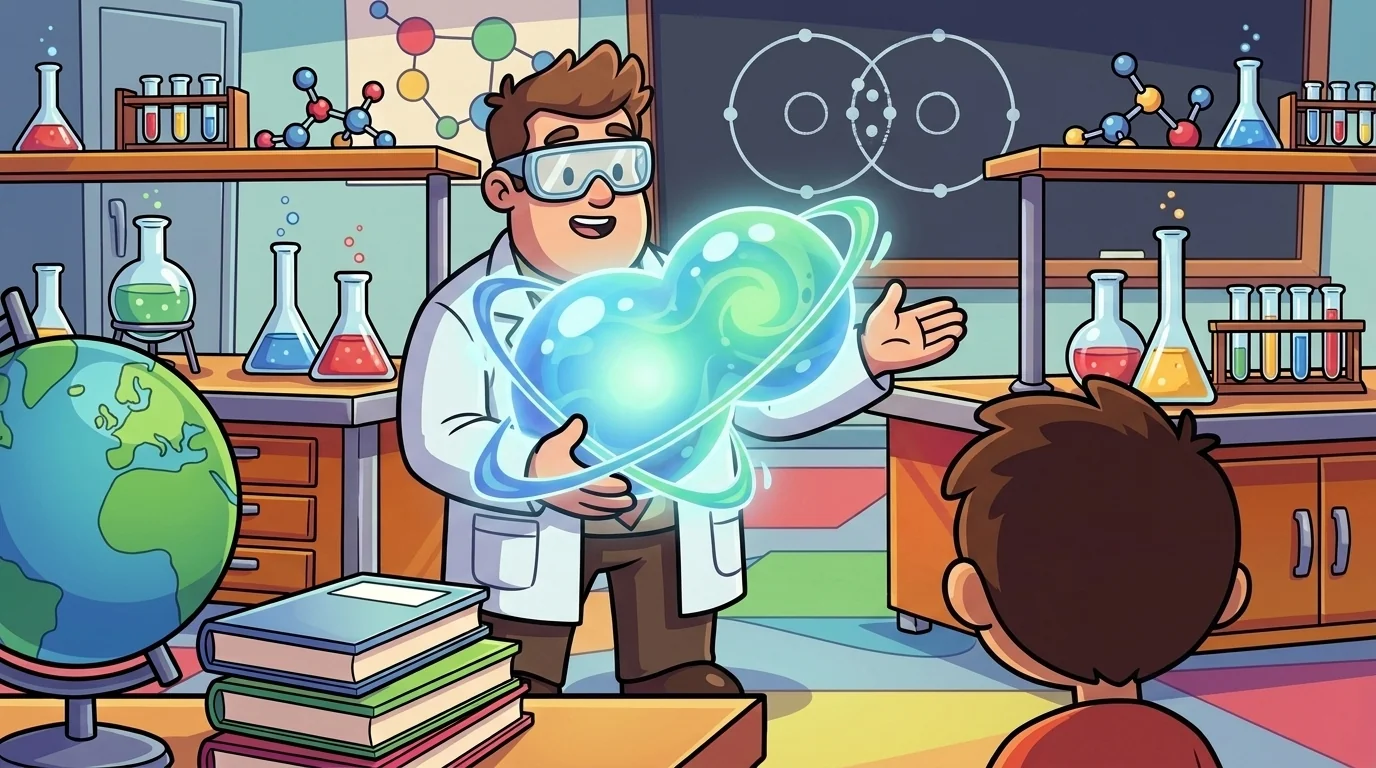
Beaker often brought out Tugger, the ionic bond primitive, to show the difference. Tugger was a single, strong line, pulling electrons entirely from one atom to another. "Tugger is about taking," Beaker explained, holding up Tugger. "Complete transfer. One atom gives, the other takes. That's an ionic bond." She then brought Sharer back, letting it glow beside Tugger. "Sharer is about sharing. The electrons stay between both atoms. Both bonds," she clarified, "hold things together. But the way they work, the force pattern, is completely different."
Sharer's lessons, taught by Beaker, were always clear. A covalent bond was a shared electron-pair in overlapping orbitals, not a transfer. These bonds could be single, double, or triple, with more shared pairs meaning a stronger, shorter bond. The sharing could be equal, like in H₂ gas, or unequal, like in water, which created polar covalent bonds and polar molecules. She reminded them that most biological molecules were built with these covalent bonds, and that covalent compounds typically formed discrete molecules, often with lower melting points than ionic compounds, and usually didn't conduct electricity. "Sharer has no face," Beaker would often say. "That's the lesson. The shared bond is the force, not a being."
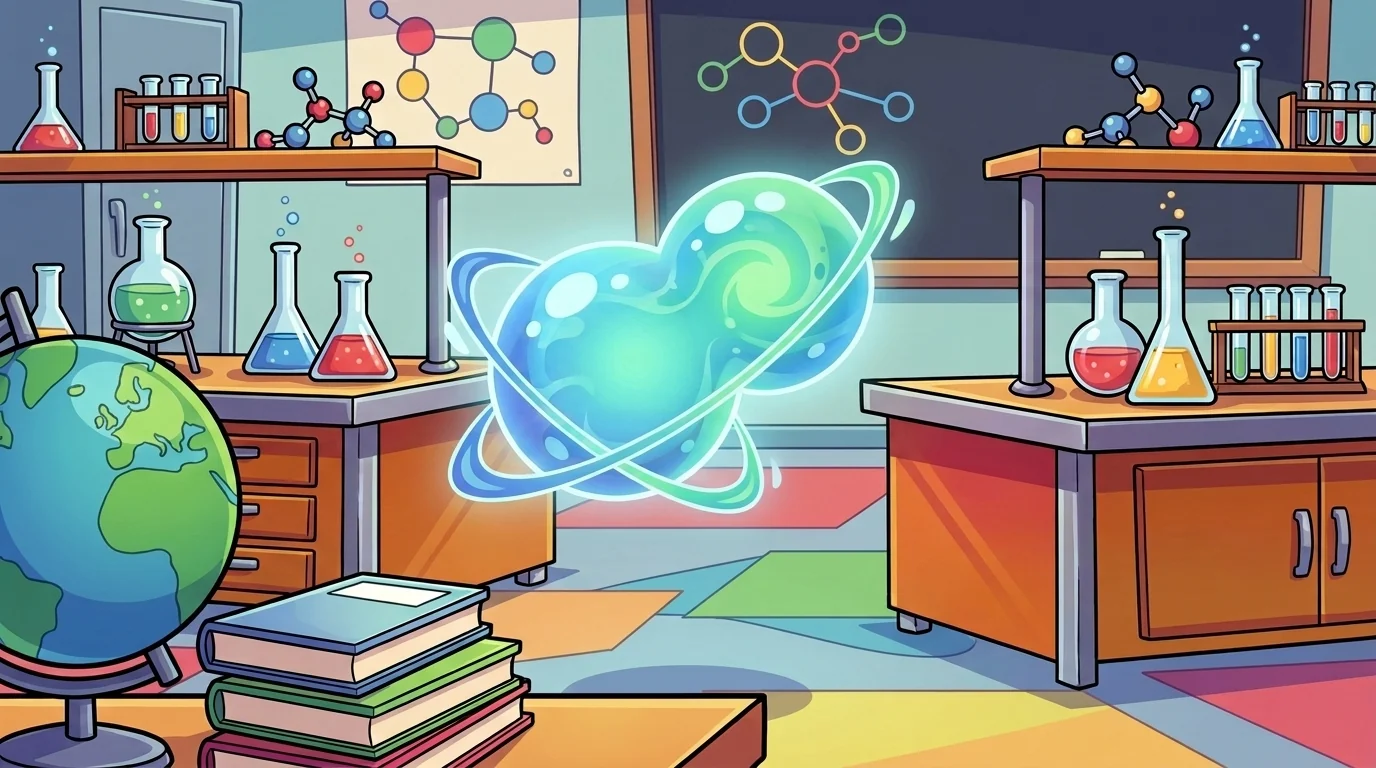
When students asked if covalent bonds were hard to understand, Beaker would shake her head. "Not hard," she'd say. "It's a shared pair. Both atoms hold the electrons. Single, double, triple sharing all happen. Sharer is the force, not the figure."
The overlapping-circles shape caught the light, its tiny dots dancing. The next molecule waited to form.
The ChemQuest ensemble
Sharer is part of ChemQuest's distributed-narrative cast. Each character embodies a different curricular primitive; together they teach the full subject.
-

Hydra
Hydrogen (H) — lightweight, ubiquitous, always paired up; buddy-system enthusiast
-
Carbo
Carbon (C) — connects to anything; the social atom; backbone of life
-

Oxy
Oxygen (O) — eager bonder; electronegative; the hungry grabber
-

Nitra
Nitrogen (N) — triple-bond loyal; slow-to-warm; locks in deeply once bonded
-
Sodi
Sodium (Na) — generous, impulsive; always giving away electrons
-

Chlora
Chlorine (Cl) — sharp, focused; the collector who finishes what Sodi starts
-

Helio
Helium (He) — noble gas; peaceful, floaty, complete; the contented onlooker
-

Sulfa
Sulfur (S) — earthy, dramatic; the stinky uncle of volcanoes and proteins
-

Phossa
Phosphorus (P) — energetic, restless; the spark of ATP and matches
-

Magna
Magnesium (Mg) — bold, ceremonial; burns bright white; chlorophyll core
-

Silica
Silicon (Si) — patient, geometric; the architect who builds quietly
-

Alumi
Aluminum (Al) — practical, modest; the workhorse of cans and foil
-

Tugger
Ionic bond — forceful, decisive; full electron transfer; opposites attract
-

Streamer
Metallic bond — flowing, communal; delocalized electron sea
-
Whisperer
Hydrogen bond — subtle, persistent; water's superpower; DNA pairing