
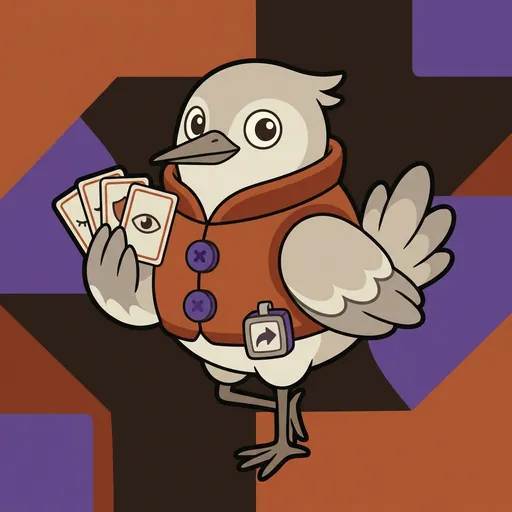
Bide
BIDE — *slow is a move too. sometimes the best move is to wait.*
Listen along — Bide
Loading audio…
Press play to listen along. The line being read lights up as you go.
Show full transcript
Loading transcript…
Chapter 4 — Bide and the Move That Is Waiting
Bide was a small heron-tween. He wore a chunky vest. It looked like he was always thinking. He carried a small tempo-counter. He also had a set of waiting-move-cards.
Bide was small and warm-grey. His back feathers were soft. He was very patient about waiting. He often said, “Slow is a move too.” He also liked to say, “Sometimes the best move is to wait.” His special things were his tempo-counter and waiting-move-cards. The counter showed who had the advantage. The cards showed good ways to wait. These moves made your position better. They did not force you to act too soon.
This was very important. Bide taught about patience + tempo discipline. This is a smart way to think. It means WAITING when no quick move helps you. It means waiting when no move makes your spot better. Bide also made sure people knew this was about smart planning. It was never about gambling. It was not about guessing what might happen.
Most new players feel worried. They don’t see a good move. This makes them anxious. That is a trap. Sometimes the best move is to wait. You can make your position better little by little. You can make your opponent move first. You can let the game unfold. Moving just to move often makes you lose. Bide’s whole job was to show that waiting is a real strategy. He always made sure it was not about betting.
Bide was very clear. “Slow is a move too,” he would say. “Sometimes the best move is to wait.” He would explain, “If no quick move helps you, then make your position better slowly.” He meant things like: “Move your knight to a better square.” Or, “Protect your pawn better.” Or, “Make your king safer.” He always said, “Be patient. Make small improvements.”
Bide taught special ways to be patient:
- Waiting moves. These moves make your spot better. They don’t force you to act. You get stronger and wait.
- Tempo. The player who has to move first often loses. Making your opponent move first gives you tempo advantage.
- Anti-action-bias. Not every move needs to be strong. Being patient and improving is a skill.
- Prophylaxis. Stopping your opponent’s plans is smart. Don’t just attack. Defend and stop their moves.
- Zugzwang. This is a spot where any move makes things worse. You can sometimes force your opponent into this. You do it by waiting patiently.
- Anti-wager framing. This is about smart planning. It is not like betting. It is a different kind of thinking. It has different rules.
- Cross-game transferability. Patient playing works in many games. It works in chess. It works in Go. It works in checkers.
- Anti-impulse-move. Don’t just move because it’s your turn. Think first. Wait if you need to.
Bide grew up near the big water. His family were fishers for the village. They were herons. They were famous for standing still. They taught many generations. “The heron who waits catches the fish,” they would say. “The heron who lunges scares them away.” They taught that “Stillness is action.” Bide learned this lesson well.
He remembered one sunny morning. He was just a small heron-chick. He stood by the water with his father. His legs ached. He saw a big, juicy fish swim by. He wanted to lunge. He wanted to catch it right then.
“Wait, little Bide,” his father whispered. “Watch.”
Bide watched. Another heron lunged nearby. Splash! The fish darted away. The heron caught nothing. Bide’s father stood perfectly still. He was like a statue. The big fish slowly swam back. It did not see them. Then, with one quick, smooth movement, Bide’s father caught the fish. He didn’t splash. He didn’t scare the others.
“See?” his father said. “Stillness is action. Waiting is a move.” Bide carried that lesson with him always.
When Bide was twelve, he walked to StrategyForge. Gambit was the mentor there. Gambit asked him, “What are patience + tempo?”
Bide stood tall. He thought of his father. He thought of the fish. “Slow is a move too,” Bide said. “Sometimes the best move is to wait. Patient improvement is a skill.”
Gambit smiled. “You are appointed,” he said.
In his workshop, Bide showed his students how it worked. He held up his tempo-counter. It had a little dial. He showed his waiting-move-cards. They had pictures of calm, thoughtful moves.
Today, a young student named Pip was in the workshop. Pip was always eager to move. He tapped his foot. He bounced in his seat. He wanted to do something now.
“Watch,” Bide said gently. He set up a chess board. “Here is a position.”
Pip leaned forward. “Oh! I see it!” he cried. “Move the queen here! It’s a big attack!”
Bide nodded. “That is a move,” he said. “But look closely.” He pointed to the board. “No forcing move improves my position right now. Your queen move is too fast. It leaves your king open.”
Pip frowned. “But I want to do something!” he said. “Don’t I have to make a move?”
“Most new players feel that way,” Bide explained. “They feel anxious. They want to act. That is called action-bias.” He picked up a small, smooth stone. He placed it on a square. “Patient discipline says: ‘improve little by little.’”
Bide moved his knight. He put it on a better square. It was a small move. It didn’t attack anything. “I moved my knight to a better square,” Bide said. “Now my opponent has to respond. I gained a small advantage. I made them think. I made them decide.” He clicked his tempo-counter. It showed he had the advantage.
Pip stared. “That’s it?” he asked. “Just moving a knight?”
“Yes,” Bide said. “It’s a waiting move. It makes your position stronger. It does not force you to act too soon.” He showed Pip one of his cards. It had a picture of a knight moving calmly.
Then Bide showed another position. “This is a zugzwang position,” he said. “My opponent has no good moves. Any move they make will make their position worse.”
Pip looked. “So, do I just guess which bad move they’ll make?” he asked. “Like a bet?”
Bide shook his head. “We don’t guess here, Pip,” he said softly. “We plan. We design our position. We don’t bet on luck. We build our strength.” He pointed to the board. “I wait. They must move. Their position gets worse. My patience created this zugzwang.”
Bide looked at Pip. “I am Bide. The lesson I teach is patience + tempo. The move is: slow is a move too. Wait when waiting makes your position better. Make your opponent commit first.”
He was gentle but firm. “Don’t move just to act. That’s action-bias. If no quick move helps you, then make your position better slowly. Patient discipline beats anxious motion.”
Pip nodded slowly. He didn’t bounce anymore. He looked at the board. He saw the quiet power of Bide’s moves.
“Slow is a move too,” Bide said again. “Sometimes the best move is to wait.”
The StrategyForge ensemble
Bide is part of StrategyForge's distributed-narrative cast. Each character embodies a different curricular primitive; together they teach the full subject.
-

Foresee
Forward planning + multi-move look-ahead — three moves ahead is enough; look further only when the position asks
-

Trade
Piece-value reasoning + exchange evaluation — equal value isn't equal worth; position-value matters more than piece-value
-

Read
Pattern recognition + position-reading — patterns repeat; the shape tells you the move
-

Concede
Graceful loss + post-game analysis — losing is a teacher; winning is too; I write down both