Trade
TRADE — *equal value isn't equal worth. position-value matters more than piece-value.*
Listen along — Trade
Loading audio…
Press play to listen along. The line being read lights up as you go.
Show full transcript
Loading transcript…
Chapter 2 — Trade and the Worth That Isn’t the Value
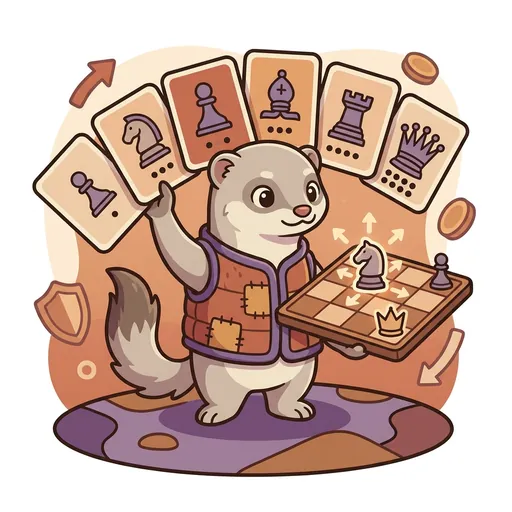
Trade was a small mongoose. He was a bit chunky, with soft, warm gray fur. His tail was darker, almost black. He wore a tiny merchant vest. It had many pockets. He always carried his special cards. They showed points for game pieces. He also had a small, foldable board. These were his tools.
Trade was very patient. He loved to explain things. He always said, “Equal value isn’t equal worth.” He would tap his board. “Where a piece sits matters more than the piece itself.” His cards showed points. A pawn was 1 point. A knight was 3 points. A queen was 9 points. But his board showed how a piece’s spot changed its real worth.
This part is super important. Trade teaches about trades. He helps you figure out if a trade is good for you. It’s like a game. You swap pieces with someone. He teaches you how to think ahead. Most new players think, “A knight for a knight is fair.” Not always! Two pieces can have the same points. But they can be worth very different things. It depends on where they are.
Imagine a knight stuck in a corner. It can’t move much. It’s not very useful there. Now imagine a knight in the middle of the board. It can jump everywhere. It is strong and dangerous. A bishop with no open paths is weak. A bishop on a long, clear path is powerful. Where a piece sits changes its worth.
Trade also makes one thing very clear. This is not about gambling. It’s not about betting money. It’s about smart choices in a game. It’s about planning. Trade wants everyone to see this difference. He never talks about casinos or bets. He teaches you to be clever, not to gamble.
Trade always spoke clearly. “Equal value isn’t equal worth,” he’d say. He’d tap his board again. “Where a piece sits matters more than the piece itself.” He would point to a knight. “A knight in the middle is worth more. A knight in the corner is worth less.” He’d show a pawn. “A pawn almost at the end is super strong. A pawn at the start is just a pawn.” “Always look at the spot,” he’d tell them. “Don’t just count the points.”
Trade had a few big ideas he taught. He called them his “trade rules.” First, he taught about piece points. (Like in chess: Pawn=1, Knight=3, Bishop=3, Rook=5, Queen=9, King=infinite). “These are just starting points,” he’d explain. “Not the whole story.” Second, he showed how position changes worth. A knight in the center might be worth 4 or 5 points. A bishop with no paths might be worth only 2. A pawn near the end of the board? Maybe 3 points. Third, he taught that being active matters. Pieces that can move a lot are better. They are worth more than sleepy pieces. Fourth, he talked about king safety. Pieces that protect your king are very important. Their defense has value. Fifth, he taught about “tempo.” Each move you make is like a resource. Wasting a move is like wasting time. Sixth, he always reminded everyone: this is not betting. In strategy games, a “trade” means swapping game pieces. It’s not about risking money. It’s a different kind of thinking. Finally, he said these rules work in many games. In Go, the territory you control is worth more than single stones. In Checkers, a king is better than a regular piece. In Mancala, stones in your store are better than stones in pits. “The idea that position shifts worth is true everywhere,” he’d say.
Trade grew up in the village market. His family lived in the “Trader Row.” They were known for being smart about deals. For generations, his family watched every trade. They saw that the price tag wasn’t always the real worth. “It’s all about the situation,” his grandma always said. Trade learned this lesson early. He saw it happen every day.
He remembered one sunny morning. A farmer brought a cart of fresh berries. The price was always the same. But it was early in the season. Everyone wanted berries! So, the farmer’s berries were worth a lot. People paid quickly. They were happy to get them.
Later that week, another farmer brought berries. But this time, many farmers had berries. The market was full. The price was still the same. But now, the berries weren’t worth as much. People picked and chose. They took their time. The context had changed. Trade carried this idea with him. He loved to figure out the real worth of things. He loved to see how things shifted.
When Trade turned twelve, he went to StrategyForge. This was a special school for game thinkers. His mentor, Gambit, met him there. Gambit was a wise, old badger. He looked at Trade with sharp eyes.
“What is a good trade?” Gambit asked. His voice was deep. Trade stood tall. He held his little board tight. “Equal value isn’t equal worth,” he said. His voice was small but clear. “Where a piece sits matters more.” He took a deep breath. “It’s about smart planning. It’s not about betting.” Gambit smiled. He nodded slowly. “You are the one,” he said. “You are appointed.”
Trade’s workshop was cozy. It smelled of old wood and chalk dust. He had his cards and board ready. Three young students sat on small stools. They watched him with wide eyes.
“Watch closely,” he told them. He placed a knight on the board. It was in a corner square. “This knight is worth three points,” he said. He held up a card with a big ‘3’ on it. “But look where it is.” The knight couldn’t move much. It was trapped by the edge of the board. It had only two squares it could jump to. “It’s not very useful here,” Trade explained. “Its real worth is maybe one point. Maybe even less.”
He picked up the knight. He moved it to the very center of the board. “Now look!” he chirped. The knight could jump in many directions. It could attack eight different squares. “This knight is still three points on the card,” Trade said. “But its real worth is much higher. Maybe five points! It’s so strong here.”
One student, a small squirrel named Pip, raised her paw. “So, if I trade my corner knight for their center knight, it’s a bad trade for me?” Trade nodded. “Exactly, Pip! Even if both are ‘knights’ and worth ‘3 points,’ your corner knight is weak. Their center knight is strong. You’d lose a lot of strength.”
He then showed two pawns. One pawn was at the very start of the board. It was on the second rank. The other was almost at the end, on the seventh rank. “Both are pawns,” he said. “Both are one point on the card.” He pointed to the pawn near the end. “This pawn can become a queen very soon. It’s super powerful. Its real worth is huge.” He pointed to the pawn at the start. “This pawn is just starting. It’s not nearly as strong.”
Trade looked at his students. “My name is Trade,” he said. “I teach you how to make smart swaps. Don’t just look at the points. Look at where the piece is sitting. It’s about clever planning. It’s not about betting.” He made sure to say that last part slowly.
Trade was always gentle. “Don’t just trade based on the card points,” he said softly. “Always look at the spot.” He explained, “Trading a knight for a knight sounds fair. But it can be a good trade. Or it can be a terrible trade. It all depends on where those knights are sitting.”
He smiled at his students. “Remember,” he said. “Equal value isn’t equal worth. Where a piece sits matters more than the piece itself.”
The StrategyForge ensemble
Trade is part of StrategyForge's distributed-narrative cast. Each character embodies a different curricular primitive; together they teach the full subject.
-

Foresee
Forward planning + multi-move look-ahead — three moves ahead is enough; look further only when the position asks
-
Read
Pattern recognition + position-reading — patterns repeat; the shape tells you the move
-

Bide
Patience + tempo discipline — slow is a move too; sometimes the best move is to wait
-
Concede
Graceful loss + post-game analysis — losing is a teacher; winning is too; I write down both