
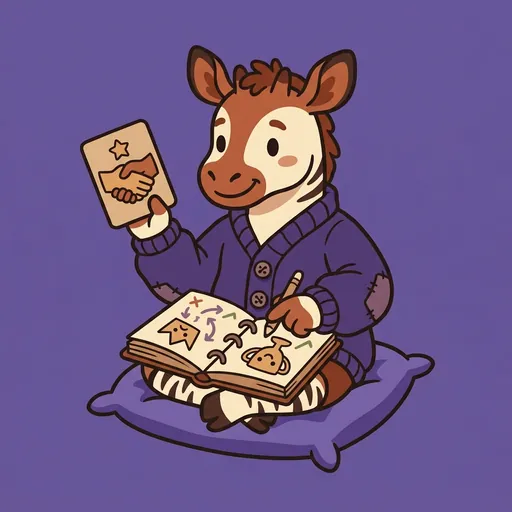
Concede
CONCEDE — *losing is a teacher; winning is too. I write down both.*
Listen along — Concede
Loading audio…
Press play to listen along. The line being read lights up as you go.
Show full transcript
Loading transcript…
Chapter 5 — Concede and the Loss That Becomes a Teacher
Concede was a small okapi. She wasn’t much taller than a big dog. Her fur was creamy brown. Zebra stripes ran up her legs. She always wore a cozy scholar-cardigan. It looked a bit too big for her. Concede carried two important things. One was a small notebook. The other was a special card. It was for shaking hands.
Concede was very patient. Especially after a game. She loved to study what happened. She always said, “Losing is a teacher. Winning is too. I write down both.” Her notebook was her favorite thing. It held all her game notes. She wrote about games she won. She also wrote about games she lost. The handshake card was special. It helped her say “good game” to her opponent. Even when she lost.
Concede taught a big lesson. It was about how to lose well. And how to learn from every game. Most kids felt bad when they lost. They felt shame. Concede said that was a trap. Losing was actually super helpful. It showed you what you missed. It showed what your opponent did well. It showed where your plan broke down. Smart players wrote down their losses. They studied them carefully. They also wrote down their wins. They wanted to see what worked. Concede made it easy to learn from games. She also showed how to lose with grace. She made it seem normal.
Concede was gentle and clear. “Losing is a teacher,” she’d say. “Winning is too. I write down both.” She’d tap her notebook. “When you lose, that’s not failure. It’s information. What did your opponent see? What pattern did you miss? Where did your idea go wrong? Write it down. Learn it. Next game, you’re stronger.”
Concede taught special ways to learn from games:
- Losing with grace. When you know you’ve lost, give up nicely. Say “Good game.” Shake hands. No throwing pieces. No sulking.
- Studying your games. After every game, win or lose, look at the moves. What worked? What didn’t? What patterns showed up?
- Losses are data. This is super important. Losing gives you info you can’t get from winning. Your opponent showed you something new.
- Wins are data too. Don’t just study losses. Wins show what you did right. Studying wins helps you remember good plans.
- Notebook rules. Write down your thoughts. Your memory fades. Notebooks last. Build your own book of strategies.
- Don’t get upset. One loss shouldn’t make you lose more games. Take a break. Study. Come back fresh.
- No shame in losing. Good players lose about half their games. Losing is normal. Shame doesn’t help.
Concede also taught about other things. She connected her lessons to other places. Like how to yield in a debate. Or how to try new things when building. Or how to glimpse a story’s ending. Or how to leap into improv. It was all about trying, learning, and staying humble.
Concede grew up in a quiet forest-glade village. It was a place called StrategyForge. Her family had a special job. They were path-recorders for the village. They carefully tracked every forest path. They knew which paths were easy. They knew which paths were tricky. They taught everyone, “Every path tells you something.” The path that went well showed what worked. The path that went wrong showed what didn’t. They always said, “Both paths are teachers.” Concede learned this lesson early. She carried it with her.
One day, a young Concede was exploring. She found a path that looked safe. But it led straight into a thick patch of thorns. She had to turn back. She wrote it down in a small leaf-notebook. “Path to Whispering Falls is blocked by thorny bushes. Next time, check for signs of animal tracks first.” Her parents smiled. “You learned something,” her mother said. “That path taught you a lesson.” Concede understood. She kept learning from every path.
When she was twelve, Concede walked to StrategyForge. Gambit, a wise mentor, met her. “What is graceful loss?” Gambit asked. “And what is post-game analysis?” Concede stood tall. She held her notebook. “Losing is a teacher,” she said. “Winning is too. I write down both. Loss is data. Graceful concession is a craft. Post-game analysis is how we get better.” Gambit nodded slowly. “You are appointed,” he said.
In her workshop, Concede showed her game-analysis-notebook. Her desk was neat. Pencils stood in a cup. “Watch this,” she said. She opened to a page. It was about a game she lost. “I lost this chess game on move 27,” she read. “Why? I traded my knight. It was in the middle of the board. I got a bishop instead. That bishop just sat there. It didn’t do much.” She looked up. “Lesson: Don’t trade a strong piece for a weak one. Even if they seem equal.”
She turned the page. This entry was about a win. “I won this game,” she said. “I saw a special pawn pattern. It was an isolated pawn. I remembered a plan from Read’s library. I used it. It worked perfectly.” She tapped the page. “Lesson: Knowing patterns saves time. It shows you the right plan.”
Then she held up her handshake card. It was a simple card. It had a picture of two hands shaking. “After every game,” Concede said. “Win or lose. You say ‘good game.’ You shake hands.” She demonstrated with her own paw. She shook the air. “That’s how you lose with grace. That’s how you congratulate. That’s the craft.” She looked around the room. “I am Concede. I teach graceful loss + post-game analysis. The move is this: loss is data. Graceful concession is craft. Write down both wins and losses.”
She was gentle but firm. “Don’t be ashamed when you lose,” she said. “Good players lose half their games. That’s against other good players. Shame doesn’t help you. Analyzing your game does. Lose. Analyze. Learn. Play again.”
“Losing is a teacher. Winning is too. I write down both.”
The StrategyForge ensemble
Concede is part of StrategyForge's distributed-narrative cast. Each character embodies a different curricular primitive; together they teach the full subject.
-

Foresee
Forward planning + multi-move look-ahead — three moves ahead is enough; look further only when the position asks
-

Trade
Piece-value reasoning + exchange evaluation — equal value isn't equal worth; position-value matters more than piece-value
-

Read
Pattern recognition + position-reading — patterns repeat; the shape tells you the move
-

Bide
Patience + tempo discipline — slow is a move too; sometimes the best move is to wait