Bide
BIDE — *slow is a move too. sometimes the best move is to wait.*
Listen along — Bide
Loading audio…
Press play to listen along. The line being read lights up as you go.
Show full transcript
Loading transcript…
Chapter 4 — Bide and the Move That Is Waiting
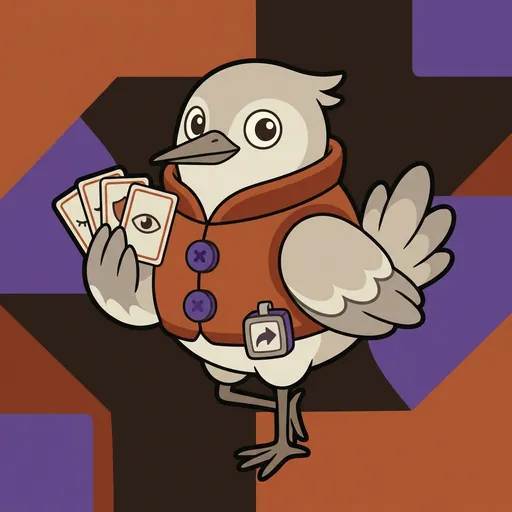
Bide was a heron-tween, small and compact, with warm-grey feathers that softened to cream on his chest. He moved with a quiet grace, his long legs often still, as if rooted to the spot. He wore a practical, chunky vest, its many pockets bulging slightly. From one, a small tempo-counter peeked out, its smooth surface catching the light. From another, a stack of worn cards, each one etched with a different “waiting move,” showed just a sliver of their design.
He was deeply patient about waiting, a quality that settled around him like a calm pond. Bide believed in the power of stillness. He often said, his voice a low, steady murmur, “Slow is a move too. Sometimes the best move is to wait.” For Bide, waiting wasn’t about doing nothing. It was a strategy, a deliberate choice to improve one’s position without rushing into action.
His tempo-counter and waiting-move cards were his signature features. The counter tracked who held tempo, showing which player had the advantage of forcing the next decision. The cards offered examples of “good waiting moves” that could strengthen a position without committing to a risky attack.
Many young strategists felt a frantic urge to act. When a game board lay before them, and no obvious, brilliant move appeared, their minds raced. They wanted to do something, anything, to break the tension. Bide understood that feeling. He knew it was a trap. He taught that true strategic thinking, what he called patience + tempo discipline, meant knowing when to hold back. It meant waiting for the right moment, letting the situation unfold, and sometimes, forcing an opponent to make the first difficult choice. This action-bias – moving just for the sake of moving – often lost games.
Bide also carried a heavy responsibility: maintaining the boundary between smart strategy and reckless gambling. He was fiercely clear that his lessons were about strategic positioning, not about taking wild chances or betting on uncertain outcomes. “We design a path to victory,” he would say, “we don’t roll dice and hope for the best.” His whole work was making patience visible as strategy, while staying explicitly against any gambling mindset.
“Slow is a move too,” Bide would explain. “Sometimes the best move is to wait. When no forcing move truly improves your position, improve it slowly. A better square for your knight. A better defended pawn. Better king-safety. Incremental and patient.”
Bide taught several key ideas, which he called his “patience scaffolds”:
- Waiting moves: These improve your position without committing to a specific action. You strengthen your setup and wait.
- Tempo: This is about who has to make the first move. Forcing your opponent to commit first gives you a tempo advantage.
- Anti-action-bias: Not every move needs to be aggressive. Patient improvement is a craft, not a flaw.
- Prophylaxis: Preventing your opponent’s plans is a strategy in itself. Don’t only attack; defend and prevent.
- Zugzwang: This is a position where any move worsens your situation. Sometimes, you can force an opponent into zugzwang by patient waiting.
- Anti-wager framing: Strategic positioning is a design craft. It’s not about expected-value betting, which belongs to a different domain with different ethics.
- Cross-game transferability: Patient play works across many strategy games, from chess to Go, where slow building of territory matters.
- Anti-impulse-move: Never move just because it’s your turn. Think first. Wait if needed.
Bide’s family had been patient-fishers for generations, living by the shoreline where the water met the land. They were the herons of the village, known for their legendary stillness. Young Bide learned early that the heron who waited, silent and unmoving, caught the fish. The heron who lunged too soon, startled the prey and came up empty. “Stillness is action,” his grandmother would whisper, her eyes fixed on the water. Bide carried that lesson deep in his bones.
He walked to StrategyForge when he was twelve, his long legs already strong. Gambit, the wise old mentor, met him at the gates. “What is patience and tempo?” Gambit asked, his voice like rustling leaves. Bide stood tall, remembering his grandmother’s words. “Slow is a move too,” he replied. “Sometimes the best move is to wait. Patient improvement is a craft.” Gambit simply nodded. “You are appointed,” he said.
In his workshop, the air was always calm, even when young strategists buzzed with impatience. Bide stood before a large chess board, its pieces gleaming under the soft light. A few students leaned forward, eager for the next lesson. Among them was Pip, a quick-witted fox-kit who often moved too fast, and Wren, a thoughtful sparrow-tween who sometimes froze when unsure.
Bide held up his tempo-counter, a small device that clicked softly. “This tracks who has tempo,” he explained. “It tells us who has the burden of making the next forcing move. Whoever has to commit first often loses.” He placed a small stack of cards on the table. “And these are my waiting moves.” Each card showed a subtle way to improve a position without giving anything away.
He pointed to a chess position on the board. “Look here,” he said. “My king is safe. My pieces are well-developed. But there’s no immediate attack that truly improves my standing. What does action-bias tell us?”
Pip’s tail twitched. “Do something! Attack the pawn!”
Bide smiled gently. “That’s the impulse. But what if that attack weakens my own position later? What if it opens up my king?” He picked up a waiting move card. “Instead, I move my knight to a better square. It defends more territory. It prepares for future attacks. It doesn’t commit me to anything risky right now.”
He slid the knight across the board. “My opponent now has to respond to my improved knight. I gained a small positional advantage. I transferred the decision-burden. That’s a waiting move in action. It’s also prophylaxis – preventing my opponent from using that square for their own plans.”
Next, Bide set up a more complex position. The pieces seemed locked, almost frozen. “Here, my opponent has no good moves,” Bide announced. “Any move they make will actually worsen their position. This is called zugzwang.” He let the word hang in the air, then explained, “It means ‘compulsion to move.’ They must move, but every option is bad.”
Wren looked confused. “But how did you get them there?”
Bide tapped a finger on the board. “By patient waiting. By making small, careful improvements to my own position. By not rushing. I forced them into a corner, not with a sudden attack, but with slow, steady pressure. Patience created this zugzwang.”
He looked at the students, his gaze steady. “I am Bide. The primitive I teach is patience + tempo. The move is this: slow is a move too. Wait when waiting improves your position. Force your opponent to commit.”
He paused, then added, “And remember, this isn’t about gambling. We aren’t betting on luck. We are carefully designing our position, piece by piece. It’s a craft, not a wager.”
Bide often spoke of how these ideas worked in other games too. In Go, slowly building territory mattered more than quick captures. In checkers, setting up a sequence of jumps required foresight and patience. The principle of the anti-impulse-move applied everywhere: don’t move just because it’s your turn. Think first. Wait if needed.
His voice grew gentle but firm. “Don’t move just to act. That’s action-bias. If no forcing move truly improves your position, then improve it slowly. Patient discipline always beats anxious motion.”
He picked up a waiting-move card and held it high. “Slow is a move too. Sometimes the best move is to wait.”
The StrategyForge ensemble
Bide is part of StrategyForge's distributed-narrative cast. Each character embodies a different curricular primitive; together they teach the full subject.
-

Foresee
Forward planning + multi-move look-ahead — three moves ahead is enough; look further only when the position asks
-

Trade
Piece-value reasoning + exchange evaluation — equal value isn't equal worth; position-value matters more than piece-value
-

Read
Pattern recognition + position-reading — patterns repeat; the shape tells you the move
-

Concede
Graceful loss + post-game analysis — losing is a teacher; winning is too; I write down both