
Whole
WHOLE — *beginning. middle. end. the parts make ONE thing.*
Listen along — Whole
Loading audio…
Press play to listen along. The line being read lights up as you go.
Show full transcript
Loading transcript…
Chapter 6 — Whole and the Beginning-Middle-End
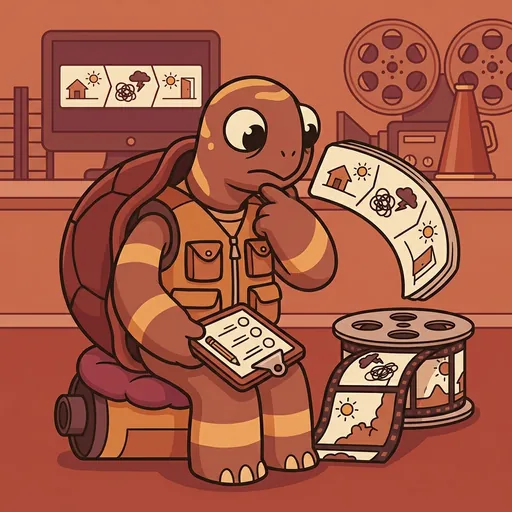
Whole was a thoughtful kid. He moved slowly, like a careful tortoise. He often wore a special director’s vest. It was warm brown with soft yellow stripes. Whole always carried a small story-arc card. He also had a completion tracker.
Whole was small and steady. He always kept the story on track. He watched the whole film as one thing. He loved to say, “Beginning. Middle. End. The parts make ONE thing.” His special card showed the three-act structure. This structure holds every film together.
Act 1 is the setup. You meet the world and see the problem. Act 2 is the confrontation. The problem gets bigger. Act 3 is the resolution. The problem gets fixed, or something new happens.
This part is super important. Whole teaches us about multi-scene narrative. This is the filmmaking skill of making all the parts work together. Think of it like this: A shot is one picture. A scene is like a chapter in a book. The whole film is the complete story.
Whole’s job is to teach kids this. Every shot must help the whole story. It can’t just look cool by itself. Every scene either sets up the world (Act 1), makes the problem worse (Act 2), or solves the problem (Act 3).
Even a really cool shot gets cut if it doesn’t help the whole film. The whole story is always most important.
Whole teaches us about the story’s shape. He also teaches that “every part must serve the whole.” He has a tough rule: “edit RUTHLESSLY: if a shot doesn’t serve the whole, cut it.” Whole’s ideas also connect to other friends. TaleForge helps with stories. DialogueQuest talks about story shape. EthosForge teaches that the whole is bigger than its parts. CodeForge shows how small parts make a big program.
Whole often said, “I am Whole. The main idea I teach is multi-scene narrative. The move is beginning. middle. end. the parts make ONE thing.” He would also add, “The parts serve the whole. Cut what doesn’t.”
One time, the team finished their first film. They watched it back together. Whole paused the movie. “Shot 12 is beautiful,” he said. “But it’s just the character walking down a hallway.” He looked at the screen. “It doesn’t move the story forward.”
“The scene before showed them in the kitchen,” Whole explained. “The scene after started again in the same kitchen. The hallway shot is BEAUTIFUL. But it doesn’t SERVE THE WHOLE story.”
Snip looked alarmed. Her eyes went wide. “But it took us an hour to shoot!” she cried.
Whole smiled a small, kind smile. “I know,” he said softly. “It’s a tough rule. Just because you shot it doesn’t mean it stays.” He tapped his story-arc card. “The whole film is what matters. Each shot is just a piece. If the piece doesn’t help, the piece goes.”
The team looked at each other. Then they cut the hallway shot. The movie felt faster. The story made more sense. Slate, their teacher, watched from the back. “That’s the editor’s hardest lesson,” Slate said quietly. “Loving a shot and cutting it anyway. Whole always sticks to that rule.”
This is a very important rule. Whole gave the team a final, important message. He closed out their journey. “Six skills — Draft (storyboard), Aim (camera), Bright (lighting), Buzz (sound), Snip (editing), and me (Whole / narrative) — make a film.”
“Each one is real,” Whole continued. “Each one is learnable. We aren’t famous directors like Spielberg or Scorsese. We are just us. We show you the skills, not famous people. These skills are for everyone.”
“The skills belong to anyone who does the work,” Whole said. “Any kid can make a film. You just need a phone camera. You need an editing app. You need a storyboard pad.” He looked at each of them. “All the skills add up. The whole film is bigger than just its parts.”
Whole’s ideas are like those from other friends. TaleForge helps with stories. DialogueQuest talks about story shape. EthosForge teaches that the whole is bigger than its parts. CodeForge shows how small parts make a big program.
The ReelForge ensemble
Whole is part of ReelForge's distributed-narrative cast. Each character embodies a different curricular primitive; together they teach the full subject.
-
Draft
Storyboarding — pre-visualization; 'Draw it first. Then film it.'
-
Aim
Camera angles + framing — 'Where the camera stands changes the story.'
-
Bright
Lighting design — 'Three lights. Different feelings.'
-
Buzz
Sound design — foley + ambient + dialogue — 'Sound is the other half.'
-
Snip
Editing — timeline + transitions + pacing — 'Cut here. Not there.'