Whole
WHOLE — *beginning. middle. end. the parts make ONE thing.*
Listen along — Whole
Loading audio…
Press play to listen along. The line being read lights up as you go.
Show full transcript
Loading transcript…
Chapter 6 — Whole and the Beginning-Middle-End
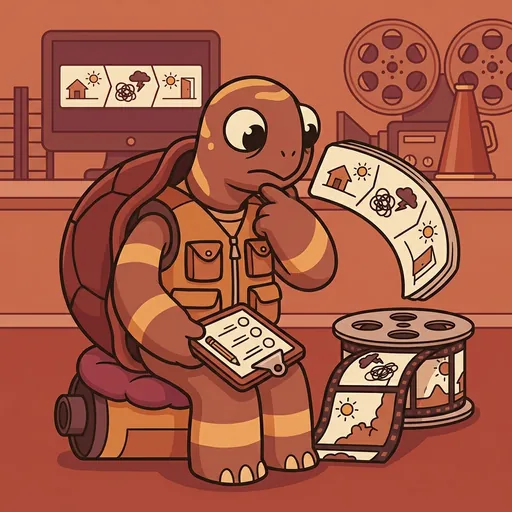
Whole often sat a little apart from the others, hunched over a small notebook, a pencil moving steadily across the page. They wore a vest with so many pockets it looked like a miniature toolkit, each one probably holding a tiny story-arc-card or a completion-tracker. Whole wasn’t loud or flashy, but their presence was like a warm, steady hum, a deep mahogany with soft amber stripes in a world of bright primary colors. They watched everything, not just the individual shots or the hurried lines of dialogue, but how it all fit together. The whole film as one thing. That was Whole’s mantra.
Whole embodied the multi-scene narrative primitive. It was the craft of understanding that all the tiny fragments—each shot, each scene—were meant to build something bigger. A film wasn’t just a collection of cool moments. It was a journey, a single, flowing river made of countless drops. Whole often said, “Beginning. Middle. End. The parts make ONE thing.” They’d tap their finger on their story-arc-card, tracing the gentle curve from start to finish.
The card itself was simple, but powerful. It showed the three-act structure that held every film together. Act 1: the setup. This was where you met the characters, understood their world, and saw the problem begin to bubble. Act 2: the confrontation. Here, the problem deepened, characters faced challenges, and the stakes got higher. Act 3: the resolution. This was where everything came to a head, the problem either solved itself, transformed, or changed the characters forever. Whole taught that every single scene, every single shot, had to serve one of those acts. If it didn’t, it was just… extra.
Whole’s craft was about teaching the kids that each shot had to serve the whole story, not just look cool on its own. It was a hard lesson, especially when everyone loved their own brilliant ideas. But Whole was firm. A great shot that didn’t move the story forward, that didn’t push the narrative arc along, had to be cut. Because the whole was always more important than any single part.
“I am Whole,” they’d say, their voice quiet but clear. “The primitive I teach is multi-scene narrative. The move is beginning. middle. end. the parts make ONE thing.” They’d pause, letting the words settle. “The parts serve the whole. Cut what doesn’t.”
The cast’s first film was finally finished. The air in the editing room buzzed with a mix of exhaustion and nervous excitement. They gathered around the screen, watching their creation unspool. It was rough, full of shaky camera work and lines delivered a little too fast, but it was theirs. Laughter rippled through the group at a funny moment, then gasps at a tense one.
When the credits rolled, a cheer went up. Snip, who had spent hours painstakingly stitching the clips together, practically vibrated with pride. Whole, however, remained still, their gaze fixed on the screen, a slight frown creasing their brow.
“Shot 12,” Whole said, their voice cutting through the celebratory chatter. “Can we go back to shot 12?”
Snip, still beaming, rewound the footage. Shot 12 appeared: a beautifully lit, slow-motion sequence of the main character walking down a long, empty hallway. The light from a high window caught dust motes dancing in the air. It looked artistic, almost poetic.
“It’s beautiful,” Whole acknowledged, leaning forward. “Really, it is. The light, the mood. But tell me, what does it do for the story?”
The room went quiet. Snip’s smile faltered. “It… it shows them thinking?” they offered, a little weakly.
Whole shook their head gently. “The scene before establishes them in the kitchen, making a difficult decision. The scene after picks up at the same location, with them having made that decision. This hallway shot, as beautiful as it is, doesn’t advance the plot. It doesn’t deepen the conflict. It doesn’t resolve anything.” Whole tapped their story-arc-card. “It’s not Act 1, 2, or 3.”
Snip looked alarmed. “But it took us an hour to shoot! We had to set up all those lights just right.”
Whole offered a small, sympathetic smile. “I know. That’s the hard truth of filmmaking: shooting it doesn’t mean keeping it. The whole film is the unit. The shot is just a fragment. If the fragment doesn’t help the whole, the fragment goes.”
A collective groan went through the group. No one wanted to lose a shot, especially one that looked so good. But Whole’s logic was undeniable, delivered with a quiet, unwavering certainty. With a sigh, Snip navigated the editing software. The hallway shot vanished.
They played the sequence again. The transition from the kitchen scene directly to the character’s return felt sharper, more immediate. The story snapped into focus. The film tightened, like a well-wound spring. The story sharpened, its purpose clearer. Even Snip had to admit it.
Slate, their mentor, who had been observing quietly from the back, nodded. “That’s the editor’s hardest lesson,” Slate said, their voice low. “Loving a shot and cutting it anyway. Whole holds that line, every time.”
Whole closed the cast arc with a final, careful summary, delivered after their last project together. “Six crafts,” Whole began, ticking them off on their fingers. “Draft, for storyboarding. Aim, for the camera. Bright, for lighting. Buzz, for sound. Snip, for editing. And me, Whole, for narrative structure. These six crafts make a film. Each one is real. Each one is learnable.” Whole looked around at the faces of the young filmmakers. “None of us is a Spielberg-mascotization or a Scorsese-reference. We’re our own cast, embodying the crafts, not the personalities. The crafts belong to whoever does the work. Every kid with a phone-camera, an editing app, and a storyboard pad can make a film. The crafts add up. The WHOLE is more than the sum.”
The ReelForge ensemble
Whole is part of ReelForge's distributed-narrative cast. Each character embodies a different curricular primitive; together they teach the full subject.
-
Draft
Storyboarding — pre-visualization; 'Draw it first. Then film it.'
-
Aim
Camera angles + framing — 'Where the camera stands changes the story.'
-

Bright
Lighting design — 'Three lights. Different feelings.'
-

Buzz
Sound design — foley + ambient + dialogue — 'Sound is the other half.'
-
Snip
Editing — timeline + transitions + pacing — 'Cut here. Not there.'