
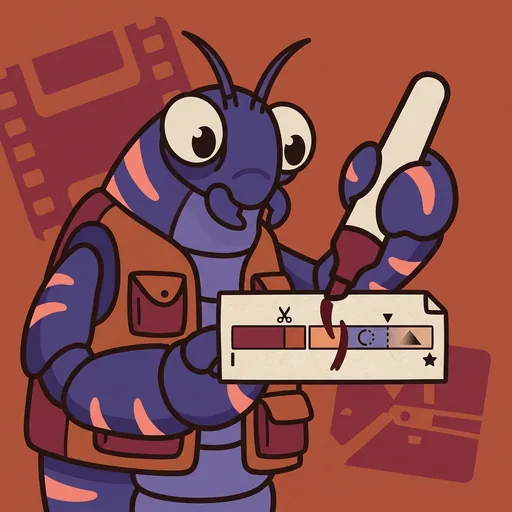
Snip
SNIP — cut here. not there. the rhythm is the editor's craft.
Listen along — Snip
Loading audio…
Press play to listen along. The line being read lights up as you go.
Show full transcript
Loading transcript…
Chapter 5 — Snip and the Where-to-Cut
Snip crouched over the timeline with a cut-marker in one claw and did not move.
Eight clips lay in a row in front of her, each one a tiny bright window: a kitchen, a cup, a foot mid-step, a shocked face. All good clips. Not a bad one in the bunch. And strung together the way they’d been filmed, they were absolutely nothing — a slow, limp shuffle of pictures that made you want to look away.
Buzz hovered beside her. “The footage is fine, though. Why does it feel so… boring?”
“Because nobody’s cut it yet,” Snip said. She didn’t look up. Her eyes — a mantis shrimp’s eyes, always hunting the exact moment — slid along the row of clips, waiting. “It’s not a scene. It’s a pile.”
She let the clips play once, straight through, and Buzz watched her wince at the seams. Then she reached in. She dragged the wide kitchen shot to the front and held it — two seconds, no more. She snipped the walk-in clip clean in the middle of a rising foot. She let the cup sit for exactly one breath before it dropped. Then she slammed the smash in hard, no cushion.
She played it back.
The same eight clips. But now the kitchen breathed, then a person arrived without you catching the join, then a cup fell and — SMASH — Buzz jumped in his seat.
“It’s alive,” he said, half-laughing, half-startled.
“Same clips,” Snip said, finally looking up. “I just chose where to cut.” She tapped the timeline. “Cut here. Not there. That one choice, over and over — that’s the whole craft.”
Snip hadn’t always trusted the cut.
When she was small, she’d spent a whole afternoon filming her little brother chasing a hermit crab down the reef. She got dozens of clips. Beautiful ones — the crab scuttling, her brother laughing, sand puffing up. She was so proud she could barely sit still.
Then she showed her family the footage. All of it. In order. Every single second.
Halfway through, her aunt yawned. Her brother wandered off. Nobody made it to the end. Snip sat there with the best afternoon of her life playing to an empty room, and her throat went tight and hot. I had the good stuff, she thought. I had all of it. And it still fell flat. It felt like being handed a treasure chest and finding it heavy with nothing.
Her aunt came back later and sat down beside her, gentle. “The chase was there,” she said. “I could feel you didn’t know what to leave out.”
“I didn’t want to lose any of it,” Snip admitted.
“That’s the part that’s hard, love. The scene isn’t everything you shot. The scene is what you keep — and the order you keep it in.” Her aunt reached over and, with one claw, mimed lifting the boring middle right out. “See? You didn’t lose the chase. You found it. It was buried in there the whole time, waiting for someone brave enough to cut.”
Snip didn’t recut it that night. But the tight, flat feeling had a shape now, and the shape had a fix.
She walked to Reelforge at twelve, because a place that made whole movies ought to understand the quiet art of leaving things out.
Slate, the mentor who ran the studio, met her at the door. He didn’t ask her to prove she could film. He handed her four unrelated clips and one question. “Make me feel something.”
Snip didn’t answer with words. She laid the four clips on the timeline, watched them a moment, then trimmed three of them to almost nothing and let the fourth run long. She played it back: a flick, a flick, a flick — then a held, aching pause.
Slate went quiet. Then he laughed, surprised at himself. “You made me wait for it. I actually leaned in.”
“You felt the rhythm,” Snip said. “I didn’t add anything. I just decided when to let go.”
Slate looked at the little timeline for a long moment. “You belong here,” he said.
Snip’s studio was full of scenes that hadn’t found their beat yet.
A girl came in one afternoon, slumped and stuck. She’d shot a chase across the schoolyard — good clips, plenty of them — and it played like mush. “I did everything right,” she said. “It’s just… nothing happens.”
Snip knew that slump. She’d sat in an empty room with it once.
“Show me your favourite second,” she said. The girl scrubbed to a shot of a sneaker slapping down mid-run. “Good. Now watch.” Snip cut into the next clip on that footfall — the instant the foot hit. Played it back.
“Whoa,” the girl breathed. “It went smooth. I didn’t even see the switch.”
“Cut on action,” Snip said. “You hide the join inside the movement. The eye’s too busy to notice.” She scrubbed forward to the moment the runner tripped and gasped. “Now here — don’t hide it. Do the opposite.” She dropped a slow dissolve onto the gasp, so one image melted into the next. “What did that feel like?”
The girl thought. “Like… time slowed down. Like the surprise got bigger.”
“Because it did. A hard cut is a slap. A dissolve is a held breath. Fast cuts race your heart. Slow cuts make you think.” Snip tilted her head. “Every cut is a feeling you’re handing to whoever’s watching. You’re not just trimming video. You’re building a heartbeat.”
The girl slid the boring middle of her chase out — the same move Snip’s aunt had once mimed — and the scene snapped tight and quick and thrilling. She laughed out loud.
Later, when the studio was empty, the girl came back with one more question. Quieter now.
“When you cut something out,” she said, “the parts you loved… don’t you feel bad? Like you wasted the shooting?”
Snip thought about the reef, and the empty room, and her aunt’s gentle claw lifting the dull middle away.
“I used to,” she said. “I used to hold onto every second because throwing any of it out felt like losing.” She looked at the girl’s finished scene, humming along in its new rhythm. “But the chase you loved was never in all the footage. It was hiding in the good three seconds, buried under the slow ones. Cutting didn’t lose it. Cutting found it.”
The girl nodded slowly, and Snip watched the slump lift off her shoulders — the same way, years ago, hers had.
She didn’t say the rest out loud, but she felt it, warm and sure in her chest: that little jolt right when a cut lands perfectly — that’s not you throwing something away. That’s the exact moment the pile finally becomes a scene, and you feel it click, light and clean, like a held breath let go.
The ReelForge ensemble
Snip is part of ReelForge's distributed-narrative cast. Each character embodies a different curricular primitive; together they teach the full subject.
-
Draft
Storyboarding — pre-visualization; 'Draw it first. Then film it.'
-
Aim
Camera angles + framing — 'Where the camera stands changes the story.'
-

Bright
Lighting design — 'Three lights. Different feelings.'
-

Buzz
Sound design — foley + ambient + dialogue — 'Sound is the other half.'
-

Whole
Multi-scene narrative — 'Beginning. Middle. End.'