
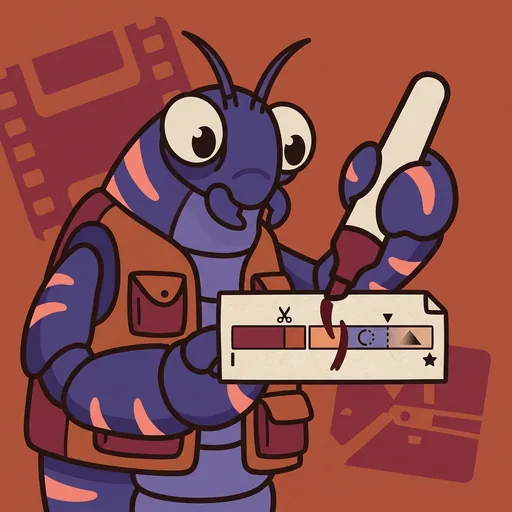
Snip
SNIP — *cut here. not there. the rhythm is the editor's craft.*
Listen along — Snip
Loading audio…
Press play to listen along. The line being read lights up as you go.
Show full transcript
Loading transcript…
Chapter 5 — Snip and the Where-to-Cut
Snip moved with the quick, darting precision of a mantis shrimp, though they were a tween in a chunky director’s vest. The vest, a deep cool purple with soft coral stripes, was covered in tiny, embroidered film reels and clapperboards. Snip held a small timeline-card in one hand and a fine-tipped cut-marker in the other. Their eyes, large and unblinking, were fixed on the glowing screen before them, deeply attentive to the exact moment a cut matters.
Snip was small, but their focus was immense. They were a master of cut-deciding, a quiet authority on where a film should break and begin again. “Cut here. Not there,” Snip often said, their voice low and certain. “The rhythm is the editor’s craft.” On their timeline-card, Snip meticulously annotated each potential cut, noting the type of transition—a hard cut, a dissolve, a fade—and, more importantly, why.
This was the core of Snip’s work. They taught editing, the filmmaking craft of choosing the precise moment to move from one shot to the next. It was where a collection of recorded moments transformed into a story, where raw footage truly became a film. A great script, stunning visuals, and perfect sound could all fall apart with poor editing. But good editing? It created a rhythm, a pulse that guided the audience’s experience.
Snip believed in the power of that rhythm. They taught strategies like cutting on action, where a cut happens mid-movement, making it almost invisible. Or cutting on emotion, shifting perspective when the audience needed a new feeling. Even cutting on dialogue, transitioning the instant a character finished a thought. Snip’s craft showed kids that every single cut was a deliberate choice, and the tempo of those choices shaped how an audience felt time itself. Fast cuts could build urgency, a rush of action. Slow cuts invited contemplation, giving weight to a moment. An invisible cut-on-action felt seamless, while a jarring cut-on-stillness could be a powerful, intentional shock.
“I am Snip,” they said, looking up from the screen, their gaze intense. “The primitive I teach is editing. The move is cut here. not there. the rhythm is the editor’s craft.” They tapped the timeline-card. “The cut is the heartbeat. Choose its tempo.”
Snip’s signature scene was always the same: taking the cast’s raw footage and weaving it into something coherent. Today, it was the “kitchen-cup scene,” a simple sequence with eight different camera angles. Snip had them laid out on a digital timeline, a long, colorful strip representing time.
“Alright,” Snip began, pointing a precise finger at the screen. “Here’s Shot 1: a wide view of the kitchen.” The screen showed an empty, sunlit kitchen. “We hold this for two seconds. Just long enough to establish the setting.”
Then, a new clip appeared. “Shot 2: our character walks in.” The figure entered the frame, taking a step. “Now, watch carefully.” Snip dragged a virtual razor blade across the timeline. “I’m cutting right here, while their foot is mid-step.” The screen flickered, instantly switching to the next shot. “That’s a cut-on-action. It feels invisible, doesn’t it? Like you just blinked.”
Buzz, who had been leaning forward, nodded slowly. “Yeah, I didn’t even notice the switch.”
“Exactly,” Snip said, a hint of satisfaction in their voice. “Then, Shot 3: a close-up of the cup on the counter. We hold this for one second. Just enough time for the audience to register its importance.” The camera zoomed in on a delicate ceramic mug.
“And now, the drama.” Snip’s finger hovered. “Shot 4: the cup drops.” The screen showed the cup tilting, beginning its fall. “Hard cut to Shot 5: the cup hits the floor.” CRASH. The image snapped, jarringly, to shattered ceramic. “That hard cut emphasizes the suddenness, the impact.”
“Whoa,” Buzz breathed. “That really felt like it happened fast.”
“Now, for the character’s reaction,” Snip continued. “We don’t want another hard cut here. We want the audience to feel the surprise, the slow-motion shock.” Snip selected a different transition. “So, a slow dissolve to Shot 6: the character’s surprised face.” The image of the broken cup slowly faded, blending with the character’s wide-eyed expression before fully revealing it. “The dissolve says ‘time slowed for them.’ The audience feels the surprise, too, because the transition itself takes time.”
Buzz’s eyes were wide. “And the foley I recorded,” he said, remembering, “the shatter sound fits perfectly with that hard cut, and then the quiet for the dissolve.”
Snip nodded, a rare, almost imperceptible smile touching their lips. “Sound and picture together. Edit them as one craft.”
Slate the mentor, who had been observing from the back of the room, stepped forward. “Snip just made eight clips into a SCENE,” he said, his voice quiet but firm. “They didn’t just string pieces together. They gave it a heartbeat.”
The ReelForge ensemble
Snip is part of ReelForge's distributed-narrative cast. Each character embodies a different curricular primitive; together they teach the full subject.
-
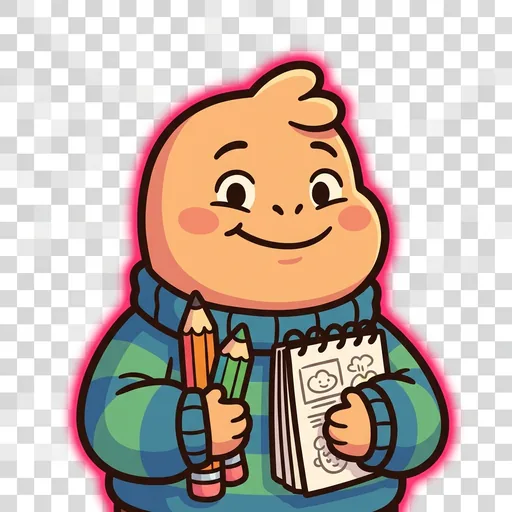
Draft
Storyboarding — pre-visualization; 'Draw it first. Then film it.'
-
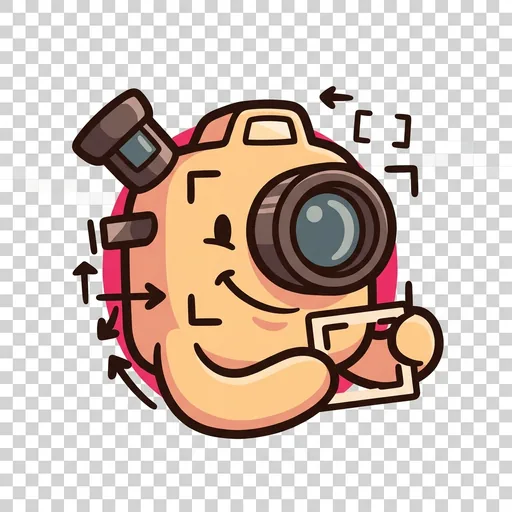
Aim
Camera angles + framing — 'Where the camera stands changes the story.'
-

Bright
Lighting design — 'Three lights. Different feelings.'
-

Buzz
Sound design — foley + ambient + dialogue — 'Sound is the other half.'
-

Whole
Multi-scene narrative — 'Beginning. Middle. End.'