
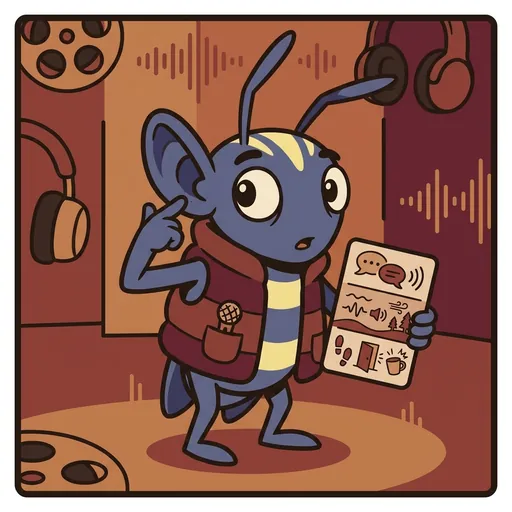
Buzz
BUZZ — sound is the other half. picture without sound is half a story.
Listen along — Buzz
Loading audio…
Press play to listen along. The line being read lights up as you go.
Show full transcript
Loading transcript…
Chapter — Buzz and the Half-Story
The kitchen scene was beautiful, and Buzz couldn’t stand it.
He sat in the dark editing room, a small cricket in a chunky vest, watching the rough cut play for the third time. The framing was perfect. The light fell moody and gold across the counters. And yet the whole thing made his antennae itch, because the scene said nothing. No footsteps. No fridge. No breath. A girl crossed the room and dropped a mug and it hit the floor in total, glassy silence, like the world had been switched off.
“Play it again,” Buzz said quietly.
They played it again. Same silence. The cast shifted in their seats.
“It’s boring,” someone admitted. “But I don’t know why. The picture’s good.”
Buzz closed his eyes and did the thing he always did — he listened to the room around the screen instead of the screen itself. He heard the real fridge two doors down. A chair creak. Someone’s sneaker scuffing the floor. All the tiny textures that told his ears he was somewhere real.
Then he opened his eyes and pointed at the frame. “There,” he said. “That kitchen has no there. You built a room with your eyes and forgot to build it with your ears.” He tapped his microphone charm. “Half a story. We only shot half of it.”
The cast stared at the frozen mug, mid-air, silent.
“So let’s go get the other half,” Buzz said, and stood up.
Buzz had learned about the missing half when he was small, and it had stung.
His very first film was a thirty-second thing about rain on a window. He’d worked for a week. The picture was gorgeous — grey drops sliding down glass, the whole world blurred and soft behind them. He’d shown it to his family, so proud his shell nearly popped, and watched their faces go politely blank.
“It’s very pretty,” his aunt said. “It’s just kind of… lonely?”
Lonely. The word landed wrong and heavy in his chest. He’d meant it to feel cozy — rain, safe inside, warm. Instead it felt like a photograph of nobody’s house. He watched it back alone that night and felt the loneliness himself, and couldn’t figure out where it was hiding.
His grandfather, an old cricket who’d recorded sound for radio plays his whole life, sat with him. He didn’t say the film was bad. He just leaned close to the little speaker and said, “Listen. What do you hear?”
“Nothing,” Buzz said.
“Exactly. That’s the lonely.” His grandfather smiled. “You gave them rain to look at. You never let them hear it. No tapping on the glass, no far-off thunder, no kettle behind them. The eyes said rain. The ears said empty room. And the heart believes the ears.” He patted Buzz’s shoulder. “Sound is where the warm lives, little one. You forgot to record the warm.”
Buzz never forgot again. The lonely feeling had a cause now, and a cure.
He walked to ReelForge at twelve, because a place that studied how to make whole films ought to take the ears as seriously as the eyes.
Aim, who ran the workshops, met him at the door. She didn’t ask him to prove he had a good eye. She gestured at a screen playing a clip with the sound turned off — a door swinging shut — and asked, “What’s missing?”
Buzz didn’t answer with a speech. He walked to a shelf, took down a real wooden box, opened it, and let the lid fall shut. Thunk. The soft, specific sound of a heavy door settling into its frame filled the room.
“That,” he said. “The room just got smaller and safer, and you felt it, and I never touched the picture.” He looked up at her. “It was there the whole time. Nobody wrote it down.”
Aim watched him for a long moment. “You belong here,” she said.
So now, in the kitchen, Buzz set about getting back the half they’d lost.
“First, we listen to the room doing nothing,” he said. He held up his microphone and pressed record. “Everybody still. Thirty seconds.”
The cast froze. For thirty long, awkward seconds they heard only the low hum of the real refrigerator, so quiet it was almost nothing. Someone started to giggle and Buzz held up a stern claw. When it was done, he slid that hum under the whole scene back in the editing room — and the frozen kitchen suddenly had an inside. Nobody could say what changed. The picture was identical. But it felt like a place you could stand in.
“Now the fun part,” Buzz grinned. “The little sounds. We make them ourselves.”
The girl on screen walked across the floor. “What’s on her feet?” Buzz asked.
“Sneakers,” said Pip.
“Then be her feet.” Pip put on sneakers and walked past the mic. Tap-tap-tap. “Too polite,” Buzz said. “She’s in a hurry. Walk like you’re late.” Thump-thump-thump. “There.”
The mug came next. They dropped a real ceramic mug onto a plank of wood — CLINK — again and again, from different heights, chasing the exact crack that matched the fall on screen.
Then the gasp, when the girl sees something startling. Dash tried it big and fake. “Too much,” Buzz said gently. “Don’t act surprised. Just be surprised. Picture your snack gone.” Dash shut their eyes, thought hard, and let out one small, sharp hup! — real enough that everyone flinched.
Buzz lined it all up: hum, footsteps, clink, gasp, each one landing on its picture. Then he played it back. This time the kitchen breathed. You heard the fridge, the hurried sneakers, the crack of the mug, the caught breath — and the scene stopped being a photograph and became a moment, with a room and a person and a small shock in it.
The cast sat very quiet, the good kind of quiet.
Later, when the room had emptied, Pip lingered. “How did you know it was missing?” they asked. “The picture already looked done.”
Buzz thought about the rain film, and the word lonely, and his grandfather leaning toward a little speaker.
“Because I felt it before I could name it,” he said. “That’s the honest answer. When something’s finished on the outside but still feels hollow inside — flat, far away, like you’re watching it through glass — that hollow is almost always the sound. It’s the warmth you can’t see.” He looked at the dark, quiet screen. “Your eyes tell you what a place looks like. But your ears are what make you believe you’re there. Get the sound right and the loneliness just… lifts.”
Pip nodded slowly, and Buzz watched them understand it — the same soft, settling feeling he’d been chasing since he was small.
He didn’t say the rest out loud. He just felt it, warm and sure: a room isn’t real until you can hear it breathe.
The ReelForge ensemble
Buzz is part of ReelForge's distributed-narrative cast. Each character embodies a different curricular primitive; together they teach the full subject.
-
Draft
Storyboarding — pre-visualization; 'Draw it first. Then film it.'
-
Aim
Camera angles + framing — 'Where the camera stands changes the story.'
-

Bright
Lighting design — 'Three lights. Different feelings.'
-
Snip
Editing — timeline + transitions + pacing — 'Cut here. Not there.'
-

Whole
Multi-scene narrative — 'Beginning. Middle. End.'