
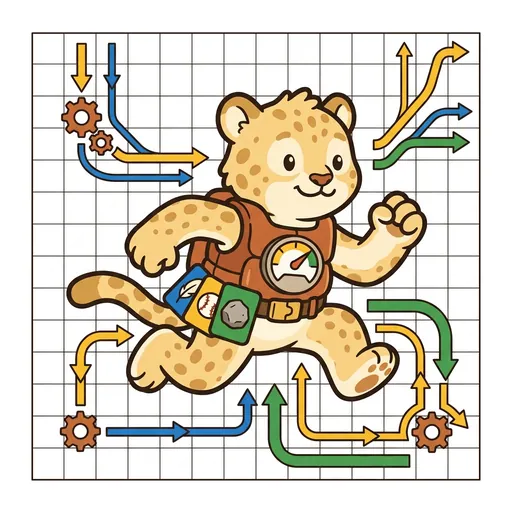
Sprint
SPRINT — energy of motion. mass times velocity squared, halved.
Listen along — Sprint
Loading audio…
Press play to listen along. The line being read lights up as you go.
Show full transcript
Loading transcript…
Chapter 1 — Sprint and the Energy That Only Exists While Moving
Sprint could not sit still, and he’d stopped apologising for it.
He was a cheetah-tween with gold-flecked cream fur and legs that seemed to want to be somewhere else. Right now he was blurring across the open grassland outside Powerforge, low and fast, and the whole world had narrowed to wind and ground and the thud of his own paws. This — this — was the thing he loved most. Not being fast, exactly. The feeling of fast. The way the air turned solid against his face and the grass smeared into green streaks.
He skidded to a stop by a fence post, panting and grinning, and rolled a small stone toward a stack of tin cans — slow, gentle. It bumped the bottom can. Nothing fell.
Then he backed up, wound himself tight, and flicked the same little stone with a running snap of his paw. It cracked into the stack and blew the cans across the field.
“Same stone,” he said, to nobody. “Just faster.” He watched a can wobble to a stop. “So much faster.”
He’d learned exactly how much faster on a day he’d rather not repeat.
As a cub, Sprint had thought going fast was simple: twice the speed, twice the whoosh. Fun times two. So one afternoon, showing off, he’d doubled his usual downhill pace toward a hay bale he liked to crash into.
He did not bounce off it the way he expected. He hit it like it was a wall. It knocked the wind clean out of him and left him blinking at the sky, chest heaving, more shocked than hurt.
His father — an old, unhurried runner — had trotted down and crouched beside him. He didn’t scold. He just asked, “Bigger than you thought?”
“I only went twice as fast,” Sprint wheezed. “It should’ve been twice as hard. It was — it was way more than that.”
“Because speed doesn’t add up the way you feel it does,” his father said. “Go twice as fast and you don’t carry twice the punch. You carry four times. The going gets multiplied by itself.” He helped Sprint sit up. “That scared feeling in your chest right now? That’s the extra. That’s the part nobody warns you about.”
Sprint never forgot it — not the lesson, and not the shaky, wide-awake feeling of learning that fast wasn’t a little more dangerous than slow. It was a lot more.
He walked to Powerforge at twelve, because it was the one place that measured the thing he’d felt against the hay bale.
Volt met him at the gate and asked, “What is kinetic energy?”
Sprint didn’t recite anything. He asked for two identical clay balls, rolled one slowly into a row of wooden blocks — it nudged one over — then hurled the other at a run. Blocks scattered everywhere.
“Same ball,” Sprint said, still breathing hard. “The fast one carried more. Way more than the little bit of extra speed I gave it. Motion is energy — and the speed part counts double, because it gets multiplied by itself.”
Volt watched the blocks settle. “You belong here,” he said.
Sprint’s workshop had a long smooth track and a wall of dented targets.
A girl came in sure she already had it figured out. “The heavy ball wins,” she announced. “More weight, more power. Obvious.”
Sprint loved this part.
“Let’s find out.” He set a heavy ball and a light ball at the same slow speed against soft clay. The heavy one left a deeper dent. “You’re right — twice the weight, twice the mark. Weight counts, straight across.” The girl looked smug.
“Now watch the light one.” He took the light ball back to the track and sent it flying — fast, then twice as fast. The first shot left a small dent. The second didn’t leave a dent; it punched a hole. “Same light ball. I doubled its speed and it hit four times as hard. Not twice. Four.”
The girl’s mouth opened. “That’s not fair.”
“It’s not fair,” Sprint agreed happily. “Speed gets multiplied by itself — so a little more speed is a lot more energy. It’s why a highway crash is so much worse than a parking-lot bump, even though it’s not that many more numbers on the dial. It’s why the wind can spin a giant turbine and light up a town — moving air is just a huge, fast crowd of tiny masses. And it’s why,” he added, quieter, “my dad taught me to respect speed before I taught myself the hard way.”
At the end of the day the girl lingered, watching Sprint roll a ball down the track one last time. It slowed, and slowed, and stopped.
“Where’d it go?” she asked. “All the go. When it stops — where does the energy go?”
Sprint put a paw on the ball. It was faintly warm.
“Feel that? Little bit of heat. Some went into the track, some into sound, some into the air. It doesn’t vanish — it just leaves the motion and turns into something else.” He looked out at the grassland, at the wind bending the grass in long waves. “That’s the strange, honest thing about my kind of energy. It only lives while the moving lives. The second you stop, it’s already somewhere else, keeping the world’s books balanced.”
He was quiet a moment, and then he said the part he actually cared about — the part that had nothing to do with formulas and everything to do with the shaky, alive feeling by the hay bale.
“When you’re really moving — really flying — you can feel how much you’re carrying. That feeling isn’t nothing. It’s the most real thing there is. Just… know how fast you’re going before you decide where to point yourself. The going always turns into something when it stops. Make it turn into something you’d choose.”
The girl nodded slowly, and Sprint — who could not sit still, and had stopped apologising for it — trotted out into the wind to carry a little energy for the sheer glad feel of it.
The PowerForge ensemble
Sprint is part of PowerForge's distributed-narrative cast. Each character embodies a different curricular primitive; together they teach the full subject.