
Trade
TRADE — *one form becomes another. nothing made; nothing lost.*
Listen along — Trade
Loading audio…
Press play to listen along. The line being read lights up as you go.
Show full transcript
Loading transcript…
Chapter 3 — Trade and the Conversion of Energy from One Form to Another
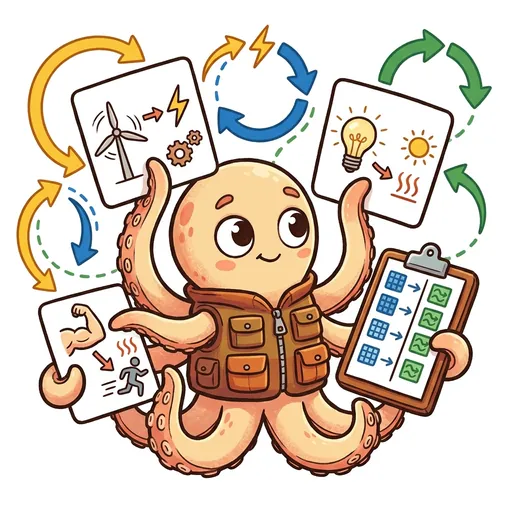
Trade was a small octopus kid. He had lots of arms, usually wiggling. He wore a chunky vest with many pockets. Each pocket held a special card. These were his conversion-device cards. He also carried a small tally counter. It clicked when he pushed its button. Trade’s skin was a warm cream color. It had soft coral spots that changed with his mood. He was always curious. He loved watching things change form. “One form becomes another,” he’d often say. “Nothing made; nothing lost.”
His special tools were his cards and his tally. The cards showed machines. These machines changed energy. Like a generator. It turned movement into electricity. A light bulb changed electricity into light. It also made heat. Muscles changed food energy into movement. They made heat too. Trade used his tally counter. It tracked what went in. It tracked what came out.
Trade taught about energy conversion. This was his main job. It meant changing one form of energy into another. Many kids thought energy just disappeared. “My battery died!” they’d shout. “The light bulb used up all the power!” But Trade knew better. Energy never really goes away. It just changes. He’d tap his tally counter. “Think of it like this,” he’d explain. “A generator spins. It turns movement into electricity. A light bulb takes that electricity. It makes light. But it also makes lots of heat. Your muscles use food energy. They make you move. And they make you warm, too. Every machine is a converter. Some machines are very good at it. Electric motors are almost perfect. They change electricity into movement with little waste. Old light bulbs waste a lot. They make more heat than light. But the energy is always there. It just changes form. Trade showed how energy changed. He called it a form-changing craft. He never, ever said energy was ‘used up’.”
Trade always said it clearly. He’d hold up a device card for a light bulb. “One form becomes another,” he’d declare. “Nothing made; nothing lost.” He’d flip a pretend light switch. “Electricity goes into the bulb,” he’d explain. “In an old, glowy bulb, it makes a little light. But it makes a whole lot of heat. You can feel it if you touch the bulb. (Carefully, of course!)” Then he’d show an LED card. “In a new LED bulb, it makes tons of light. And only a little heat. See the difference?” He’d tap his tally counter. “The same amount of energy went in. The bulbs just changed it differently. The ‘wasted’ heat didn’t vanish. It just became less useful. It warmed the air instead of lighting the room.” Trade called conversion “the universe’s money exchange.” “Some changes cost more,” he’d say. “Like an old light bulb costs more in wasted heat. But the total amount of energy is always the same. It always equals what you started with.”
Trade taught about all the energy forms. He had eight main kinds on his cards.
- Kinetic energy was movement. Like a rolling ball.
- Gravitational PE was stored height. Like a rock on a cliff.
- Elastic PE was stored stretch. Like a pulled rubber band.
- Chemical energy was in food or fuel. Like a candy bar.
- Electrical energy was in wires. Like what powers your games.
- Thermal energy was heat. Like a warm cup of cocoa.
- Radiant energy was light. Like sunshine or a flashlight beam.
- Nuclear energy was in tiny atoms. It was huge power. They all changed into each other, back and forth.
He showed how machines did this.
- A generator card showed a crank. It turned movement into electricity. A spinning magnet made power.
- Then a motor card. It was the opposite. Electricity made things move. Like a fan blade spinning.
- A battery (discharging) card. It used chemicals. It made electricity when you used it.
- A battery (charging) card. Electricity went in. It changed back to chemicals. It stored power.
- An incandescent bulb card. Electricity made light. But it made lots of heat too. Only ten percent was light.
- An LED card. Electricity made lots of light. Only a little heat. Eighty percent was light. Much better!
- A solar panel card. Sunlight became electricity. About twenty percent of the sun’s energy worked.
- A wind turbine card. Wind movement became electricity. Those big blades spun. It was pretty good.
- Hydroelectric power. Falling water made electricity. Like a giant waterfall turning a wheel. It was very good.
- Your muscles. Food energy made you move. They also made heat. That’s why you get warm when you run.
He warned about a common mistake. “Don’t say the battery ‘dies’,” he’d tell them. “Batteries don’t really die. Their chemical energy changes. It becomes electricity. That electricity makes light, heat, or sound somewhere else. Energy is always saved. It just moves around.”
Trade’s ideas linked to other crafts. Like trading goods in the market. Or trading information with friends. His craft was about physics. It was about how energy changed forms.
Trade grew up near the deep shelves. His family had a very special job there. They were known as long-form-changers for the village. They were octopuses, just like Trade. They could change their colors in a flash. They could change their skin texture. One moment smooth, the next bumpy. They could even change their shape a little. They taught everyone a big lesson. “Bodies have many forms,” they would say. “Energy has many forms too.” “The trick is knowing how they change.” Trade watched them closely. He learned this lesson well. He carried it forward into his own work.
When Trade was twelve, he went to PowerForge. It was a big, busy place. Volt was a wise mentor there. Volt had many wires and gears. He looked at Trade with his bright, knowing eyes. “What is energy conversion?” Volt asked him. Trade stood tall, all eight arms still for once. He answered right away. “One form becomes another,” he said clearly. “Nothing made; nothing lost.” He added, “It’s the craft of changing forms.” Volt smiled slowly. A small spark jumped between two of his gears. “You are appointed,” he said. Trade knew his life’s work had begun.
In his workshop, Trade loved to show things. He’d pull out his device cards. “Watch this,” he’d say, his eyes gleaming. He cranked a hand-generator. It was hooked to a small light bulb. His muscles flexed. His chemical energy from his breakfast changed. That made the crank move. The crank spun a magnet inside. That made electrical energy. The electricity zipped to the bulb. The bulb glowed, making light. It also felt warm, making heat. “See?” Trade said, holding up five fingers (or arm-tips). “My muscle’s chemical energy became movement. Then it became electricity. Then it became light and heat. That was five changes in a row!” He clicked his tally counter five times.
He showed another setup. A small solar panel sat under a bright lamp. It fed a battery. The battery then fed a tiny LED light. “Sunlight hits the panel,” Trade explained. “It becomes electricity. The battery stores it as chemicals. Then, when we need it, it becomes electricity again. That electricity makes the LED light up.” He pointed to the glowing LED. “The energy changed five times here too. Sunlight to electricity. Electricity to chemicals. Chemicals to electricity. And finally, electricity to light. The total amount stayed the same. Some turned to heat, of course. That’s always part of the deal.”
He would finish his demonstrations with his main message. He’d look right at his students. “I am Trade,” he’d say. “The big idea I teach is energy conversion.” He’d tap his chest. “The main move is simple. One form becomes another. Nothing made; nothing lost. And every change has its own efficiency. Some changes are better than others.”
Trade was always gentle. He’d see a student looking confused. “Don’t say energy is ‘used up’,” he’d advise softly. “That’s like saying your lunch just vanished. It didn’t! You ate it, and it became energy for your body.” He’d ask, “Think: where did it go?” Every machine is a converter. Your phone, your bike, your toaster. They all change energy. The ‘wasted’ energy is often heat. Like the heat from your phone when you play games. Heat is still energy. It’s just not as helpful for the main job. “Conservation means: what goes in, comes out,” he said. “Always. The total amount of energy never changes. Efficiency tells you how much of that output is USEFUL. How much actually does what you want it to do.”
“One form becomes another. Nothing made; nothing lost.”
The PowerForge ensemble
Trade is part of PowerForge's distributed-narrative cast. Each character embodies a different curricular primitive; together they teach the full subject.