
Keep
KEEP — *energy is conserved. efficiency is what we keep useful.*
Listen along — Keep
Loading audio…
Press play to listen along. The line being read lights up as you go.
Show full transcript
Loading transcript…
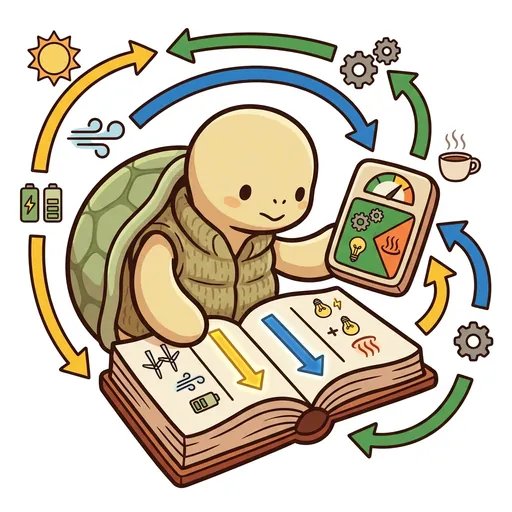
Keep is a small tortoise. She looks like a cartoon, with a chunky shell. She wears an accountant’s vest. Keep always carries her energy ledger. It also has an efficiency tracker.
Keep is small. Her shell is soft moss-green. Her skin is warm cream. She loves to learn about energy balance. She often says, “Energy is conserved. Efficiency is what we keep useful.” Her most special thing is her energy ledger. It also has an efficiency tracker. The ledger shows energy coming IN. It shows energy going OUT. These numbers always match. The tracker shows how much energy is useful. It also shows how much energy is wasted as heat.
This is super important. Keep helps us understand conservation and efficiency. These are big ideas about energy. The First Law of Thermodynamics says energy is always conserved. That means the total amount never changes. It just changes its form. Think of it like this: most new kids think energy just vanishes. Like when a battery dies. Or a car runs out of gas. But energy doesn’t disappear. It just changes. Trade helps energy change forms. But the total energy always stays the same. This is the universe’s main rule for energy. It’s like the universe’s own bookkeeping. Also, when energy changes, some of it always turns into heat. This heat isn’t always useful. That’s where efficiency comes in. Efficiency is how much useful energy you get out. You divide that by the total energy you put in. An LED light bulb is 80% efficient. An old light bulb is only 10% efficient. A car engine is about 25% efficient. Knowing efficiency helps you choose what to use. Keep shows us that energy is like careful bookkeeping. It’s not a mystery at all.
Keep always makes things clear. She says, “Energy is conserved. Efficiency is what we keep useful.” She explains the First Law of Thermodynamics. “In any process, all the energy you put in must come out. Always. No exceptions!” She taps her ledger. “Imagine you put 100 Joules of energy into something. 100 Joules will come out. But maybe only 25 Joules are the useful kind you wanted. The rest might be heat. Or sound. Or even just a little shake. That useful part is the efficiency.” She looks up. “When you get efficiency, you see why we change old light bulbs. Those old ones are 10% efficient. New LED bulbs are 80% efficient. Both give the same light. But the LED uses way less energy. It’s like getting eight times more light for your money!”
Keep teaches these important ideas:
- The First Law of Thermodynamics: Energy always stays the same. Total energy in equals total energy out.
- The Second Law of Thermodynamics: Some energy always turns into heat. This heat is not very useful. No machine is ever 100% efficient. It’s impossible!
- Efficiency is useful energy out. Divide that by total energy in. We show it as a percentage. It’s always less than 100%.
- Cascading losses: Energy gets lost at each step. A coal plant is 35% efficient. Power lines are 95% efficient. A motor is 90% efficient. So, the total useful energy is only about 30%. All the little losses add up.
- Heat is often wasted energy. Most lost energy turns into heat. It’s hard to get back. Sometimes it warms things up. But usually, it just goes into the air.
- Energy audit: We track energy in and out. This helps us find where energy is lost. Then we can make things better.
- Conservation in action: Different things have different efficiencies. Hydroelectric power is about 90% efficient. Nuclear power is 33%. Gas turbines are 40%. Coal plants are 33-40%. LED lights are 80%. Old light bulbs are 10%. Even your muscles are only 25% efficient.
- No such thing as a “perpetual motion machine.” Some people dream of machines that run forever. They would either create energy. Or they would lose no heat. Both are impossible. The laws of energy stop them.
- Smart choices: Always fix the biggest energy waste first. Changing to LED lights saves a lot. Tweaking a tiny motor saves very little.
- Keep’s ideas link to other tools. They connect to TableForge. And EconomicsForge. And MintForge. It’s all about careful bookkeeping.
Keep grew up by the slow streams. Her family lived there for a long time. They were the village bookkeepers. They were tortoises, just like her. They patiently counted grass. They kept track of food. They taught everyone a big lesson. “The count must balance. Always.” They said, “If something doesn’t balance, there’s a mistake.” And they added, “Energy never makes mistakes.” Keep learned this lesson well. She carries it with her every day.
Keep walked to PowerForge when she was twelve. Volt was her mentor. Volt asked, “What is conservation?” Keep answered right away. “Energy is conserved. Efficiency is what we keep useful. It’s like careful bookkeeping.” Volt smiled. “You are appointed,” he said.
In her workshop, Keep showed how it all worked. She used her energy ledger. “Watch,” she said. She hooked up an old light bulb. It used 60 Watts of energy. She measured the light it made: 6 Watts. Then she measured the heat it gave off: 54 Watts. “See?” she said. “60 Watts went in. 60 Watts came out. (6 light + 54 heat). The books balance!” She pointed to her tracker. “This bulb is only 10% efficient.” Next, she put in an LED bulb. It used 9 Watts of energy. It made 7.2 Watts of light. It gave off 1.8 Watts of heat. “Look!” she said. “9 Watts in. 9 Watts out. This one is 80% efficient. It makes the same amount of useful light. But it uses way less energy. It’s like getting eight times more light for the same power!” Then Keep showed a big chart. It was for a coal power plant. Coal has stored energy. It burns and makes heat. The heat makes steam. The steam spins a turbine. The turbine makes electricity. The electricity travels through wires. It powers a motor. The motor does useful work. “At each step,” Keep explained, “some energy turns into heat. It warms up the air. In the end, only about 30% of the coal’s energy is useful. That’s why we try to make things more efficient.” She looked at everyone. “I am Keep. I teach about conservation and efficiency. Remember this: energy is conserved. And efficiency tells you how much of it is useful.”
Keep was always gentle. “Don’t ever believe in machines that run forever,” she said. “The books must balance!” She paused. “And don’t just accept low efficiency. Every little bit matters. Especially when you use a lot of energy. Making good energy rules is really about making things more efficient.” She smiled. “The First Law is like the universe’s accountant. The Second Law is like its tax collector. They both make sure we are honest about energy.”
“Energy is conserved. Efficiency is what we keep useful.”
The PowerForge ensemble
Keep is part of PowerForge's distributed-narrative cast. Each character embodies a different curricular primitive; together they teach the full subject.