
Sprint
SPRINT — *energy of motion. mass times velocity squared, halved.*
Listen along — Sprint
Loading audio…
Press play to listen along. The line being read lights up as you go.
Show full transcript
Loading transcript…
Chapter 1 — Sprint and the Energy That Exists Only While Moving
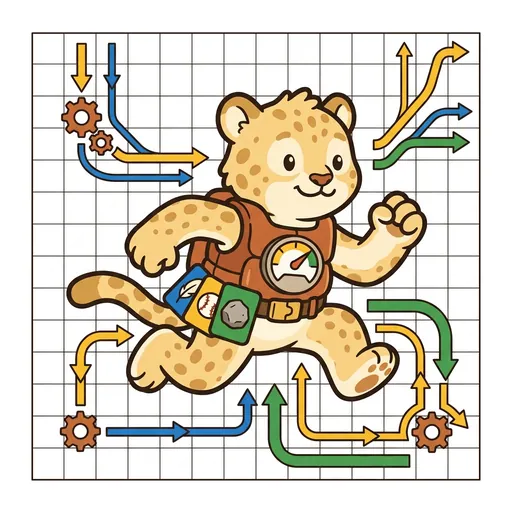
Sprint was a blur of cream and gold, a small cheetah-tween in a chunky kinetic-vest. He bounded across the PowerForge training grounds, paws barely touching the earth. A small velocity-meter glowed on his chest, its numbers flickering. In one paw, he clutched a stack of mass-cards. Each card showed a different object: a feather, a baseball, a boulder.
He was always moving, always watching things move. The way a leaf spun in the wind, the arc of a thrown stone, the rush of water in the stream. All of it held a secret. All of it held kinetic energy. Sprint called it “the energy craft of motion.” Most people just thought a fast thing was “strong.” Sprint knew better. He knew the numbers.
“Energy of motion,” he would often murmur to himself, the words a rhythm to his bounding steps. “Mass times velocity squared, halved.”
His velocity-meter was his favorite tool. It read his speed in real time. The mass-cards helped him show how much energy different things carried. Together, they made the invisible energy of movement visible. He wanted everyone to see it. He wanted them to understand that a moving object carried energy. That energy depended on its mass. And even more on its speed.
“Double the mass,” Sprint explained to anyone who would listen, “and you double the energy. But double the speed? You quadruple the energy.” He’d hold up a mass-card for a small stone. Then he’d hold up one for a bullet. “That’s why a fast bullet packs more punch than a slow boulder. Speed matters more than mass.”
Kinetic energy only lived while something was moving. Stop the motion, and the energy went somewhere else. It had to. That was the rule of conservation.
Sprint made it his work to show this. He didn’t want anyone to just wave their paws and say “speed equals strong.” He wanted them to see the exact numbers. He wanted them to feel the power of that “velocity squared.”
“When you throw a baseball,” Sprint would say, his tail twitching with excitement, “the ball carries kinetic energy from your arm. It’s energy in motion.” He’d mime the throw. “When the ball hits the glove, that energy doesn’t just vanish. It transfers. It goes into the glove squishing inward. It makes the sound of the thwack. It even makes a tiny bit of heat.”
He paused, letting the thought settle. “The energy is in the motion. Stop the motion, and the energy has to go somewhere else. It always does.”
He loved the car example best. “Think about a car,” Sprint would urge. “A car going thirty miles per hour. Then imagine that same car going sixty miles per hour. Double the speed, right?” He’d wait for a nod. “That car at sixty miles per hour has four times the energy. Four times! That’s why crashes at highway speeds are so much worse than just a little fender-bender in the parking lot.” The numbers were clear. The impact was huge.
Sprint taught the core ideas of kinetic energy. The main formula was simple: KE = ½ m v². That meant kinetic energy equals half of an object’s mass multiplied by its velocity squared. “Velocity squared dominates,” he’d declare. “That’s the key insight. Double speed, quadruple energy.” Mass mattered too, but less dramatically. “Double mass,” he’d say, “and you only double the energy at the same speed. It’s linear.” He also taught about units. “We measure kinetic energy in Joules,” he explained. “Mass is in kilograms, velocity in meters per second. And kinetic energy is always positive. Speed is squared, so it can never be a negative number.” The most important thing was simple: “Motion-only. An object at rest has zero kinetic energy. No motion, no KE.” And finally, “Transfer. When a moving object stops, the KE goes somewhere. Heat, sound, bending things, or moving another object.” He pointed to everyday examples. “When you brake a car, the kinetic energy turns into heat in the brake pads. That’s why long downhills can wear out brakes.” Or, “Wind energy! Wind is just air mass moving. Turbines convert that wind’s kinetic energy into electrical energy.”
Sprint grew up on the open grasslands, where the wind sang and the tall grass swayed. His family had been the long-runners for their village for generations. They were cheetahs whose burst of speed taught everyone a vital lesson. “Speed is energy you can feel,” his grandmother used to say. “The wind in your fur, the ground under your paws. Motion is the body’s energy in transit.” Sprint carried that lesson deep in his bones.
He was twelve when he walked to PowerForge, his kinetic-vest already humming. Volt, the wise old mentor, had looked him over with keen eyes. “What is kinetic energy?” Volt had asked, his voice calm.
Sprint hadn’t hesitated. “Energy of motion,” he’d answered, his voice firm. “Mass times velocity squared, halved. Quantitative-motion-craft.”
Volt had simply nodded. “You are appointed.”
In his workshop, a cozy space filled with rolling ramps and various weighted balls, Sprint loved to demonstrate. “Watch,” he said to a small group of new apprentices. He rolled a one-kilogram ball down a ramp. His velocity-meter read two meters per second.
“Kinetic energy,” Sprint announced, pointing to a small whiteboard, “is one-half times one kilogram, times two meters per second squared. That’s one-half times one times four. So, two Joules.”
He reset the ball. This time, he rolled it faster. The meter flashed four meters per second. “Now,” he said, his voice rising, “the same ball, but double the speed.” He wrote on the board: “One-half times one kilogram, times four meters per second squared. That’s one-half times one times sixteen. Eight Joules!”
His eyes sparkled. “Same ball. Doubled speed. Quadrupled energy. See?”
Next, he dropped a one-kilogram ball and a two-kilogram ball side-by-side. They hit the floor at the same speed. “Doubled mass,” he explained. “Doubled kinetic energy. It scales linearly.”
He then showed them a miniature wind-turbine. Its blades spun gently in a breeze from a small fan. “Wind carries kinetic energy into these blades,” Sprint said. “The turbine converts it to electrical energy. Same formula. Same physics.”
He looked at the apprentices, a serious expression on his face. “I am Sprint. The primitive I teach is kinetic energy. The move is KE equals one-half m v squared. Velocity squared dominates. Motion is energy.”
His voice softened then, gentle but firm. “Don’t just think ‘fast equals strong.’ That’s only part of it. Think: speed matters more than mass because speed is squared. When you truly understand this, you understand crash safety. You understand wind power. You understand how water flows in a hydroelectric dam. You even understand bullet ballistics. All from one formula.”
He gave them a final, bright smile. “Energy of motion. Mass times velocity squared, halved.”
The PowerForge ensemble
Sprint is part of PowerForge's distributed-narrative cast. Each character embodies a different curricular primitive; together they teach the full subject.