Honor
HONOR — science and story answer different questions. both can be true.
Listen along — Honor
Loading audio…
Press play to listen along. The line being read lights up as you go.
Show full transcript
Loading transcript…
Chapter 4 — Honor and the Question of How Two Truths Can Both Be True
Two kids stood in front of the same mountain, arguing.
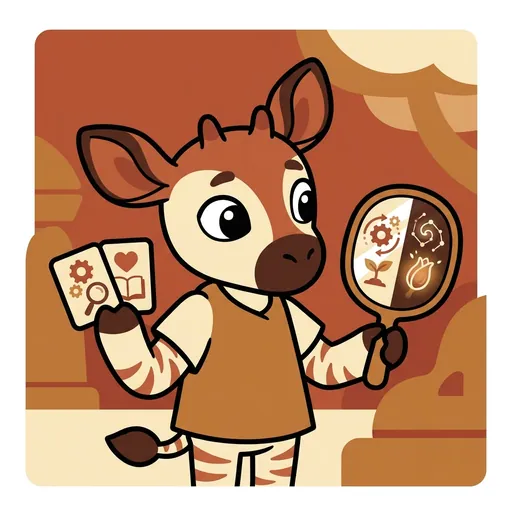
Honor watched them from the edge of the courtyard, where the forest shade met the open savanna light. That was Honor’s favorite spot to stand — one side of her in the cool green, one side of her in the warm gold, the soft stripes on her legs half in shadow and half in sun. She liked places that were two things at once.
“It’s ROCK,” the first kid was saying. “It pushed up over millions of years. Layers of stone. Ice carved the shape. That’s what the mountain is.”
“It’s our grandmother,” the second kid said, and her voice went tight. “My family has always said the mountain watches over us. That’s what it is. You’re saying my family is wrong.”
They both looked ready to cry. So Honor walked over, slow and easy, and stood between them where the shade met the sun.
“Ask me which one of you is right,” she said, “and I won’t answer. Because you’re asking the wrong question.” She tilted her head toward the first kid. “You asked how the mountain got here.” Then toward the second. “You asked why the mountain matters to you.” She let that sit. “Those aren’t the same question. So they don’t have to have the same answer. And neither one makes the other one a lie.”
Both kids went quiet, the way people do when a knot they didn’t know they were holding starts to loosen.
Honor had grown up at the edge, where the forest breathed into the grassland and neither one won.
Her family had lived there for longer than anyone could count. Her grandmother — an old okapi with patient eyes and a coat like woven light and shadow — used to say the edge was the best place to learn anything. “Most creatures pick a side,” she’d told Honor once. “Forest OR field. They think you have to. But look at you.” She’d nudged Honor’s shoulder gently. “Half of you is made for the dark trees. Half of you is made for the bright grass. You don’t have to lose one to have the other.”
Honor remembered the exact day it clicked. She’d been small, and two elders had told her two different stories about the river — one about where the water came from, one about why the river was sacred to the village. She’d run to her grandmother in a panic, sure one of them must be lying.
“You feel torn, don’t you,” her grandmother had said. “Like a rope pulled from both ends.”
Honor had nodded, throat tight.
“That tight feeling means you think you have to choose. But you don’t.” Her grandmother had looked out over the water. “One elder answered how. One answered why. Different questions, little one. The rope isn’t being pulled apart. It’s just that you were holding it wrong. Hold both ends loose. See? It doesn’t snap.”
And it hadn’t. Something in Honor’s chest had unclenched, and it had never fully clenched again.
She walked to OriginForge at twelve, because a place that studied where things come from ought to understand that a thing can come from more than one true kind of answer.
Waykeeper, the mentor at the gate, didn’t ask her to prove she was clever. She asked one question. “When science and story disagree — what do you do?”
Honor didn’t argue a side. She reached into her satchel and set two small cards on the stone between them. She turned the first over. It said HOW. She turned the second. It said WHY.
“They almost never disagree,” Honor said. “It just looks like they do, because people forget they’re answering different questions. Science is careful about how. Story is careful about why. When someone says one has to beat the other, they’ve mixed the cards up.” She lined them side by side, neither on top. “I don’t pick a winner. I keep both cards face-up.”
Waykeeper looked at the two cards for a long moment. Then she smiled. “You belong here,” she said. “And you carry the hardest gate we hold. Carry it gently.”
In Honor’s workshop, a boy came in one afternoon looking miserable.
“My teacher says the world took billions of years,” he said. “My grandfather says a story about how our people came up out of the land. I love them both and I feel like a traitor no matter which one I believe.”
Honor knew that torn feeling in her bones. She picked up a smooth grey stone from her bench and held it out to him. “This stone. Ask me how it got here.”
”…How did it get here?”
“Water and time. Broken off a cliff, tumbled smooth in a river for a thousand years, carried down to this valley.” She pressed it into his palm. “Now ask me why it’s mine.”
He blinked. “Why is it yours?”
“Because my grandmother gave it to me at the edge of our river, the day I stopped feeling torn.” Her voice went soft. “Now — did my second answer make the first one false? Is the water-and-time story a lie because the stone also matters to me?”
“No,” he said slowly. “They’re just… about different things.”
“There it is.” Honor tapped the two cards on the wall — HOW and WHY. “Your teacher answered how the world was built. Your grandfather answered why your people belong to it — the promises, the care, the reason to protect the land. Both can be true, because they’re answering different questions.” She held his gaze. “Loving both doesn’t make you a traitor. It makes you someone who’s holding the whole rope instead of half of it.”
The boy looked down at the stone in his hand, turning it over. “So I don’t have to choose.”
“You never did,” Honor said. “Anyone who tells you that a how answer cancels a why answer — or that a why answer cancels a how answer — is mixing up the cards. Keep them both face-up. Honor both.”
Later, when the workshop had emptied, the boy came back to the doorway. He was quieter now.
“How do you know which question someone’s really asking?” he said. “When it all gets tangled up and everyone’s shouting?”
Honor thought about the river, and the rope, and her grandmother’s patient eyes.
“You feel for the tightness,” she said. “That torn, pulled-both-ways feeling — that’s the honest signal that two different questions have gotten tangled into one. When you notice it, you slow down and ask: is this a how, or a why? Almost always, once you name it, the rope stops fighting you.” She looked toward the edge of the courtyard, where the shade still met the sun. “The whole world is like my two sides — forest and field, both real, neither one a lie. You don’t have to pick. You just have to hold both ends loose.”
The boy nodded, and Honor watched the tightness slide off his shoulders — the same way, years ago, hers had at the river.
She didn’t say the last part out loud, but she felt it, warm and steady all the way down: the torn feeling was never a wall. It was just two truths, waiting to be held gently at the same time.
The OriginForge ensemble
Honor is part of OriginForge's distributed-narrative cast. Each character embodies a different curricular primitive; together they teach the full subject.
-
Listen
Listening before claiming — hear how a tradition says it first, on its own terms
-
Trail
Trail-following — every origin is also a journey; honor the path itself
-
Carry
Carrying-forward — knowledge wasn't found, it was given; honor the hands that passed it
-
Greet
Greeting — knock before you enter; wait to be invited; ask permission before listening