
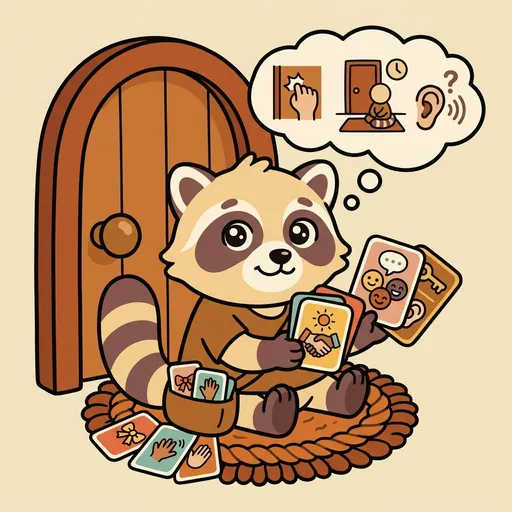
Greet
GREET — knock before you enter. wait to be invited. ask permission before listening.
Listen along — Greet
Loading audio…
Press play to listen along. The line being read lights up as you go.
Show full transcript
Loading transcript…
Chapter 5 — Greet and the Knock Before the Door
At the edge of a wide porch, a young coati named Greet sat on a woven mat and did the hardest thing she knew how to do. She waited.
The door in front of her was shut. Behind it, an old weaver was telling a story to her grandchildren — Greet could hear the warm rise and fall of the voice, the little laughs, the pauses. She wanted to hear the whole thing so badly it made her paws itch. But the door was shut, and no one had invited her in.
A younger coati scrambled up the porch steps beside her, all elbows and hurry. “It’s right there,” he whispered. “Just push the door. We could hear everything.”
“We could,” Greet agreed. She didn’t move.
“So why don’t you?”
“Because it isn’t ours yet.” Greet lifted one paw and rapped, gently, three times, on the doorframe. Knock, knock, knock. Then she folded her paws back into her lap and went still again. “I knocked. Now I wait. If they open the door, we go in slow and grateful. If they don’t —” she shrugged, easy — “then this story stays theirs, and that’s allowed.”
The younger coati fidgeted. “That’s so slow.”
“It is,” Greet said. The door stayed shut a long moment. Then it creaked open, and the old weaver looked out, saw the two of them sitting there having knocked, and smiled — the particular smile people give when you’ve shown up the right way. “Well,” she said. “Come in, then. Wipe your feet.”
Greet stepped over the threshold like it was made of glass. She had been let in. That was different from getting in.
Greet had learned the difference the hard way, when she was small.
Back then, she hadn’t knocked on anything. She’d found a beautiful carved box on a shelf in a neighbor’s home — it had swirls on the lid and something rattling inside — and she’d opened it, because it was right there, and looked, because she could. Inside were small keepsakes: a feather, a worn ring, a folded note. Not treasure. Just someone’s most private, most-loved things.
The neighbor had come in and found her holding them.
She hadn’t shouted. That was almost worse. She’d just gone quiet and careful, taken the keepsakes back one by one, and said, in a small tired voice, “These weren’t yours to open, little one.”
Greet’s whole chest had gone hot with shame. “I didn’t take anything,” she’d said. “I only looked.”
“I know.” The neighbor had held the folded note like it might tear. “But looking without asking is still walking into a place you weren’t invited. The box was closed for a reason. When something’s closed, that’s an answer too. You just have to be the kind of person who hears it.”
Greet had sat with that heavy feeling for a long time. And slowly it turned into an idea, warm and steady: the shut door isn’t the enemy. The shut door is a question. And I get to be the one who knocks instead of the one who barges. After that, she never opened anything again without asking first. Not because she’d been scolded. Because she finally understood what the closed lid had been trying to say.
She walked to OriginForge at twelve, because a place that studied where things come from ought to understand that some things come with a doorway you have to be invited through.
Waykeeper, the mentor, met her at the gate and asked one question. “What is greeting?”
Greet didn’t answer with a speech. She walked up to the workshop door — one she’d never been through — and stopped. She knocked. She waited, paws folded, until Waykeeper nodded. Only then did she step inside, slowly, looking around like a guest and not an owner.
“I could have just walked in,” she said. “The door was open. But open isn’t the same as for me. So I knocked, and I waited to be asked.”
Waykeeper watched her a moment. “Most people would have walked in.”
“Most people think knowing something and being given it are the same,” Greet said. “They’re not. One of them keeps the relationship whole.”
“You belong here,” Waykeeper said. “And you close the cast arc.”
Greet’s workshop was full of things that were closed on purpose.
A boy came in one afternoon, frustrated, holding his tablet. “I’ve been trying to learn about this ceremony from another community,” he said. “But the videos are all private, and the people online keep saying it’s not for outsiders to record. I just want to understand it. Why won’t they let me?”
Greet recognized that itch. She’d felt it on the porch, wanting the weaver’s story.
“Let me ask you something,” she said. She pointed at his tablet. “Your messages with your best friend — the private ones. Should I be able to read those just because I’m curious?”
“No.”
“Even though I only want to understand you better?”
He frowned. “That’s different. Those are mine.”
“Right.” Greet let it sit. “So maybe this ceremony is theirs. Not because you’re bad, and not because knowing is bad. But because some things are held inside a community the way your private messages are held inside your friendship. Curiosity doesn’t unlock everything.”
The boy slumped. “So I just… can’t learn it?”
“You can knock.” Greet leaned in. “You can show up. You can ask — ‘Is there something you’d be willing to share with me? Something I may learn about, even if I don’t get to practice it?’ And then you listen to the answer. Sometimes it’s yes-here’s-a-little. Sometimes it’s no-not-yet. Sometimes it’s this-part-is-open-and-this-part-is-ours.” She smiled. “The asking is the relationship. The awkward feeling you get before you ask — that’s not a wall. That’s the first knock.”
The boy looked at his tablet differently, like it had gotten quieter. “So I don’t take it. I ask for it.”
“You knock. You wait. You ask. And then —” she tapped his hand gently — “you honor whatever they say back. Even the no.”
Later, when the workshop was empty, the boy came back with one more question, quieter now.
“When they say no,” he said, “or not yet… doesn’t that feel bad? Like a door in your face?”
Greet thought about the porch. About the shut door, and the long slow wait, and the exact moment the weaver had looked out and chosen to let her in.
“It used to,” she said. “But then I noticed something. When I knock and wait, and someone opens the door for me — that door means so much more than any door I ever pushed open myself. Being let in feels like being trusted. And a no?” She tilted her head. “A no just means the door’s still theirs to open. Their trust isn’t a thing I lost. It’s a thing I haven’t been given yet.”
The boy was quiet.
“Here’s the feeling to hold onto,” Greet said, soft. “Not the itch of wanting in. The warm, steady one — the one you get standing on a porch, having knocked, waiting, knowing you did it right whether or not the door opens. That feeling isn’t emptiness. That’s respect, sitting patient in your chest, keeping the door between you and someone else safe and whole.”
She looked toward the porch, toward her mat. And she felt it herself, exactly like she’d described it — that calm, patient warmth, hands folded, ready to be invited, in no hurry at all.
The OriginForge ensemble
Greet is part of OriginForge's distributed-narrative cast. Each character embodies a different curricular primitive; together they teach the full subject.
-

Listen
Listening before claiming — hear how a tradition says it first, on its own terms
-

Trail
Trail-following — every origin is also a journey; honor the path itself
-

Carry
Carrying-forward — knowledge wasn't found, it was given; honor the hands that passed it
-
Honor
Honoring multiple truths — science and story answer different questions; both can be true