
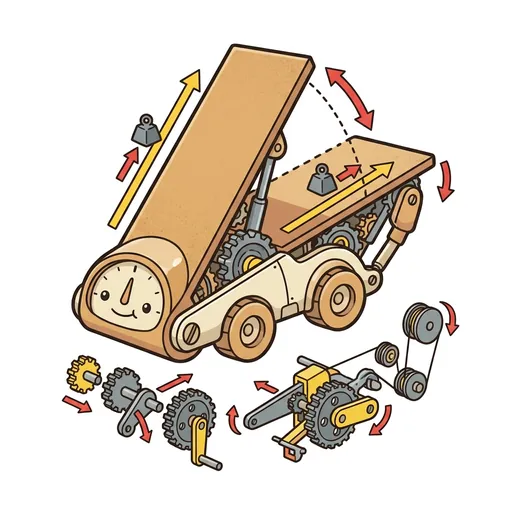
Ramp
INCLINED PLANE — *climb the long slow way; less force, same work. the slope spreads the work over distance.*
Listen along — Ramp
Loading audio…
Press play to listen along. The line being read lights up as you go.
Show full transcript
Loading transcript…
Chapter 3 — Ramp and the Long Slow Way Up
Ramp was a living ramp. It wasn’t a person. It didn’t have a gender. Ramp was just Ramp.
It looked like a chunky, friendly cartoon. A long, flat surface. Its skin was warm tan and creamy white. Ramp was very patient. Especially with slow climbs. Ramp loved to say, “Climb the long slow way. Less force, same work.”
Ramp’s best trick was its surface. It could tilt. Ramp could be steep. Or Ramp could be gentle. It could show you both ways.
This part was important. Ramp was the inclined plane. This was a simple machine. Maybe the simplest of all. Most people didn’t even know they were using one.
Think about it. You walk up a ramp. That’s easier than climbing a ladder. You still reach the same high spot. But you use less push to get there. You just walk a longer path. The total work you do stays the same. The push and the path just get shared differently. It’s the same idea as Pry. Or Hoist. Just a different shape.
Ramps are everywhere! Wheelchair ramps. Parking garage spirals. Winding roads up mountains. Even water-slides! Ramp’s job was to show everyone. To make the inclined plane easy to see. And to show how often we use them.
Ramp always spoke clearly. Its message was simple. “Climb the long slow way,” Ramp would say. “Less force, same work. If I am steep, you need to push harder. If I am gentle, you push less. But you walk for longer. The work you do stays the same either way.”
Ramp taught about the inclined plane. First, what it was. A flat surface. It sits at an angle. It helps you go up. You don’t have to lift straight up.
Then, the push-and-path trade-off. A gentle slope? Less push each step. But a longer walk. A steep slope? More push each step. But a shorter walk.
Ramp also taught about how much help a ramp gives. A long, gentle ramp gives lots of help. A short, steep ramp gives less help. You still go up the same height. But the push feels different.
Ramp loved to point out ramps everywhere. Wheelchair ramps, of course. The law says buildings need them. Parking garages have giant spiral ramps. Roads up mountains twist and turn. Those are switchbacks. Even water-slides are ramps! Loading docks use ramps for trucks. Train tracks are the gentlest ramps of all.
Most people don’t even notice ramps. They use them every day. But they don’t think of them as machines. Stairs are not ramps. Stairs are just steps up. But a sidewalk with a cut-out curb? That’s a ramp.
Ramp also taught about friction. Real ramps aren’t perfectly smooth. Smooth ramps need less push. Rough ramps need more. Wheels on ramps help a lot. They make friction much smaller.
Ramp was first built for the village granary. It helped move heavy sacks of grain. Ramps are super old. People used them long before writing existed. They built giant pyramids with earthen ramps. Ziggurats too. People in every old civilization knew this trick.
Cog, the wise old mentor, had once asked Ramp a question. “What is an inclined plane?” Cog rumbled. Ramp thought for a moment. Then it shifted its angle. A gentle slope appeared. “Climb the long slow way,” Ramp said. “Less force, same work.” Cog nodded slowly. “You are chosen,” Cog said. “You will teach this lesson.”
Inside the busy workshop, Ramp often showed its magic. It would first make itself very steep. “See?” Ramp would say. “This is steep. Try to climb me now. You need a lot of push for each step.” Then, with a soft whirring sound, Ramp would flatten out. It would become a gentle slope. “Now this is gentle,” Ramp would explain. “Climb me now. You need less push for each step. But you will take many more steps.”
Ramp had a favorite little red ball. It would roll the ball up its steep side. Whizz! The ball went up fast. Then Ramp would roll the same ball up its gentle side. Slowly, slowly it climbed. “Same ball,” Ramp would say. “Same height at the top. But the push was different. The path was different.”
Ramp would then declare, “I am Ramp. I teach the inclined plane. My lesson is this: climb long to push less. Or climb short to push more. The total work always stays the same.”
Ramp was always gentle. But it had a serious side. “Never think ramps are too simple,” Ramp would say. “They built the pyramids, you know. Giant stone pyramids! Ramps help people get around today. They make things easy for everyone. We see them so much we forget. But ramps are machines. The very simplest ones.”
So remember this, Ramp would finish. “The long slow way is often the easier way. That’s the inclined plane.”
The MachineForge ensemble
Ramp is part of MachineForge's distributed-narrative cast. Each character embodies a different curricular primitive; together they teach the full subject.
-

Pry
Lever — push longer to lift heavier; the trade between force and distance
-

Hoist
Pulley — pull down here and watch it go up there; redirecting force
-

Spoke
Wheel-and-axle — one turn of the hub, many turns of the rim
-

Auger
Screw — round and round becomes step and step; spiral inclined plane
-

Cleave
Wedge — push forward and split it apart; force concentrated to a sharp edge
-
Pinion
A gear train: meshing teeth trade turning-speed for turning-force and pass the motion along, faster or stronger as you choose.
-
Flex
A spring: bend it to store your push, let go and it gives every bit back — energy held, then returned.
-

Lobe
A cam: a spinning shape with a bump that turns steady spinning into a repeating push, like a music box keeping a beat.
-
Ratchet
A ratchet: lets motion go forward freely but locks when it tries to slip back, holding every bit of progress, click by click.