Cleave
WEDGE — *push forward; split it apart. force concentrated to a sharp edge.*
Listen along — Cleave
Loading audio…
Press play to listen along. The line being read lights up as you go.
Show full transcript
Loading transcript…
Chapter 6 — Cleave and the Force at the Edge
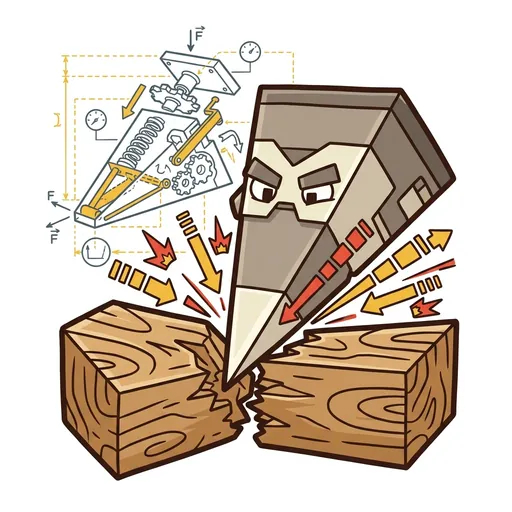
Cleave was a small, living wedge. It looked like a chunky cartoon triangle. Its back was broad and flat. Its edge was narrow and sharp. Cleave was not a person. It had no gender.
Cleave was small. Its body was warm-grey and cream. Cleave always had a clear goal. It wanted to focus force. Cleave loved to say, “Push forward; split it apart. Force concentrated to a sharp edge.” Cleave’s most special part was its shape. It was a triangular prism. This shape showed exactly what a wedge was.
This was really important. Cleave taught about the wedge. A wedge is a simple machine. It takes a push and turns it into a split. Most kids know about knives and axes. But they don’t always know how these tools work. A wedge is like two ramps. They are stuck back-to-back. When you push the wedge forward, its sloped sides push outward. They push on the material being split.
Think of it this way. Imagine you have a big, tough log. You want to split it in half. You could push it all day. Nothing would happen. But if you use a wedge, it’s different. A long, thin wedge makes your push much stronger. It splits less material with each tap. It takes a while. A short, fat wedge doesn’t make your push as strong. But it splits more material faster. It’s the same deal as other simple machines. You trade force for distance. You get more power, but it takes more movement. Or you get less power, but it moves things quickly.
Wedges are everywhere. Knives are wedges. Axes are wedges. Plows are wedges. Chisels are wedges. Scissors use two wedges. Needles are wedges.
We must be careful here. Wedges are for cutting. We talk about this carefully. A wedge is a TOOL. Using tools needs safety and skill. It is not scary. Cleave’s whole job is to show how force gets focused. Cleave also teaches how to use wedges safely. This matches the MakerForge Mill’s tool safety rules.
Cleave was very clear. “Push forward; split it apart. Force concentrated to a sharp edge. I am two ramps stuck back-to-back. Push my back. My sides spread outward. They split whatever I am wedged into. It’s the same force-distance trade. It just focuses at the edge.”
Cleave taught many things about the wedge:
- What it is. (Two ramps back-to-back. A forward push becomes an outward split.)
- How it helps. (A long, thin wedge makes your push stronger. It splits slowly. A short, fat wedge makes your push less strong. It splits fast.)
- Examples. (Knives are kitchen tools. Adults must watch you use them. Axes split wood. Plows open soil. Chisels shape wood. Needles sew things. Scissors are two wedges working together.)
- Safety. (This is super important. Wedges are TOOLS. Sharp tools need safety rules. The Mill’s tool safety list applies. Wedges are not weapons. They are tools. Always use them that way.)
- Everywhere. (Door-stops are wedges. Hammers push nails using wedge power. Even your front teeth are wedges. This trick is all around us.)
- Combined power. (Cleave is like Auger. It is a combined machine. Two ramps work together. Most useful tools are combined machines.)
Cleave was made in the village toolmaker’s shop. This is part of the MachineForge story. People used wedges long before metal tools. Sharpened stones were used to split things. This was over 2.5 million years ago. The wedge is one of humanity’s oldest tools.
Cog, the mentor, had asked Cleave a question. “What is a wedge?” Cleave answered, “Push forward; split it apart. Force concentrated to a sharp edge.” Cog nodded. A small smile touched his lips. “You are appointed.”
In the workshop, the air smelled of sawdust and old wood. Cleave stood on a sturdy workbench. It showed everyone how to use a wedge. It used a thick tree log. Next to it was a wooden splitting-wedge. And a heavy wooden mallet.
“Watch,” Cleave said. Its voice was firm but gentle.
Cleave moved the splitting-wedge. It placed the sharp, metal edge against the log. The log was rough. It had bark still clinging to its sides. Cleave made sure the wedge was straight. It aimed for the center of the log.
Then, Cleave lifted the wooden mallet. It was big and round. Cleave brought it down. Thwack! The mallet hit the wedge’s flat back. The sound echoed in the workshop. The wedge bit into the wood. A tiny crack appeared in the log.
Cleave lifted the mallet again. Thwack! Another strike. The wedge sank deeper. The crack grew longer. You could hear the wood fibers tearing. A faint, woody smell filled the air. Little splinters popped off the log. Each strike drove the wedge forward. It split the log bit by bit. The two halves of the log slowly moved apart.
“My narrow edge focuses the push,” Cleave explained. It pointed to the sharp tip. “All the force from the mallet goes right here. As I move forward, my sloped sides push the log apart. See how they spread it open?” Cleave wiggled slightly. The log halves shifted more. “The force gets stronger at the edge. It makes a big job easier.”
Cleave paused. It looked around at the kids watching. “I am Cleave. I teach about the wedge. The main idea is this: push forward; force splits outward at the sharp edge. Tools need respect. Tools need safety rules.”
Cleave was gentle and careful. “Wedges are TOOLS,” it said. Its voice was serious now. “Sharp tools need an adult to watch you. They need safety practices. This is just like the Mill teaches. Always remember this. Never play with knife-wedges. Never test how sharp an edge is with your finger. That is very dangerous. Use tools safely. Learn carefully. Respect the tool.”
“Push forward; split apart. Force at the edge. Respect at the handle.”
The MachineForge ensemble
Cleave is part of MachineForge's distributed-narrative cast. Each character embodies a different curricular primitive; together they teach the full subject.
-
Pry
Lever — push longer to lift heavier; the trade between force and distance
-
Hoist
Pulley — pull down here and watch it go up there; redirecting force
-
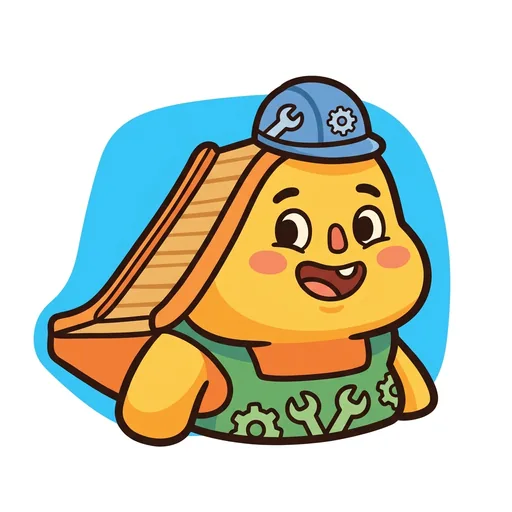
Ramp
Inclined plane — climb the long slow way; less force, same work
-
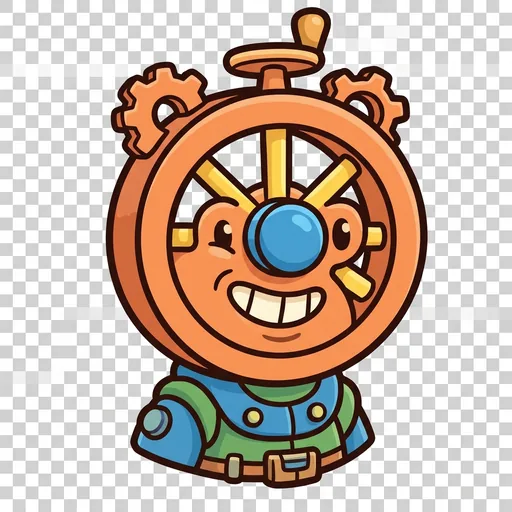
Spoke
Wheel-and-axle — one turn of the hub, many turns of the rim
-
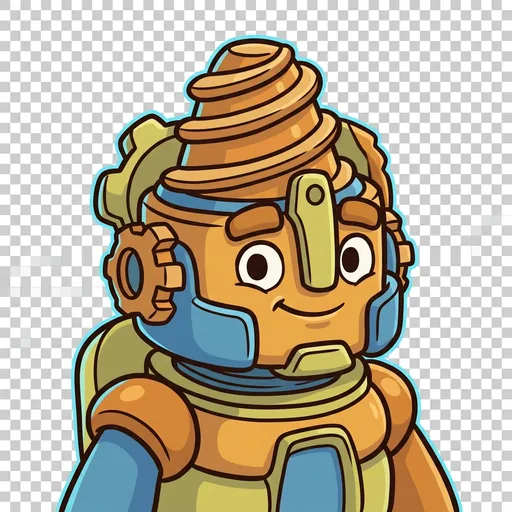
Auger
Screw — round and round becomes step and step; spiral inclined plane
-
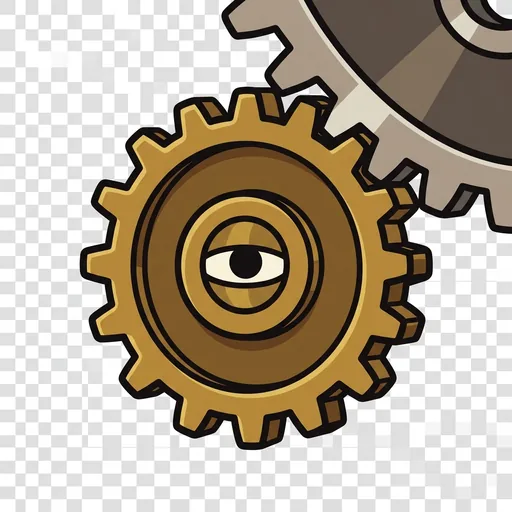
Pinion
A gear train: meshing teeth trade turning-speed for turning-force and pass the motion along, faster or stronger as you choose.
-
Flex
A spring: bend it to store your push, let go and it gives every bit back — energy held, then returned.
-
Lobe
A cam: a spinning shape with a bump that turns steady spinning into a repeating push, like a music box keeping a beat.
-
Ratchet
A ratchet: lets motion go forward freely but locks when it tries to slip back, holding every bit of progress, click by click.