
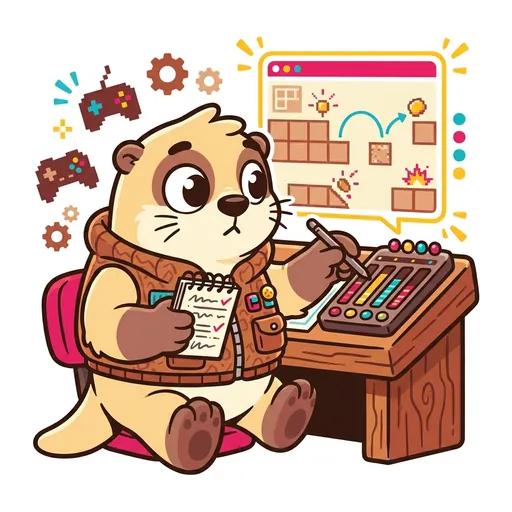
Probe
PROBE — what they DID, not what they SAID. listen with your eyes.
Listen along — Probe
Loading audio…
Press play to listen along. The line being read lights up as you go.
Show full transcript
Loading transcript…
Chapter 4 — Probe and the Difference Between What Playtesters Said and What They Did
Probe sat on an upside-down bucket in the corner of the workshop, a notebook balanced on his knee, and watched a kid named Marlo play a level for the very first time.
He did not say a word. That was the whole point.
Marlo pushed the little hero left, then right, then left again at a doorway near the start. Probe’s pencil moved. Doorway. Paused. Three seconds. Marlo tried jumping. Fell. Tried again. Fell. On the fifth try he sat back, huffed out a breath, and set the controller down on the table with a small, tired clack.
“So?” said Marlo, rubbing his eyes. “Yeah, it was good. Pretty fun.”
Probe looked at his notebook, not at Marlo. His river-brown paw tapped one line. “You said fun,” he said gently. “But five minutes ago you put the controller down. Your shoulders went up around your ears. You stopped looking at the screen.” He tilted his head, warm and curious, not accusing. “Your mouth said fun. Your body said stuck.”
Marlo went a little red. “I mean — the doorway was kind of annoying.”
“There it is.” Probe made one more tally mark and smiled like the kid had handed him a gift. “That’s the honest part. That’s the thing your words were being too polite to tell me.” He closed the notebook. “I don’t need you to like it. I need to see what actually happened to you. What they did,” he said, half to himself, an old habit, “not what they said.”
Probe had learned to listen with his eyes long before he ever touched a game.
He grew up on the river-stone banks, in a family of otters who had watched the water for the village for as long as anyone could remember. When he was small, his aunt used to take him out at dawn and make him sit — just sit — beside a still pool where the trout gathered.
The first few mornings had made him miserable. He wanted to do something. He kept asking questions the fish couldn’t answer: Are they hungry? Are they scared? Which way will they go? His aunt only shushed him and pointed.
“You keep asking the trout what it wants,” she said one morning, when his frustration finally spilled over into a whine. “The trout will never tell you. It can’t talk, little one — but it isn’t silent.” She nodded at the water. “See how it hangs where the current is slow? See how it flicks away from the shadow before the shadow even arrives? The fish doesn’t say what it wants. It acts it out, every second, right in front of you.” She rested a paw on his shoulder. “Watch the acting. Learn the truth.”
Something loosened in his chest that morning — the itchy, useless feeling of needing to be told. He didn’t have to interview the fish. He just had to watch, patiently, and the river would show him everything if he was quiet enough to see it. For the first time, sitting still stopped feeling like doing nothing. It felt like the most awake he had ever been.
He walked to LevelForge at twelve, because a place that built worlds for other people to move through ought to care how those people actually moved.
Pixel, the mentor who ran the workshops, met him at the gate and asked him one thing. “What is playtesting?”
Probe didn’t answer with a speech. He pointed back down the path, to where two younger students were trying a rope bridge Pixel had rigged as a joke. One of them kept reaching for a handrail that wasn’t there, again and again, then edging across sideways with tiny nervous steps.
“She’s telling you the bridge is scary,” Probe said quietly. “She hasn’t said a single word. But watch her hands — she keeps grabbing for a rail you didn’t build. Her feet know something her mouth hasn’t gotten around to yet.” He looked at Pixel. “You don’t ask her if the bridge is good. You watch her cross it. Then you build the rail she was reaching for.”
Pixel watched the girl inch across, then looked back at the otter for a long moment. “You’re appointed,” she said.
Probe’s workshop was full of kids being watched kindly.
Marlo came back the next week, still a little sheepish about the controller. Probe sat him down at the bench and played back a recording of his very first attempt.
“Watch yourself,” Probe said. On the screen, tiny Marlo tried the doorway and fell, tried and fell. “You said the game was fun. And I believe part of you meant it. But look.” He pointed at the screen-Marlo’s little slumped posture. “Right there. That’s the moment it stopped being fun and started being work you didn’t sign up for.”
Then he turned the notebook around so Marlo could see the tally tracker — five columns, one per kid. “You weren’t the only one,” Probe said. “Four out of five people hesitated at that exact doorway. Four out of five.” He tapped the column. “When one person struggles, maybe it’s just them having a rough day. When four out of five do the same thing in the same spot — that’s not five bad players. That’s one bad doorway.”
Marlo blinked. “So it wasn’t… my fault?”
“It was never your fault.” Probe said it plainly, like it was the most obvious thing in the world. “If a player can’t find the way through, the way isn’t inviting enough. My job isn’t to be right. My job is hospitality — to make the door so obvious that nobody’s shoulders ever climb up around their ears again.” He pulled a fresh page. “So I watched. I tallied. Now I change one thing — a light over the door, a little arrow, a ledge for the jump. Then I bring in a new person who’s never seen it, and I watch them. That loop, over and over, until the room stops lying about being fine — that’s the whole craft.”
Late in the day, when the others had gone, Marlo lingered by the door with one more question. He was quieter now.
“When you watch someone,” he said, “and you don’t help them, and you don’t tell them anything — doesn’t it feel kind of mean? Just… letting them get stuck?”
Probe thought about the dawn pool, and the itch of not being allowed to ask, and how it had turned, somewhere along the way, into something that felt almost like caring.
“I used to think so,” he said. “But it’s the opposite of mean. When I jump in and rescue you, I’m really rescuing me — I’m too impatient to sit with the not-knowing.” He set the notebook down. “When I stay quiet and just watch, I’m trusting you enough to let you show me the truth. That’s a kind of patience that feels like being held, once you’re on the other side of it.”
Marlo nodded slowly.
“Next time somebody says they’re fine,” Probe added, softer, “watch their hands. Watch where they stop looking. People are honest all the time — usually just not with their words.” He looked toward the window, toward the river he still visited on quiet mornings, and felt that same wide-awake stillness settle warm in his chest, the way it had the first time he learned to hush and simply see.
The LevelForge ensemble
Probe is part of LevelForge's distributed-narrative cast. Each character embodies a different curricular primitive; together they teach the full subject.
-
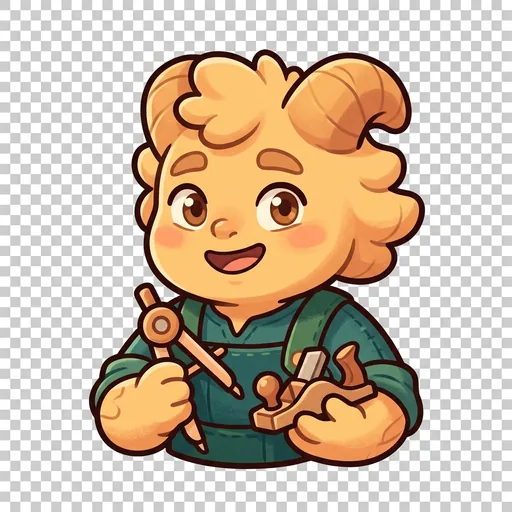
Carve
Level architecture — where-does-the-eye-go-first spatial-flow + sight-line + landmark craft
-
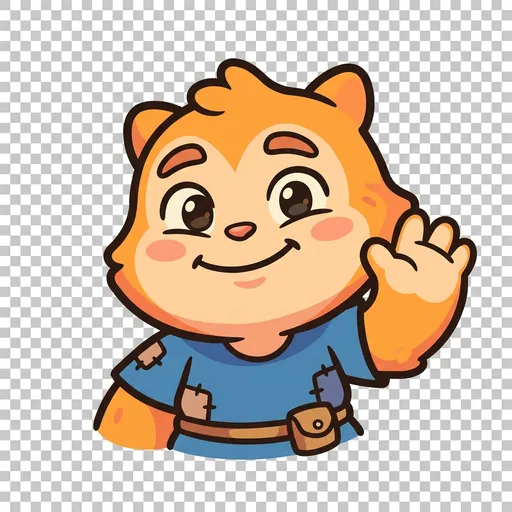
Coax
Player psychology — invite-don't-trap; warm-host posture; player chooses forward
-

Bounce
Juice + feedback — tiny-celebrations; squash-stretch-shake-thunk; juice as empathy
-

Ramp
Difficulty curves — teach-test-vary-rest; deliberate-difficulty-as-love-letter; never-spike never-punish