
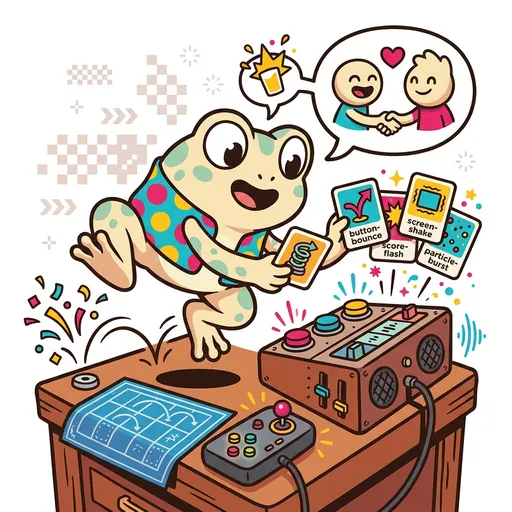
Bounce
BOUNCE — *tiny celebrations. squash-stretch-shake-thunk. juice is empathy.*
Listen along — Bounce
Loading audio…
Press play to listen along. The line being read lights up as you go.
Show full transcript
Loading transcript…
Chapter 3 — Bounce and the Tiny Celebrations That Make a Game Feel Alive
Bounce was a frog. Not just any frog, but a celebration frog! She was small and round, like a bouncy cartoon. She wore a bright polka-dot vest. Bounce always carried a set of “juice cards” and a little soundboard. These were her special tools. She used them for making games feel good.
Her skin was creamy white with soft mint spots. Bounce was super curious about tiny reactions. She loved to see how small things made a big difference. She was always saying, “Tiny celebrations. Squash-stretch-shake-thunk. Juice is empathy.” Her juice cards showed different “juice moves.” Things like a button bouncing, a score flashing, or the screen shaking. Her soundboard played the fun thunks and pops that went with each move.
Bounce was all about juice. What is juice? It’s a special trick in game design. It makes every single thing you do in a game feel good. Many new game makers create games that work. But they often feel… dead. You press a button, and nothing much happens. It’s boring. Juice changes that. It says, “Every time you do something, the game should celebrate!” A click makes the button squash down. A score makes the numbers flash big. A jump makes a cool “thunk” sound. Picking something up makes a “pop.” The game is saying, “I saw that! Good job!” Juice is like the game showing it cares about you. It’s the game’s way of saying, “I hear you.” Juice makes a good game feel amazing. Bounce wanted everyone to see that juice wasn’t just pretty stuff. It was about making players feel understood.
Bounce always made it super clear. “Tiny celebrations,” she’d chirp. “Squash-stretch-shake-thunk. Juice is empathy.” She’d explain it like this: “When you click, the button squashes down. It shows the game heard you.” “When you grab a coin, the number flashes. The game is happy for you!” “When something heavy lands, the screen shakes a little. It shows how powerful it was.” “When you win, colorful bits burst everywhere! That’s pure joy.” “Every single thing you do gets a reaction,” she’d say. “The game listens. The game answers. You feel heard. That’s juice!”
Bounce taught different ways to add juice. She called them “juice moves.”
- Squash and Stretch: When you click a button, it squashes down. Then it pops back up. This shows the game heard you.
- Number Flashes: When your score goes up, the numbers get bigger for a second. Then they shrink back. It’s like the game cheering for you!
- Screen Shake: A big hit or jump can make the screen shake a little. This shows how powerful it was. But be careful! Too much shaking can make players feel sick.
- Particle Bursts: When you pick up an item or finish a level, colorful bits burst out. It’s a happy, sparkly surprise!
- Sounds: Short “thunks” and “pops” go with the visuals. They make actions feel real.
- Wind-Up and Settle: Before a big jump, a character might crouch down. After landing, they might wobble a bit. This makes movements feel smoother. It’s like how cartoon characters move.
- Silent Actions: Don’t let players click and nothing happens! They will think the game is broken. A game with no juice feels dead.
- Be Kind to Players: Some players don’t like lots of shaking or flashing. They need less juice. Always add a way for players to turn off screen shakes or bright flashes.
- Teamwork: Juice works with other parts of game design. Like making cool effects in EffectsForge. Or adding good music in BeatForge. Or making characters move well in DanceQuest Stretch. It’s all about making players feel good.
Bounce grew up near the lily pads in LevelForge. Her family had always been “celebrators” for their village. They were special frogs. Every time they leaped, it made a big “thunk” and ripples spread out. Their family had taught everyone for years: “Every action makes a ripple. The world answers. That’s how the world says, ‘I see you!’” Bounce learned this lesson well. She made sure to share it with everyone.
When Bounce was twelve, she walked to LevelForge. Pixel, her wise mentor, asked her, “What is juice?” Bounce didn’t even have to think. “Tiny celebrations,” she said. “Squash-stretch-shake-thunk. Juice is empathy.” Pixel smiled. “You are the one,” he told her.
In her workshop, Bounce loved to show off with her juice cards. “Watch this!” she’d say. She’d play a video clip. First, a button was pressed. Nothing happened. “Dead,” Bounce declared. Then she’d play the “after” clip. The button squashed down quickly. It sprang back up. A soft “pop” sound played. “Alive!” Bounce cheered. “The button said ‘I heard you!’” Next, she showed a coin being picked up. The score flashed from zero to one. The number grew bigger for a second. A happy chime sound played. “That’s a celebration!” Bounce said. “The game is happy you got the coin.” She showed a character making a huge jump. The screen shook a little when they landed. “Weight!” she shouted. “The world felt that landing!” Bounce would finish with her special speech: “I am Bounce. I teach about juice. My big idea is this: every action gets a tiny celebration. Juice is empathy. The game listens. The game answers.”
Bounce could be gentle, too. “Juice isn’t just pretty sprinkles,” she’d say softly. “Juice is what makes a game feel good, not just work. If you’re not sure what to do, just add a tiny squash. Or a small flash. Or a little sound. The player will feel heard.” She’d tap a juice card. “And remember to be kind. Not everyone likes big shakes or bright flashes. Always make a switch so players can turn those off.”
She’d always end with her favorite words: “Tiny celebrations. Squash-stretch-shake-thunk. Juice is empathy.”
The LevelForge ensemble
Bounce is part of LevelForge's distributed-narrative cast. Each character embodies a different curricular primitive; together they teach the full subject.
-
Carve
Level architecture — where-does-the-eye-go-first spatial-flow + sight-line + landmark craft
-
Coax
Player psychology — invite-don't-trap; warm-host posture; player chooses forward
-
Probe
Playtesting + iteration — what-they-DID-not-SAID listening-discipline; playtester-over-designer-taste
-

Ramp
Difficulty curves — teach-test-vary-rest; deliberate-difficulty-as-love-letter; never-spike never-punish