
Bounce
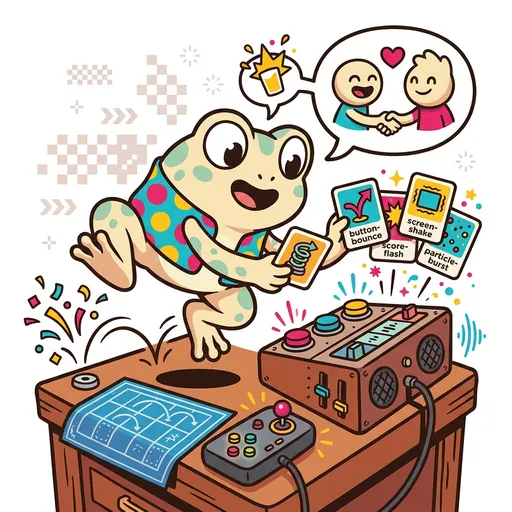
BOUNCE — *tiny celebrations. squash-stretch-shake-thunk. juice is empathy.*
Listen along — Bounce
Loading audio…
Press play to listen along. The line being read lights up as you go.
Show full transcript
Loading transcript…
Chapter 3 — Bounce and the Tiny Celebrations That Make a Game Feel Alive
Bounce, a small frog-tween with warm-cream skin and soft mint spots, adjusted the chunky polka-vest over her springy frame. Her workshop hummed with the quiet glow of screens, each displaying various game prototypes in different stages of completion. She held a set of juice-cards in one hand, her other resting on a small feedback-soundboard. Today, she was teaching the juice primitive — the game-design craft of making every action feel good via tiny celebrations.
A young student named Pip hunched over a tablet, his brow furrowed in concentration, or perhaps, frustration. On the screen, a tiny pixelated adventurer stood before a locked gate. Pip tapped a virtual button labeled “OPEN.” The gate remained stubbornly shut. He tapped again, harder this time. Still nothing. The adventurer stood motionless.
“It works,” Pip muttered, his voice tight. “The code says it opens the gate. But it just… sits there. Like a dead fly on a windowsill.” He tapped the button a third time, a flicker of annoyance crossing his face. “I keep wondering if it’s broken. If I’m doing something wrong.”
Bounce hopped closer, her springy pose making her seem to bounce even when standing still. Her mint spots seemed to deepen slightly with understanding. “Ah, the silent action anti-pattern,” she said, her voice a soft, sympathetic croak. “Many novices ship a game that technically functions, but feels utterly lifeless. The button press registers, yes. The game processes the input. But nothing visibly, or audibly, responds.” She pointed to the tablet. “The game isn’t talking back to the player. It’s like shouting into a void.”
She slid a juice-card labeled ‘Squash’ into a slot on her soundboard. The card depicted a button visibly compressing. “Watch this,” Bounce said, tapping a button on the soundboard itself. A soft, satisfying “thunk” echoed through the room. On a larger screen, a simple grey button appeared, identical to Pip’s. A cursor moved, then clicked it. Nothing happened. The button remained flat, lifeless. “See?” Bounce asked. “The player clicks, but the game gives no sign it even noticed. It’s a one-sided conversation.”
Pip nodded slowly. “Yeah. I keep clicking, wondering if it’s broken.”
“Exactly,” Bounce said, her mint spots seeming to glow with emphasis. “That’s why every player action deserves a tiny celebration. It’s the game’s empathy for the player’s input.” She slid a different juice-card across her soundboard, this one showing a button stretching. “First, squash-stretch.”
The screen flickered. Now, when the cursor clicked the button, it visibly squashed inward for a split second, then sprang back to its original shape. A soft, satisfying “pop” sound accompanied the action. “Now what does the button say?” Bounce asked Pip.
Pip’s eyes widened. “It says… ‘I heard you!’”
“Precisely!” Bounce beamed. “That’s acknowledgment. The game listened; the game answered. The player feels heard.” She paused, letting the simple yet profound difference settle in the air. “Juice transforms competent into delightful.”
“Next,” Bounce continued, selecting another juice-card that showed a number growing larger. “Let’s talk about celebrating gains. Imagine collecting a coin.”
On the screen, a small character walked past a shimmering gold coin. The character touched it, and the coin vanished. A score counter in the corner changed from “0” to “1.” Again, the action felt flat, without impact. The player knew they got the coin, but the experience felt hollow.
“It works,” Pip said, shrugging. “You got the coin.”
“But does it feel good?” Bounce countered. “Does the game seem happy you got the coin?” She tapped her soundboard. A bright chime rang out. On the screen, the score counter flashed, briefly scaling up in size as it changed from 0 to 1, then settling back. A tiny shower of golden particles burst from where the coin had been. “Now what?”
“Whoa!” Pip exclaimed. “It’s like… a mini-party! The game’s excited!”
“That’s number flashes and particle-burst,” Bounce explained. “A brief scale-up celebrates the gain. The particles are visual joy. Together, they make the collection feel significant, not just a number change.” She demonstrated a big jump next. A character leapt high, then landed with a barely perceptible thud. “No weight,” Bounce observed. “The world didn’t respond to that landing.”
She activated another juice-card, this one depicting a shaking screen. This time, as the character landed, the entire screen gave a subtle, quick shake. A deeper “thunk” sound resonated. “That’s screen-shake,” Bounce said. “It conveys weight, impact. The world responded to your landing.” She held up a finger. “But use sparingly. Too much screen-shake can cause motion-sickness. We always build an accessibility toggle for things like that.”
“I am Bounce,” she stated, her voice clear and resonant. “The primitive I teach is juice. The move is simple: every action gets a tiny celebration. Juice is empathy. The game listens; the game answers.”
She walked over to a whiteboard, sketching quickly. “Think of it like this: Anticipation and follow-through.” She drew a frog winding up for a leap, then landing and settling. “It’s a cartoon-animation principle applied to interactive feedback. The wind-up before the action, the settle after. It makes the action feel natural, expected, satisfying.” She added, “And don’t forget audio thunk and pop. Short, layered sounds that pair with the visual. They’re the game’s voice, confirming what you see.”
Pip looked at his tablet, then back at Bounce. “So, it’s not just making things look pretty?”
Bounce shook her head, her mint spots shimmering. “Never sprinkles. Juice isn’t cosmetic decoration. It’s the difference between a game that works and a game that feels good. It’s empathy-craft.” She paused, her gaze distant for a moment, remembering. “My family were the long-celebrators for our village, along the lily-pad shores of LevelForge. Every leap we took, every ripple we made, taught us that the world answers. Every action ripples; the world answers; that’s how the world says ‘I see you.’”
“I walked to LevelForge when I was twelve,” she continued, a faint smile playing on her lips. “Pixel, our mentor, asked me, ‘What is juice?’ I told him, ‘Tiny celebrations. Squash-stretch-shake-thunk. Juice is empathy.’ He just nodded. ‘You are appointed,’ he said. And that was that.”
She turned back to Pip, her expression earnest. “When in doubt, add a small squash, a small flash, a small sound. The player feels heard. And remember that reduce-motion respect. Not every player wants the big shake or the bright flash. Always build that accessibility toggle.”
“So, it’s about making the game feel alive,” Pip summarized, a new understanding dawning in his eyes.
“More than alive,” Bounce corrected gently. “It’s about making the game feel like it cares. Like it’s paying attention to you. That’s the core of it.” She held up her juice-cards. “Tiny celebrations. Squash-stretch-shake-thunk. Juice is empathy.”
The LevelForge ensemble
Bounce is part of LevelForge's distributed-narrative cast. Each character embodies a different curricular primitive; together they teach the full subject.
-
Carve
Level architecture — where-does-the-eye-go-first spatial-flow + sight-line + landmark craft
-
Coax
Player psychology — invite-don't-trap; warm-host posture; player chooses forward
-
Probe
Playtesting + iteration — what-they-DID-not-SAID listening-discipline; playtester-over-designer-taste
-

Ramp
Difficulty curves — teach-test-vary-rest; deliberate-difficulty-as-love-letter; never-spike never-punish