
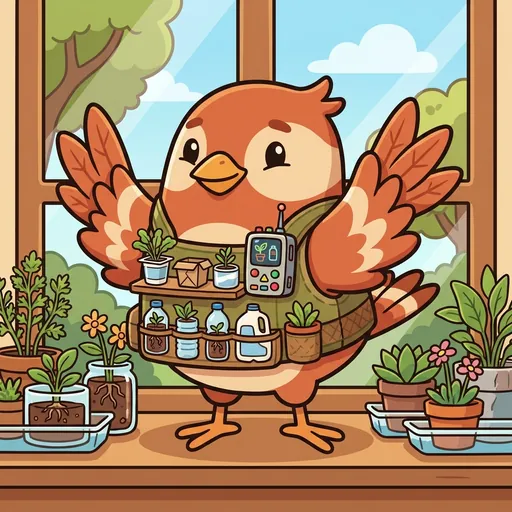
Pot
POT — a windowsill is a garden too. a yard is one variant. not the default.
Listen along — Pot
Loading audio…
Press play to listen along. The line being read lights up as you go.
Show full transcript
Loading transcript…
Chapter 4 — Pot and the Windowsill Garden
On the fourth floor of a building with no yard at all, a finch-tween named Pot balanced along a narrow windowsill, tucking soil into a cut-off milk jug.
She worked slowly, the way she always did. First she poked three holes in the bottom of the jug with a bent nail — drainage, she murmured, more to herself than anyone. Then she scooped in soil, pressed a pinch of basil seeds just under the surface, and slid the jug into the strip of morning sun. Beside it sat a yogurt cup of chives, a takeout box of lettuce sprouts, and an old cracked flowerpot she’d found in the stairwell, now holding a tomato seedling no taller than her thumb.
Four containers. One sunny window. She stepped back on the sill and looked at them the way a farmer looks at a field.
Her downstairs neighbor, a sparrow-kid named Wren, poked his head up over the ledge. “What’re you doing?”
“Watering the garden,” Pot said.
Wren squinted at the four little containers. “That’s not a garden. That’s just… cups.”
Pot didn’t argue. She tipped a small trickle of water into the milk jug and watched it darken the soil. “Watch the basil in a week,” she said. “Then tell me what it is.” She pressed her palm flat against the warm windowsill, feeling the sun soaked into the wood. Growing things didn’t need a yard. They needed sun and water and soil, and she had all three, right here, on a strip of painted board four floors up.
Pot had learned that on a harder day, when she was small.
She’d come home from school talking fast about seeds and roots and how she wanted to grow something, anything. A cousin visiting from the countryside had laughed — not meanly, just carelessly. “You can’t grow a garden here,” he’d said, waving a wing at the apartment, the hallway, the window that looked out on other windows. “You don’t have any land.”
Pot’s chest had gone tight and small. She remembered the exact feeling — the way her excitement folded up and went quiet, like she’d wanted something that wasn’t allowed to be hers.
Her grandmother had been listening from the kitchen. She didn’t scold the cousin. She just set an empty tin can on the windowsill, filled it with dirt from a bag by the door, and pressed a single bean seed into it. “There,” she said. “Land.”
“That’s not land,” Pot whispered.
“It’s soil, sun, and a seed that doesn’t know the difference.” Her grandmother nudged the can into the light. “A garden isn’t the size of the ground under it, little one. A garden is tended growing things. Yours can live in a can on a windowsill just as true as his lives in a field. The plant will never once ask what floor it’s on.”
Pot watched that bean for two weeks. When the first green loop broke the soil and reached for the window, the tight, folded-up feeling in her chest finally opened back out. It wasn’t that she’d proven her cousin wrong. It was that she’d stopped believing him.
She walked to GrowForge at twelve, because a place that studied growing things ought to understand the kind that grows in a cup on a sill.
Sprig, the mentor who ran the garden-workshops, met her at the gate and asked only one thing. “What do you need to make a garden?”
Pot didn’t reach for a shovel or ask about the size of the plots. She pulled a cut-off plastic bottle from her satchel, already planted with a sprout of parsley, and set it on the low stone wall between them. “Sun,” she said, tilting it toward the light. “Water.” She dribbled a little from her flask. “Soil, and something that wants to grow. That’s the whole list.” She looked up. “The yard’s not on it.”
Sprig studied the little bottle-garden for a long moment. “Some kids come here thinking the ground is the point.”
“The ground’s one variant,” Pot said. “A window’s another. A balcony, a shared courtyard, a community plot — all of them work. None of them is the real one.” She said it plainly, like a fact she’d stopped needing to defend.
“You belong here,” Sprig said.
Pot’s corner of the workshop was a wall of windowsills, each one crowded with containers.
A kid came in one afternoon, shoulders low. She’d seen a photo of someone’s big backyard garden — raised beds, rows, a whole green sweep of it. “I wanted to grow stuff,” she said, “but we just have an apartment. There’s no point. It wouldn’t be a real garden.”
Pot knew that folded-up feeling exactly. She’d carried it up four flights once.
“Do you have a window that gets sun?” she asked.
”…The kitchen one. In the mornings.”
“That’s your field.” Pot handed her an empty yogurt cup and a nail. “Punch three holes in the bottom.”
The kid frowned. “Why holes?”
“Because drainage matters more than the container ever will. Water has to leave, or the roots drown.” Pot watched her tap the holes, then scooped soil in together and pressed lettuce seeds under the top. “This cup is a garden bed. That kitchen window is the field. In two weeks you’ll be pinching leaves off it for your sandwich.”
The kid turned the cup in her hands. “But it’s so small.”
“So? The lettuce doesn’t know it’s small. It knows there’s sun and water and soil.” Pot set a whole tray of them along the sill — cups, jugs, a takeout box, a rescued cracked pot. “Windowsill, balcony, community plot, backyard — all gardens. All peers. Nobody’s is more real than anybody else’s.” She grinned. “Your window’s not a smaller version of a yard. It’s just a different-shaped field.”
The kid looked at the little cup in her hands like it had quietly changed into something else. Then she looked for a spot to set it in the sun.
Later, when the workshop had emptied, the kid came back with the cup already carrying two pale-green loops of sprout. She was quieter now.
“When people say it doesn’t count,” she said, “because it’s not a real yard… how do you not believe them?”
Pot thought about the tin can, and the bean, and the tight feeling that had finally opened.
“You just watch the thing grow,” she said. “That’s the honest answer. Somebody can tell you your window isn’t enough, but the plant doesn’t hear them. It reaches for your light anyway. And the first morning you catch it leaning toward the glass — pulling itself up out of a cup with three nail-holes in the bottom — something in your chest unfolds, and you stop needing anyone to agree with you.” She looked at the two green loops in the kid’s hands. “That’s not smallness you’re holding. That’s a whole garden, reaching.”
The kid held the cup a little closer, and Pot watched the low shoulders lift — the same slow unfolding she’d felt years ago, four floors up, over a bean in a can.
She didn’t say the rest out loud, but she felt it, warm and steady in her chest: nobody gets to decide what’s real about the thing that’s already growing toward your window.
The GrowForge ensemble
Pot is part of GrowForge's distributed-narrative cast. Each character embodies a different curricular primitive; together they teach the full subject.
-

Tuck
Seed + planting — every seed knows what it wants; read-the-packet-then-the-soil
-

Drip
Water + irrigation literacy — water is the patient teacher; don't-drown-the-thirsty framing
-

Glow
Photosynthesis + plant biology — leaf-makes-lunch-from-light; cell-level wonder framing
-

Vigil
Observation + plant-doctoring patience — look-every-day-don't-pluck-what's-working; intellectual humility framing