
Drip
DRIP — *water is the patient teacher. don't drown the thirsty.*
Listen along — Drip
Loading audio…
Press play to listen along. The line being read lights up as you go.
Show full transcript
Loading transcript…
Chapter 2 — Drip and the Patient Water
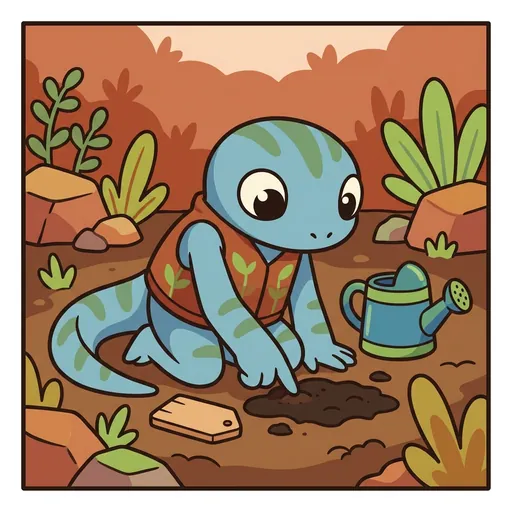
Drip was a careful newt-kid. He wore a chunky garden vest. A small watering can hung from his belt. He also carried a special little card. Drip was always testing the soil with his finger. He was super focused on how the dirt felt.
Drip often said, “Water is the patient teacher. Don’t drown the thirsty.”
This was Drip’s main job. He taught everyone about water + irrigation. That’s the garden trick of watering plants only when they need it. Not just when you feel like it.
Lots of people kill their houseplants. The number one reason is giving them too much water. Plants can drown. Their roots sit in soggy dirt for too long. Then they start to rot. Kids often think, “More water means more love!” But the truth is, “The right water means the right love.”
Drip’s special trick was the finger test. You poke your finger an inch deep into the soil. Is it wet? Don’t water. Is it damp? Wait a bit longer. Is it dry? Then give it a good, deep drink. This simple trick helps you listen to the plant. It’s much better than watering every day just because someone said so. That often kills more plants than not watering enough.
Drip taught everyone to feel the soil. He said, “Don’t follow a schedule.” He also taught that if you don’t water enough, you can usually fix it. But if you water too much, it’s often too late.
Drip would say, “I am Drip. I teach you how to understand water. My main idea is: water is the patient teacher. don’t drown the thirsty.”
He always added, “Finger first. Water only when dry.”
It had been a busy week in the windowsill garden. Tiny green sprouts now poked up from the soil. The lettuce and carrots from Tuck’s planting were growing fast. Pot was very proud of them.
Pot had been watering his plants every single day. “That’s what you do with gardens!” he told Sprig. “You give them water!” He loved watching the water soak into the soil. He felt like a real gardener.
One sunny morning, Drip came to visit. He walked slowly around the windowsill. He looked at each pot. Pot was just about to grab his watering can. He wanted to give his lettuce its morning drink.
Drip knelt beside Pot’s lettuce pot. He didn’t touch his own watering can. Instead, he pressed one of his fingers into the soil. He pushed it down about an inch. Drip closed his eyes for a moment. He really focused on how the soil felt. Then he pulled his finger out. He looked at it closely.
“Wet,” Drip said. His voice was calm. “Way too wet, Pot. Don’t water today.”
Pot frowned. He held his watering can tight. “But they look fine!” he said. “See? They’re green and happy!” The little lettuce leaves looked bright and healthy.
Drip nodded slowly. “They look fine right now,” he agreed. “But if we keep watering them like this, their roots will start to rot. They’ll get squishy and sick. In a few days, the leaves will turn yellow. Then you’ll think they need more water. You’ll add more. And then they’ll die.”
Pot’s eyes went wide. “Die?” he gasped. His watering can almost slipped from his hand. “My plants will die?” He felt a cold shiver. He loved his plants. He didn’t want them to die. Not after all the work he and Tuck had done.
“Maybe,” Drip said. “If we keep giving them too much water. Roots need air to breathe. When the soil is always wet, there’s no air. It’s like holding your breath for too long.”
Pot looked at the healthy green leaves. He looked at the wet soil. He looked at Drip’s serious face. “What do we do?” he asked. His voice was small.
“We stop watering for two days,” Drip explained. “We let the soil dry out. It needs to feel just damp. Not soaking wet. Not bone dry. Just a little bit damp.”
He continued, “Then, we water it well. We give it a good, deep drink. Make sure the water runs out the bottom. That means the roots got a full drink.”
“And then?” Pot asked.
“After that, we wait again,” Drip said. “Maybe two more days. Or three. Or even four. We feel the soil every single time before we pour.” Drip held up his finger. “The plant is teaching us,” he said. “We just have to listen. We listen with our finger.”
Pot put down his watering can. He knelt beside Drip. He pressed his own finger into the soil. It felt cool and squishy. “It’s really wet,” he mumbled.
Sprig smiled from the doorway. “That’s Drip’s big rule,” Sprig said softly. “Giving the right amount of water is better than giving more water. It’s a way of showing real love. The hardest part is waiting. The plant is patient. We have to be patient too.”
Pot spent the next two days watching his plants. It was hard not to water them. His hand kept reaching for the watering can. But he remembered Drip’s words. He remembered his plants might die. So he waited.
On the third morning, Pot knelt down. He pressed his finger into the soil again. It felt different this time. Not squishy. Not dry. Just a little bit damp. “Damp!” he called out. “It’s damp, Drip!”
Drip came over. He did his own finger test. “Good job, Pot,” Drip said. “Now, give it a deep drink.”
Pot carefully poured water into the pot. He watched it soak in. He saw a few drops come out the bottom. He felt a new kind of pride. It wasn’t just about watering. It was about listening.
Drip’s way of watering works for everyone. It doesn’t matter if you have a big garden. It works just as well for a small pot on a windowsill. You don’t need fancy sprinklers. A watering can, a cup, or even an old bottle works fine. Kids in apartments can do this. Kids with big backyards can do this. Everyone can learn the finger test.
Drip’s lesson is also about not doing too much. Sometimes, doing more isn’t always better. It’s about doing the right amount. This is true for food. It’s true for paying attention. It’s true for taking care of animals. And it’s very true for watering plants. Listening and matching what’s needed is the real skill.
This idea connects to other lessons too. It’s like learning about droughts. Or how plants deal with not enough water. It’s also like taking care of pets. You give them the right care, not too much. It’s like understanding seasons and rain. Plants change how much water they need. And it’s like paying attention. Quality attention is better than just lots of attention.
The GrowForge ensemble
Drip is part of GrowForge's distributed-narrative cast. Each character embodies a different curricular primitive; together they teach the full subject.
-

Tuck
Seed + planting — every seed knows what it wants; read-the-packet-then-the-soil
-
Glow
Photosynthesis + plant biology — leaf-makes-lunch-from-light; cell-level wonder framing
-
Pot
Container + apartment gardening — windowsill-is-a-garden-too; nature-deficit + privilege gate anchor
-
Vigil
Observation + plant-doctoring patience — look-every-day-don't-pluck-what's-working; intellectual humility framing