
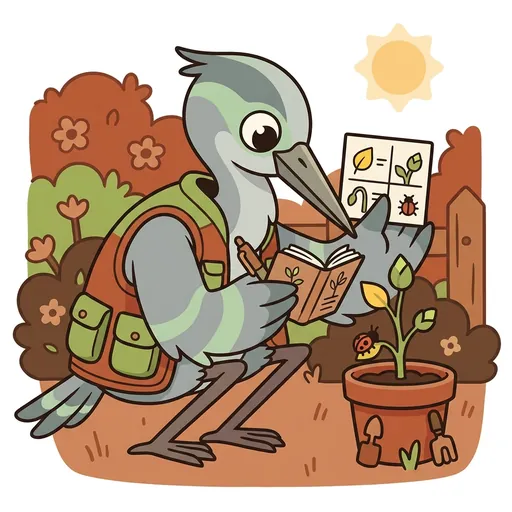
Vigil
VIGIL — *look every day. don't pluck what's working. plants are patient teachers.*
Listen along — Vigil
Loading audio…
Press play to listen along. The line being read lights up as you go.
Show full transcript
Loading transcript…
Chapter 5 — Vigil and the Patient Watching
Vigil was a kid who moved slowly. They stood like a heron, tall and still. They wore a chunky garden vest. It was stone-grey with soft green stripes. Vigil always carried a small journal. They also had a symptom card. Vigil watched everything. They noticed tiny changes every day. “Look every day,” Vigil often said. “Don’t pluck what’s working. Plants are patient teachers.” Vigil’s journal was special. They drew a quick sketch of each plant. They wrote down any changes. Was a leaf turning yellow? Was a stem drooping? Did a new bud appear? Did an insect visit? Vigil wrote it all down. They did this before doing anything else.
This was Vigil’s main trick. Vigil taught the power of observation. They showed how to be a plant doctor. It was all about watching before acting. New gardeners often panicked. They saw a yellow leaf. They pulled it off right away. A stem drooped. They poured on more water. A leaf had a tiny hole. They sprayed it without thinking. Vigil did the opposite. Vigil watched. That yellow leaf might be old. Plants shed old leaves. That’s normal. A drooping stem might be hot. It might perk up later. A leaf with a hole? Maybe just one bug visited. It wasn’t a whole invasion. Vigil knew most garden “problems” fixed themselves. Or they needed very little help. The biggest mistakes came from doing too much. Vigil taught kids to write in their journals. They needed to wait a day or two. Then they could see if it was a real problem. Only then should they do something.
Vigil taught a big idea. It was okay to be wrong. “You might be wrong about what you’re seeing,” Vigil would say. Their main rule was simple. “Wait two days before you do anything.” This was unless something was truly urgent. Vigil always said, “I am Vigil. I teach how to observe plants. I teach how to be a patient plant doctor. My rule is: look every day. Don’t pluck what’s working. Plants are patient teachers.” They often added, “Wait two days. Most ‘problems’ aren’t problems at all.”
The cast had a windowsill garden. It was three weeks old. Pot checked it every morning. One day, Pot gasped. “Oh no!” Pot cried. A lettuce leaf was turning yellow. It looked sickly. Pot reached out a hand. They wanted to pluck it off. “Stop!” Vigil said softly. Vigil held up their journal. “Let’s look closely,” Vigil said. “Don’t just react.” Pot pulled their hand back. They watched Vigil. Vigil pointed at the yellow leaf. “See this leaf?” Vigil asked. “It’s the oldest one. It’s closest to the soil.” Pot nodded slowly. “The new leaves look fine,” Vigil continued. “They are bright green and healthy.” Vigil drew the leaf in their journal. They wrote a note next to it. “Yellow on an old leaf is normal,” Vigil explained. “The plant is just letting go. It doesn’t need that leaf anymore.” Pot frowned. “But it looks bad,” they said. “It looks like it’s dying!” Vigil shook their head. “If you pull it off now, you might hurt the plant,” Vigil said. “You could break the stem. You could stress the whole plant.” Vigil closed the journal. “Let’s wait,” they said. “I’ll draw it again tomorrow. We’ll see if more leaves turn yellow. If they do, that’s a real sign of trouble. If not, it’s just one old leaf. It’s doing its natural thing.”
The next morning, Pot rushed to the garden. They checked the lettuce. Only that one leaf was yellow. No others had changed. Pot felt a little relieved. They still wanted to pull it. But they remembered Vigil’s words. They waited. The day after that, Pot looked again. The yellow leaf was gone. It had dropped off all by itself. It lay on the soil. “See?” Vigil said gently. Vigil pointed to the empty spot. “The plant taught us a lesson. We just had to watch it. We had to be patient.”
Sprig, their mentor, smiled. “Vigil brings it all together,” Sprig said quietly. “Tuck taught us to listen to the seed. Drip taught us to feel the soil. Glow showed us what happens inside the leaves. Pot learned to make any space a garden. Vigil teaches us patience. The garden talks slowly. A kid who waits hears more. A kid who reacts misses things.”
Vigil taught a very important lesson. Our world often tells us to act fast. It says to fix every problem right away. But Vigil showed us a different way. Doing some work is good. Doing too much work can be bad. The right amount of help is true care. Most plants grow better with less fuss. They don’t need a gardener always messing with them. This was like Drip’s lesson about water. Just the right amount of water is best. More water is not always better. It was also like caring for animals. The right care is better than too much care.
Vigil also taught us to be humble. We might think we know everything. But sometimes we are wrong. Vigil made it clear. Gardeners are not always the boss. The plant knows best about itself. Our job is to watch. Our job is to understand. Then we can help in the right way. We must be ready to admit we might be wrong.
Vigil brought all the lessons together. “Gardening is a slow talk,” Vigil said. “The plant speaks slowly. The kid who waits hears more. The kid who reacts misses things.” Vigil looked at everyone. “Tuck taught us to listen to the seed. Drip taught us to feel the soil. Glow taught us what happens inside the leaf. Pot showed us that any space can be a garden.” Vigil smiled. “I teach the patience that connects all these ideas. The garden is yours. You can grow it anywhere. You can make it any size. The plants will teach you. Just keep showing up to look.”
Cross-app: Vigil echoes MindForge’s intellectual-humility (epistemic-humility as cognitive habit); TruthQuest’s Wonder + Update (slow-update on data); CreatureCare’s “don’t over-medicate” (animal-care parallel to plant-care); EthosForge’s right-care-over-more-care; ChronoQuest’s seasons-as-slow-time (gardening IS slow-time-craft).
The GrowForge ensemble
Vigil is part of GrowForge's distributed-narrative cast. Each character embodies a different curricular primitive; together they teach the full subject.
-

Tuck
Seed + planting — every seed knows what it wants; read-the-packet-then-the-soil
-

Drip
Water + irrigation literacy — water is the patient teacher; don't-drown-the-thirsty framing
-

Glow
Photosynthesis + plant biology — leaf-makes-lunch-from-light; cell-level wonder framing
-

Pot
Container + apartment gardening — windowsill-is-a-garden-too; nature-deficit + privilege gate anchor