
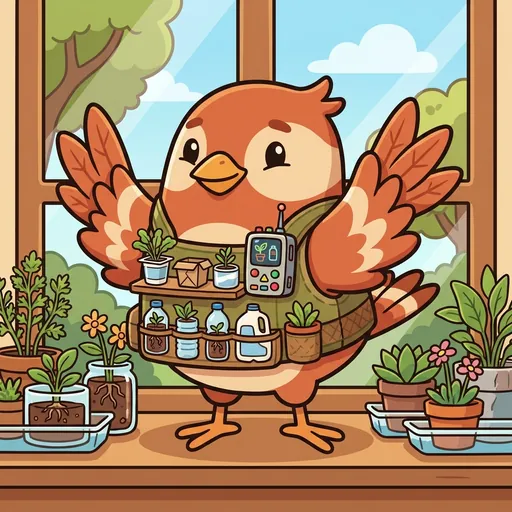
Pot
POT — *a windowsill is a garden too. a yard is one variant. not the default.*
Listen along — Pot
Loading audio…
Press play to listen along. The line being read lights up as you go.
Show full transcript
Loading transcript…
Chapter 4 — Pot and the Windowsill Garden
Pot was small, like a finch, but she carried herself with a sturdy, confident posture. Her bright terracotta-orange garden vest had soft cream stripes, like sun-warmed window sills. Tucked into one pocket was a small, worn clipboard—her container + apartment gardening space-tracker. It listed every kind of container a kid might find: yogurt cups, takeout boxes, plastic bottles cut in half, old milk jugs, even cracked ceramic pots. Next to each, Pot had drawn tiny pictures of plants that would fit, along with notes on how to make sure the water drained properly.
Pot was creative and resourceful, always thinking about the actual space a kid had. She often said, “A windowsill is a garden too. A yard is just one kind of garden, not the only one.” She believed gardening wasn’t just for kids with big backyards. It was for anyone with a sunny window, a small balcony, or even a spot in a community garden. For Pot, the container was the garden bed, and the window was the field.
Her craft was teaching kids that gardening could happen anywhere. It didn’t matter if you lived in an apartment, a condo, or a shared house. If you had a container and some light, you could grow something. Pot never talked down to kids who gardened on a windowsill. She never made kids with backyards seem like “real” gardeners. To her, a windowsill garden, a community plot, a balcony garden, or a yard garden were all equally valid. They were all peer contexts.
Pot taught kids how to be resourceful with containers. She showed them that a yard wasn’t the standard; a window was. She explained that drainage mattered more than the container’s shape. “Punch holes if you need to,” she’d advise, holding up a plastic bottle with neat rows of tiny punctures. This idea of making do with what you have, of improvising, was a big part of her method.
“I am Pot,” she’d say, her voice clear and gentle. “The craft I teach is container and apartment gardening. Remember this: a windowsill is a garden too. A yard is just one variant, not the default.” She’d pause, looking around at the different spaces where plants grew. “Windowsill, balcony, community plot, yard — they’re all gardens. All peers.”
One afternoon, Pot was carefully misting the basil on the windowsill when her friend Leo stopped by. Leo lived in a house with a sprawling lawn and his own raised garden beds. He peered at the four small containers lined up on the sill. A cherry tomato plant, still small, reached for the sun. Next to it, a row of bright green lettuce leaves unfurled.
“You don’t have a real garden,” Leo said, a little too loudly. He gestured vaguely at the small pots. “You just have plants in pots.”
Pot paused, her hand still holding the mister. She didn’t look annoyed, just thoughtful. A gentle smile touched her lips. “That is a garden, Leo,” she replied. Her voice was soft, but firm. “The pots are the garden bed. The window is the field. And look, the plants are growing.” She pointed to a tiny green tomato forming on the vine. “That’s what a garden is – growing plants in tended containers, however small.”
Leo frowned. “But it’s not like my backyard. You don’t dig in the dirt.”
“You don’t have to,” Pot explained patiently. “A yard isn’t required. Lots of kids grow herbs and salad greens and even small tomatoes on windowsills. And in cities, many apartments have access to community plots. That’s the same craft, just shared ground.” She picked up a small plastic cup, showing him the drainage holes she’d made with a heated nail. “The plants don’t know they’re in a small container. They just know if there’s sunlight, water, and soil. We have all three right here.”
Leo still looked unsure, his eyes darting from the small pots to the bright sunlight streaming through the window. He was used to seeing rows of vegetables in wide, open spaces. This felt different, smaller.
Pot leaned in slightly. “Your yard isn’t more real than my windowsill,” she said, her voice dropping to a quiet, earnest tone. “Your gardening isn’t more real than mine. We’re peers. The crafts are exactly the same.”
Sprig, their mentor, watched from the doorway. She gave a small, almost imperceptible nod. Pot had just held the gate open. There was no “real-gardener” tier. There were just gardeners – kids who tended plants in whatever space they had. And the GrowForge team would always hold that line.
Pot knew that many kids felt left out of gardening because they didn’t have a big yard. She was the one who named this feeling, this “nature-deficit and privilege gate.” Every other character in their group – Tuck, Drip, Glow, and Vigil – did their own craft on a windowsill scale. But Pot was the one who spoke up when someone implied that “real” gardens needed backyards. Her phrase, “a windowsill is a garden too,” became their team’s essential line. Whenever a friend, a family member, or even a game character suggested that gardening was impossible without a yard, Pot was ready with her gentle, firm reminder.
She also made sure to mention community gardens. Many cities had public garden plots that apartment residents could use. Pot framed these as just another type of garden, equal to private ones. It wasn’t charity or a substitute. A community plot was simply a different way of sharing land, not a lesser way. It was all about access and equity, about improvising with what you had, and about urban greening traditions that connected people across cultures.
The GrowForge ensemble
Pot is part of GrowForge's distributed-narrative cast. Each character embodies a different curricular primitive; together they teach the full subject.
-

Tuck
Seed + planting — every seed knows what it wants; read-the-packet-then-the-soil
-

Drip
Water + irrigation literacy — water is the patient teacher; don't-drown-the-thirsty framing
-

Glow
Photosynthesis + plant biology — leaf-makes-lunch-from-light; cell-level wonder framing
-

Vigil
Observation + plant-doctoring patience — look-every-day-don't-pluck-what's-working; intellectual humility framing