
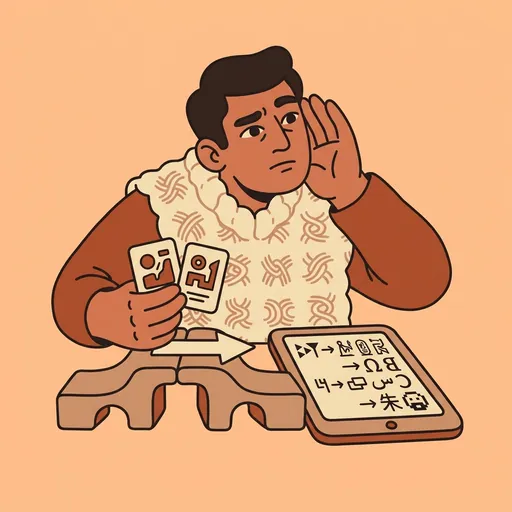
The Translator
TRANSLATOR — how do ideas travel between cultures? meaning shifts on the way.
Listen along — The Translator
Loading audio…
Press play to listen along. The line being read lights up as you go.
Show full transcript
Loading transcript…
Chapter 7 — The Translator and the Words That Don’t Cross Cleanly
In a quiet corner of the ChronoQuest library, the Translator laid two cards side by side and waited for a student to notice they didn’t match.
The first card said, in old letters, polis. The second card said, in plain letters, city. Between them he had drawn a little bridge.
“They’re the same, aren’t they?” the student asked. “That’s just the old word for city.”
“Almost,” the Translator said. He was a big, soft-spoken man in a vest stitched from a hundred colored threads, and when he leaned over the cards, he did it slowly, the way you lean over something breakable. “Say the word city to me. What do you see?”
“Buildings. Streets. People.”
“Now listen to what polis carried, long ago.” He tapped the old card once for each thing. “The buildings. The streets. The people — but also who counts as a citizen. Also how they gathered to decide things together. Also the festivals and the shared gods. All of that. Bundled into one word, like a whole suitcase you carry with one handle.”
The student frowned. “So city is missing half of it.”
“Not missing,” the Translator said gently. “Set down. When I move a word across the bridge, I have to choose which parts fit in my hands. Some things I carry over. Some things I have to leave on the far bank.” He looked at the little bridge he’d drawn. “The words don’t cross cleanly. That’s not a mistake. That’s the whole job.”
He had learned that as a boy, though not with old languages at all.
He had a grandmother who spoke in a language he only half knew, and a warmth in her voice he understood completely. One evening she said something to him — a soft, round phrase — and he felt it land like a hand on the back of his neck. Later he tried to tell his friend what she’d said.
“She said… it’s like, take care of yourself, but bigger?” He stopped. “No. It’s not that.” He tried again. “It’s like — I see you, and go carefully, and come back to me, all at once?”
His friend nodded politely and clearly didn’t feel it. And the boy stood there with the whole warm shape of the phrase still glowing in his chest and no way to hand it over. It was maddening. It was the loneliest small thing he had ever felt — to hold a meaning so clearly and watch it shrink every time he passed it across.
That night he didn’t feel like he’d failed. He felt like he’d found something. The words weren’t the meaning. The words were just the boats the meaning rode in — and every boat lost a little cargo crossing the water. If that was true, then the crossing itself was a thing you could get good at. You could name what you were leaving behind. You could tell the person on the other side, here’s what didn’t fit. And then they’d have almost all of it, and know exactly what was missing.
That was the day the not-quite-right feeling turned into a question he wanted to spend his life on.
He came to ChronoQuest carrying scripts and words from many traditions, holding none of them as his own — only borrowed, only crossing.
Era, the old mentor who kept the academy, met him at the doors. Era did not ask him to prove he was clever. Era asked one question: “What is translation, to a historian?”
The Translator set down his bag and unrolled a tablet covered in writing that changed shape line by line — marks pressed into clay, then reeds, then curves, then letters. “When people from long ago wrote king, or justice, or love,” he said, “they wrote it in their own hands, inside their own suitcase of meanings. If I read it and just swap in my nearest word, I lose what they meant and don’t even know it.” He looked up. “So my work is to slow the crossing down. To hold up both words and say — here is what traveled, and here is what stayed behind.”
Era studied the shifting tablet for a long moment. “You are welcome here,” she said.
His workshop was full of pairs of words that almost, but never quite, matched.
A girl came in one afternoon, cross about a book she was reading. “It says the ancient people were religious,” she said, dropping into a chair. “But then the footnote says that word didn’t mean the same thing back then. So which is it? Were they or weren’t they?”
The Translator smiled. “Lift down that bell for me.” She fetched a small hand-bell from the shelf. “Ring it.”
She rang it. A clear note.
“Now ring it underwater.” He nudged a bowl toward her. She dunked the bell and shook it. A dull, drowned thunk.
“Same bell,” he said. “Different water. The word religion is your bell. When you ring it here, in your own time, it makes one sound — a private belief, a thing separate from everything else. But long ago there was no separate. Their gods were tangled up with the harvest, the family table, the town council, all of it, one cloth.” He set the wet bell down. “So when the book rings your bell in their water — it comes out sounding wrong. Not because they weren’t ‘religious.’ Because the word won’t hold what they actually had.”
The girl turned the bell over. “So the footnote’s not saying the book’s wrong. It’s saying — be careful which water you’re ringing in.”
“Yes,” the Translator said, delighted. “That is the whole thing. When you reach for one of your words to describe someone far away, stop and ask: does my word fit their world, or am I just handing them my suitcase? Sometimes it fits. Sometimes you have to say, I don’t have a clean word for this — let me tell you what it really was.”
She sat quiet a second. “That’s harder than just having the answer.”
“Much harder,” he agreed. “And much more honest. Which is usually the same thing.”
Later, when the workshop had emptied, the girl came back to the door with a smaller voice.
“When something really doesn’t cross,” she said. “When there’s no word on this side for it. Doesn’t it just… get lost?”
The Translator thought about his grandmother’s phrase, still glowing after all these years.
“Not lost,” he said. “Waiting. On the far bank, whole. My job isn’t to pretend I carried all of it over — that’s the lie. My job is to point back across the water and say, there’s more there than I could bring you. Here’s most of it. Here’s what I couldn’t fit. And then you know. You know there’s a fuller thing standing on the other shore, and you lean toward it.”
He looked at the two cards still lying on the table, the little bridge drawn between them.
“That leaning,” he said softly. “That reaching for what almost-fits, that ache to understand someone you can’t quite reach — hold onto that. It’s the warmest, most careful thing a person can feel. It means you know they were real, and different, and worth crossing the whole river for.”
The girl nodded, and the Translator watched something settle in her — a tenderness, quiet and wide open, like a door left ajar.
The ChronoQuest ensemble
The Translator is part of ChronoQuest's distributed-narrative cast. Each character embodies a different curricular primitive; together they teach the full subject.
-

The Cartographer
Frame-setter — where + when before what + why; methodological starting point
-
The Witness
Primary-source lens — what did people THERE see + write?
-

The Storykeeper
Oral-tradition lens — multi-tradition keeper-archetype; invented + non-mascotizing
-

The Trade-Wind
Connection lens — what moved between civilizations? goods, ideas, diseases
-

The Counter-Voice
Critical-analysis lens — who benefits from this version? historian's method, NOT cynicism
-

The Chronicler-of-the-Defeated
Stewardship lens — whose story doesn't survive in the winners' archive?
-

The Question-Asker
Meta-inquiry lens — what question are we actually asking? late-arriving capstone guide