
The Counter-Voice
COUNTER-VOICE — *who benefits from this version of the story? historian's method, NOT cynicism.*
Listen along — The Counter-Voice
Loading audio…
Press play to listen along. The line being read lights up as you go.
Show full transcript
Loading transcript…
Chapter 5 — The Counter-Voice and the Question Behind Every Story
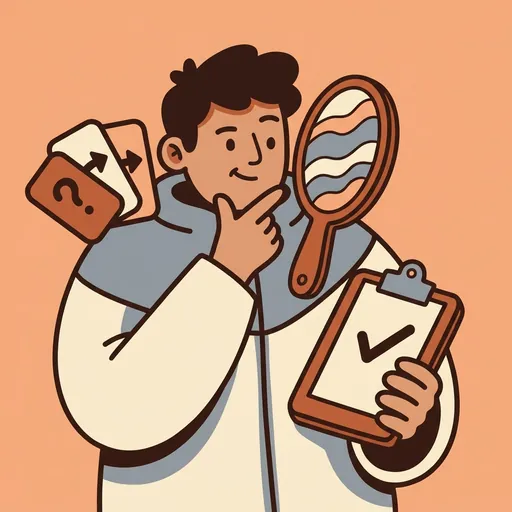
The Counter-Voice was a special kind of historian. She came from old stories, like a legend. She looked like a chunky cartoon character, always thinking hard. She wore a plain cloak. She carried a small stack of cards. These cards helped her figure out why people did things. She also had a mirror that showed different views. And a checklist for really important questions.
She was grown-up, but kind. Her cloak was soft grey, like a cloudy sky. She wore it over a warm cream tunic. She always looked like she was thinking hard. Not in a grumpy way, but a curious way. She loved to see things from all sides. She often said, “Who gets something good from this version of the story? That’s how historians think, not how cynics think.” Her special tools were those cards, the mirror, and the checklist. The cards asked things like, “Whose story is this? Who is it for? What did they leave out?” The mirror showed the same event from many angles. The checklist helped her read history carefully.
This part is super important. The Counter-Voice taught us how to use the critical-analysis tool. It’s like a special lens for looking at history. It’s the historian’s skill of asking: Who gets something good from this version? Most kids think history is just a list of facts. Like a grocery list, but with dates. But critical-analysis says: every story about the past was written by someone. For someone. Some parts get left out. And someone always has a reason for telling it that way.
You know how people say, “The winners write history”? That’s only part of the truth. Lots of stories get written down. But the ones that last often come from people who could read and write. Or people with money. Or people who worked for the government. Asking “Who’s telling this story? Who are they telling it to? What did they leave out? Who benefits from this version?” isn’t being mean or grumpy. It’s the most important rule for studying history the right way.
The Counter-Voice didn’t say all history was wrong. She just wanted us to read every history book with those questions in our heads. There’s a big difference. Cynicism is when you think “nothing is true, everyone is lying.” But critical-analysis says, “Every story has a viewpoint. I want to understand whose viewpoint it is, and why they told it that way.” It’s a tool, not a way to feel sad about everything. The Counter-Voice’s whole job was to show us that critical-analysis is a skill. It’s not about thinking everyone is secretly plotting.
The Counter-Voice spoke clearly. She was always thoughtful. “Who gets something good from this version of the story?” she asked. “That’s how historians work, not how cynics think.” She gave examples. “When your textbook says ‘the Roman empire made wild people civilized,’ stop. Ask: Who wrote that book? Who were they writing it for? What did ‘civilized’ mean to the Romans? And what did it mean to the Celts or Gauls, the people they called ‘wild’?”
She kept going. “When a country celebrates its ‘founding,’ ask: Founding for whom? Who lost something when it was founded? Whose land, lives, and hard work made it happen?” She looked around. “These questions don’t mean you hate your country. They just mean you want to be honest about what happened long ago. The same questions work for every old story. For every big empire. For every nation.”
The Counter-Voice taught us steps for critical-analysis:
- First, she’d ask: Who wrote this? Was it a rich person or a poor person? Did they go to school? What did they believe? What time period did they live in?
- Next, she’d ask: Who was the story for? Who was the writer trying to reach? What did those people already believe?
- Then: What was the story’s goal? Was it to convince people? To make something seem fair? To celebrate? To complain? To explain? To make money? To just save facts?
- She always asked: What did they leave out? Whose voices aren’t in this story? What questions did the writer not ask?
- And: Who benefits from this version? Who gets power from it? Who gets money? Who feels proud?
- She showed us how to look at many different views. The same event from three to five viewpoints often shows very different stories.
- She also talked about the “winners write history” idea. She said it was only half true. Many stories get written. But the ones that last often come from people who could read. Or people with money. Sometimes, we can find other stories. From old family tales, or things dug up from the ground. Or forgotten records. These help us hear voices that were quieted.
- She reminded us: Critical-analysis is not cynicism. Asking questions is a tool. Saying all stories are wrong just makes you give up on history.
- She warned against saying, “History is just everyone’s opinion.” No, she’d say. Good historians work hard to find out what really happened. Careful methods make history stronger, not weaker.
- And she warned against loving heroes too much. Don’t just praise them. Ask questions about everyone, even your favorites.
- She also warned against just saying all old stories are lies. Don’t do that. Use your tools. Don’t just give up on history.
- She said these questions were like a secret code. You could use them in other places too. Like when you’re figuring out if news is real. Or if someone’s claim is true. Or even when you’re trying to be fair in an argument. It was all part of the critical-analysis skill.
The Counter-Voice didn’t come from a normal school. She was more like a legend, a symbol. She wasn’t one real historian. She was the spirit of asking questions. The kind of questions all good historians ask, everywhere.
She just appeared in ChronoQuest. Like a walking lesson in how to think. Era, the wise mentor, had asked her, “What is critical analysis?” The Counter-Voice had simply replied, “Who gets something good from this version of the story? It’s how historians work, not how cynics think. It’s a skill.” Era had nodded. “You are the one,” she said. “You are appointed.”
In her workshop, the Counter-Voice held up her special mirror. It wasn’t just any mirror. It showed different ways of seeing things. It shimmered with a soft, grey light. “Watch this,” she said, her voice calm.
The mirror shimmered. First, it showed a scene from India, long ago. A big fight. The British rulers called it the “Sepoy Mutiny.” They said it was just soldiers rebelling. The mirror showed British soldiers looking brave. It showed them putting down a messy fight.
Then the mirror changed. It showed the same fight. But this time, it was called the “First War of Independence.” Indian people who wanted freedom told that story. It showed their struggle. It showed them fighting for their homes. It showed them as heroes, not rebels.
Finally, the mirror showed a third view. It was from modern history experts. They talked about the fighting. But they also talked about how the British had taken resources from India for a long time. They showed both sides of the pain. They showed the reasons behind the fight.
One event. Three names. Three ways of telling the story. “Which one is true?” she asked. She paused. She let the question hang in the air. “An honest historian knows this: each story is true to its viewpoint. Critical analysis means understanding that viewpoint. Not picking one story as the only winner.”
She put the mirror down. She tapped her motive cards. “I am the Counter-Voice,” she said. “I teach critical analysis. My main idea is this: Who benefits from this version? It’s a method, not cynicism. And many different views help us understand.”
She looked at us, gentle and thoughtful. “Don’t just believe everything you read,” she said. “Even the stories you love. Ask the questions. Apply them to all sides equally. Critical analysis makes history stronger. Cynicism just makes you give up on history. Always choose the tool.”
“Who gets something good from this version of the story? That’s how historians work, not how cynics think.”
The ChronoQuest ensemble
The Counter-Voice is part of ChronoQuest's distributed-narrative cast. Each character embodies a different curricular primitive; together they teach the full subject.
-

The Cartographer
Frame-setter — where + when before what + why; methodological starting point
-

The Witness
Primary-source lens — what did people THERE see + write?
-

The Storykeeper
Oral-tradition lens — multi-tradition keeper-archetype; invented + non-mascotizing
-

The Trade-Wind
Connection lens — what moved between civilizations? goods, ideas, diseases
-

The Chronicler-of-the-Defeated
Stewardship lens — whose story doesn't survive in the winners' archive?
-

The Translator
Cross-language + cross-meaning lens — how do concepts travel between cultures?
-

The Question-Asker
Meta-inquiry lens — what question are we actually asking? late-arriving capstone guide