The Question-Asker
QUESTION-ASKER — *what question are we actually asking? the question shapes the answer.*
Listen along — The Question-Asker
Loading audio…
Press play to listen along. The line being read lights up as you go.
Show full transcript
Loading transcript…
Chapter 8 — The Question-Asker and the Move Behind Every Move
In the map room of ChronoQuest, a girl was arguing with a wall.
The wall held a huge old painting of a city crumbling — towers cracking, roofs caving, a whole world sliding down into rubble. Under it, someone had painted big careful letters: WHY DID IT FALL?
The girl had a chart, three colored pens, and a scowl. She had been listing reasons for an hour. She was not happy.
“You look stuck,” said a calm voice behind her.
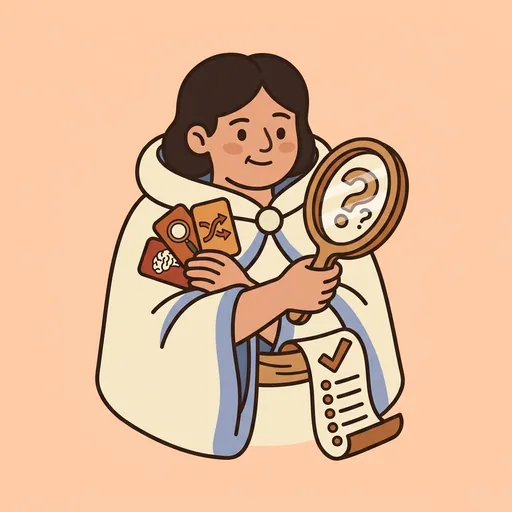
The Question-Asker had come in without a sound — a woman in a plain evening-blue cloak, holding a small stack of blank cards and a little round mirror. She didn’t look at the girl’s chart. She looked at the painting.
“I’m not stuck,” the girl said. “I’ve got eleven reasons. I just can’t decide which is the real one.”
“May I try something?” The Question-Asker took a card and, in front of the whole painting, wrote one word: FALL? Then she held her small mirror up so it caught the painted city — and the reflection, oddly, showed the edges of the picture the girl hadn’t been looking at. In the corner: people carrying baskets to a market. A child learning letters. A new roof going up on an old wall.
“You’ve spent an hour answering why it fell,” the Question-Asker said gently. “But look — half this painting is people building. So before you pick your reason…” She tapped the card. “Are we even asking the right question?”
The girl opened her mouth to argue. Then she looked at the market, and the child, and the new roof — and closed it again.
The Question-Asker had learned to distrust handed-down questions when she was young, and it had not felt clever at the time. It had felt like being cornered.
A teacher had once asked her class: “Who was the greatest hero of the old war?” Every child raised a hand and shouted a name. The Question-Asker — small then, and slow to speak — had felt something pinch in her chest, a tight uneasy knot, because none of the names felt right and she couldn’t say why.
When the shouting died down she said, very quietly, “But the question already decided there was a greatest one. And that it was one person. And that being greatest was the interesting thing.”
The room went silent. The teacher didn’t get angry. He sat on the edge of his desk for a long moment. Then he said, “Say more.”
“I mean —” she pushed on, heart thudding, “if you asked who suffered most, or who wanted the war to end, or what did the ordinary people do while the heroes fought — you’d get a whole different story. The question picked the answer before anyone even thought.”
She braced for a scolding. Instead the teacher wrote her three new questions on the board, under the first, and left them there all week.
That was the day the pinch in her chest turned into something else — not the fear of being cornered, but the thrill of finding the trapdoor out. The question isn’t the ceiling, she realized. It’s a door you’re allowed to open a different way.
She came to ChronoQuest last of all the guides, and on purpose.
She’d waited while the others taught first — the one who set the frame, the one who read old letters, the one who kept the spoken stories, the ones who traced trade and weighed a source and listened for the silenced. She’d waited because her craft only worked if you already had theirs. You can’t reframe a question well until you know how to chase an answer.
Era, the mentor, met her at the gate and asked just one thing. “What do you teach?”
The Question-Asker didn’t answer straight. She picked up a pebble, set it on the table between them, and asked, “What is this?”
“A stone,” said Era.
“That’s one question’s answer. Ask where has it been and it’s a traveler. Ask what could it become and it’s a tool, or a wall, or a spark. Ask who dropped it here and suddenly it’s part of somebody’s day, long ago.” She let the pebble sit. “I don’t hand out answers. I teach people to see the question standing behind the answer — and to ask a braver one.”
Era looked at the stone for a while. “You waited a long time to come here.”
“The best question comes last,” she said. “You need something to ask it about.”
“You’re appointed,” said Era.
Back at the crumbling-city painting, the girl still had her chart. But now she had the little mirror too.
“Try it on your list,” the Question-Asker said. “Read me your first reason.”
“‘The empire fell because its armies got weak.’”
“Good. Now — what does that question already assume?”
The girl frowned. “That… it fell. That falling is what happened.” Slowly: “But the market people. The new roof. Maybe some of it didn’t fall. Maybe it changed into something else and kept going.”
“So there’s a second question hiding behind the first.” The Question-Asker wrote it on a fresh card: Did it fall — or did it become something new? “Keep going. Who’s in your reasons?”
“Generals. Kings.” The girl’s pen slowed. ”…Nobody who carried a basket. Nobody who was a kid.”
“Then here’s a third.” Another card: What did ordinary people live through while all this was ‘falling’? She spread the three cards on the table like a hand of playing cards. “Same painting. Same year. Three questions — three completely different histories. And here’s the part that catches people: none of them is the fake one. They’re all real. They just look at different things.”
The girl stared at the three cards. “So how do I know which to ask?”
“That’s the honest work,” the Question-Asker said. “You ask why this question, and why now? Someone worried about armies asks about armies. Someone who’s ever gone hungry asks about the baskets. The question you choose says something about you — so choose it on purpose, not because it was handed to you.” She smiled. “But once you’ve chosen — you do the digging. You use everything the other guides taught you. A good question is a door, not a hammock. You don’t get to just lie in it.”
The girl laughed — surprised out of her scowl — and pulled a blank card toward herself. She sat there a moment, pen hovering, thinking hard.
Later, when the room was empty, the girl came back with one more thing to say.
“When I got here,” she said, “I thought being smart meant knowing the answer fastest. But you didn’t answer anything. You just kept… turning the question over.”
The Question-Asker nodded slowly. “How does it feel now — sitting with a question you haven’t answered yet?”
The girl considered. She’d expected to say frustrating. But it wasn’t that.
“Lighter,” she said, surprised. “Like the walls moved back. Like there’s more room in here.” She pressed a hand to her chest, over the spot where the old cornered feeling used to live. “It doesn’t pinch anymore. It kind of… opens.”
The Question-Asker watched the girl walk out into the evening, still holding her blank card, and felt the same quiet warmth she felt every time — the good ache of a door swinging wide.
The bravest thing isn’t answering fast, she thought. It’s daring to ask the question underneath — and feeling the room grow bigger when you do.
The ChronoQuest ensemble
The Question-Asker is part of ChronoQuest's distributed-narrative cast. Each character embodies a different curricular primitive; together they teach the full subject.
-

The Cartographer
Frame-setter — where + when before what + why; methodological starting point
-
The Witness
Primary-source lens — what did people THERE see + write?
-

The Storykeeper
Oral-tradition lens — multi-tradition keeper-archetype; invented + non-mascotizing
-

The Trade-Wind
Connection lens — what moved between civilizations? goods, ideas, diseases
-

The Counter-Voice
Critical-analysis lens — who benefits from this version? historian's method, NOT cynicism
-

The Chronicler-of-the-Defeated
Stewardship lens — whose story doesn't survive in the winners' archive?
-

The Translator
Cross-language + cross-meaning lens — how do concepts travel between cultures?