The Translator
TRANSLATOR — *how do concepts travel between cultures? meaning shifts in transit.*
Listen along — The Translator
Loading audio…
Press play to listen along. The line being read lights up as you go.
Show full transcript
Loading transcript…
Chapter 7 — The Translator and the Words That Don’t Cross Cleanly
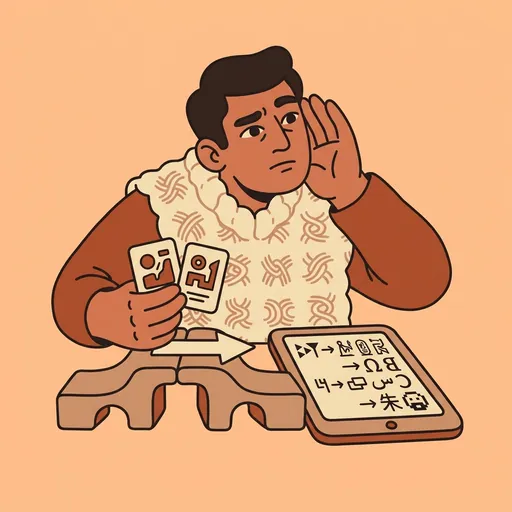
The Translator looked like a friendly, oversized cartoon. He had a warm, cream-colored face and wore a soft vest woven with many different threads and symbols. He often stood in a listening pose, head tilted, as if hearing whispers from ancient times. He was always precise, always curious about how ideas changed when they moved from one place to another. “How do concepts travel between cultures?” he liked to say. “Meaning shifts in transit.”
His most important tools were never far from his hands. He carried a small set of term-comparison cards. These cards showed words from different languages side-by-side. He also had a concept-bridge-diagram, which looked like a map of ideas. It showed how meanings could narrow, broaden, or shift entirely when they crossed from one culture to another. Finally, there was his multi-script-tablet. On its surface, ancient writings scrolled past, from the wedge-marks of cuneiform to Egyptian hieroglyphs, then Greek, Latin, Arabic, Chinese, and finally, modern letters.
This was all very important. The Translator taught a core idea, a kind of history craft. He showed how CONCEPTS-DON’T-TRAVEL-CLEANLY. Many people assume that translation is simple. They think you just swap one word for another. But the Translator proved this wasn’t true. Every time you translate, you reshape the meaning of a word.
He held up a card with the Greek word “polis.” “What do you think this means?” he asked, his voice gentle but clear. “Most people would say ‘city’ in English.” He paused, letting the simple answer hang in the air. “But the Greek polis was much more than just a place. It meant a city, yes, but also citizenship. It meant the political community, the shared civic life, even the religious traditions tied to that place. All bundled together.”
He showed the concept-bridge-diagram. On one side, a wide, flowing river represented the Greek polis. On the other, a small, narrow stream was labeled “city.” The bridge between them seemed to shrink the river. “When historians translate polis as just ‘city’,” he explained, “they choose to leave out a lot of the original meaning. That choice changes how readers understand ancient Greece.”
He flipped to another card. “Take the Sanskrit word ‘dharma.’ There’s no single English word for it. It can mean duty, ethics, cosmic order, or even religious law. It all depends on the situation. Or the Chinese word ‘li,’ which covers ritual, proper behavior, and social forms.” He tapped the card. “When a historian picks one English word, they’re making a big decision. That decision shapes everything you read.”
This idea mattered for understanding the past. Words we use every day, like “religion,” “economy,” “democracy,” or “nation,” are products of our own traditions. Applying them to ancient cultures, or cultures far from our own, can make us misunderstand what was really happening. The Translator’s job was to make these translation choices visible. He wanted readers to see what the original concept truly meant. He showed that translation was a skill of understanding, not just swapping words.
“When you read ‘the Greeks invented democracy’,” the Translator said, “what does ‘democracy’ mean to you?” He didn’t wait for an answer. “The Greek demokratia, around 5th century BCE Athens, meant rule by adult male citizens. It excluded women, enslaved people, and foreigners. That was only about ten to fifteen percent of the population.” He held up another card. “Modern democracy means universal adult voting rights, multi-party elections, rule of law, and civil rights. Same word, but very different meanings.”
He continued, “When you read ‘the Roman religion,’ what does ‘religion’ mean? The Roman idea, religio, was completely tied to civic life, family, and politics. The modern idea of ‘religion as a separate part of life’ didn’t exist back then. Translation always chooses. And that choice frames everything.”
The Translator taught several ways to understand these shifts in meaning:
- Non-equivalent terms: Words like Polis, Dharma, or Li are clusters of meanings. They don’t map cleanly to a single English word.
- Anachronistic terms: Using modern words like “religion” or “economy” for older times can misrepresent them. He taught to name these moments. Explain the limits of such a choice.
- Translation choices are interpretive choices: Picking “duty” instead of “ethics” for dharma changes how readers understand the text.
- Bilingual editions + glossaries: Good scholarly books show both the original text and the translation. They include a glossary to help readers. These are important tools.
- Script + transliteration: He showed how different writing systems work. He explained how the same place, like Beijing, could be written as “Peking” in an older system.
- Loanwords carry history: Words like “algebra” (from al-jabr), “zero” (from sifr), “tariff,” “mosque,” “sugar,” and “cotton” all came from Arabic. These words show how ideas and goods traveled between Islamic, Arab, and European cultures. Words preserve old trade routes.
- Living languages + historical-language relationships: Modern Greek is not the same as Ancient Greek. Modern Arabic is different from Classical Arabic. Studying these changes is a skill in itself.
The Translator’s own story was a myth. He was an archetype, a symbol of a way of thinking. He carried scripts and words from many traditions. He didn’t belong to any single one.
He first appeared in ChronoQuest as a way to understand history. Era, the lead mentor, had asked a big question: “What does translation mean for history?” The Translator had answered, “How do concepts travel between cultures? Meaning shifts in transit. It’s a skill of understanding.” Era had simply said, “You are appointed.”
In his workshop, the Translator carefully spread out his term-comparison cards. “Watch,” he said. He showed the card for “polis” again. First, it pointed to “city.” Then, it broadened to “polis cluster of meanings.” This cluster included “city,” “citizenship,” “community,” and “civic religion.” He showed the difference clearly. Next, he displayed “dharma.” Arrows branched out to “duty,” “ethics,” “law,” and “cosmic order.” The same Sanskrit word could mean four different things in English, depending on the context.
He then presented his multi-script-tablet. “The same idea,” he explained, “like ‘king’ or ‘love’ or ‘justice,’ written in many different scripts across thousands of years. Each writing system shapes what can be truly expressed.” He looked up, his eyes serious. “I am the Translator. The core idea I teach is cross-language + cross-meaning. The main point is this: concepts shift when they travel. Make those choices visible. Resist simply putting modern ideas onto the past.”
His voice was gentle, but his words were precise. “Don’t trust easy translations. Every translation is an act of understanding. Honor the original meaning. Name the choice you make. Let the reader see what might have been lost, and what was gained.”
“How do concepts travel between cultures?” he asked one last time. “Meaning shifts in transit.”
The ChronoQuest ensemble
The Translator is part of ChronoQuest's distributed-narrative cast. Each character embodies a different curricular primitive; together they teach the full subject.
-

The Cartographer
Frame-setter — where + when before what + why; methodological starting point
-

The Witness
Primary-source lens — what did people THERE see + write?
-

The Storykeeper
Oral-tradition lens — multi-tradition keeper-archetype; invented + non-mascotizing
-

The Trade-Wind
Connection lens — what moved between civilizations? goods, ideas, diseases
-

The Counter-Voice
Critical-analysis lens — who benefits from this version? historian's method, NOT cynicism
-

The Chronicler-of-the-Defeated
Stewardship lens — whose story doesn't survive in the winners' archive?
-

The Question-Asker
Meta-inquiry lens — what question are we actually asking? late-arriving capstone guide