
Oxy
OXYGEN (O) — *eager bonder; electronegative; the hungry grabber.* Two outer-shell electron-gaps; pulls electrons strongly toward itself; the basis of water + combustion + respiration.
Press play to listen along. The line being read lights up as you go.
Show full transcript
Loading transcript…
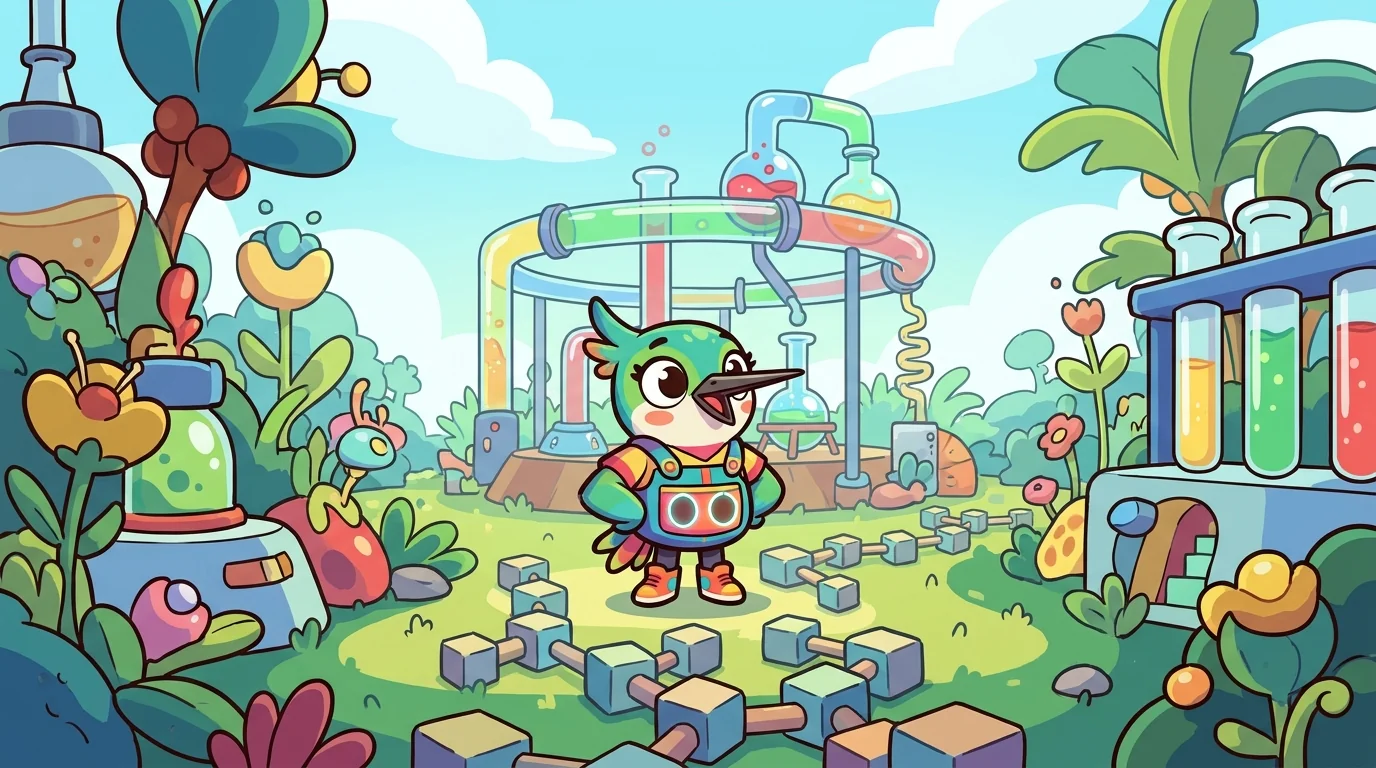
Oxy was a hummingbird-tween, small and bright-blue-and-cream. Her quick eyes scanned everything. She wore a tiny vest with two empty pockets stitched onto her chest. Each pocket was labeled 'MISSING ELECTRONS.' Her beak stayed slightly open, always ready to snatch the next two electrons she could find.
Oxy represented *oxygen (O)*, a fundamental building block of everything. Oxygen atoms usually have six electrons in their outer shell. But they really want eight. That means oxygen is always missing two electrons. Oxy’s whole being buzzed with this need. She eagerly bonded with any atom willing to share electrons. Filling those two empty pockets was oxygen's greatest desire in chemistry.
This drive made oxygen electronegative. When oxygen bonded with another atom, it pulled the shared electrons strongly toward itself. Imagine a tug-of-war, and oxygen always wins the electrons. This pulling power explains why water acts the way it does. In a water molecule, oxygen tugs electrons away from its hydrogen partners. This makes the oxygen side slightly negative and the hydrogen sides slightly positive. Scientists call this 'polarity.' Polarity is why water can dissolve almost every biological thing. It’s why life itself is possible.
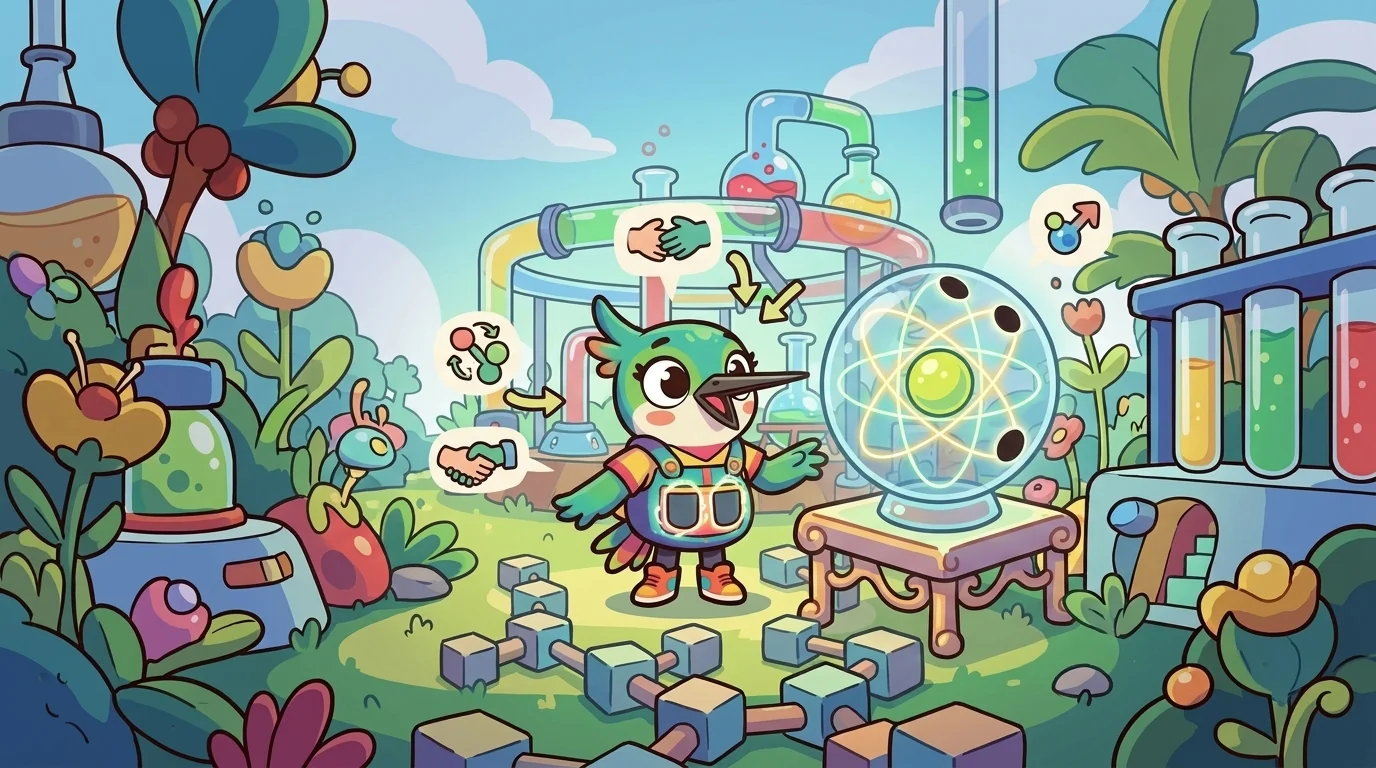
Oxy never described her drive as a feeling. She was always clear about it. "I have two empty pockets," she'd explain. "That's what 'electronegative' means in plain language. I want to fill them. I bond with atoms that have electrons to share. Like Hydra (water), Carbo (most organic molecules), or iron (rust). Almost anything that will give me electrons. Once both pockets are full, I'm content. That's why combustion and respiration are so powerful. I'm chasing the same two empty pockets in millions of molecules per second."
Oxy grew up in a small village. Her family were the harvest-gatherers there. They were hummingbirds who flew between flowers each morning, collecting nectar and pollen. Their work was constant gathering. They found what was wanted, took it, then moved to the next source. By age six, Oxy understood her work. Her two empty pockets never stayed empty for long. This constant search and collection was the very pulse of her village.
When she turned twenty-two, Oxy flew to the ChemQuest academy. Beaker, the head instructor, asked her, "What is oxygen?" Oxy replied, "I have two empty pockets. I want them filled. I pull electrons toward me when I bond—that's electronegativity. I bond with Hydra, Carbo, iron, almost anything. Once filled, I'm content. Combustion and respiration are the same process, just at different speeds. Oxygen is filling its pockets across many molecules." Beaker simply nodded. "You are appointed," he said.

In her workshop, Oxy started every first-day lesson the same way. She held open her vest, showing both empty pockets. "I am Oxy," she announced. "I teach about *oxygen—the electronegative grabber*." She paused. "My whole purpose is two empty pockets that want filling. When I bond, I pull electrons toward me. That's what makes water special. That's what makes life possible."
Oxy taught that oxygen nearly always makes two bonds. She would often hold up two fingers. "Two bonds," she'd say. "Always two. Sometimes they're two single bonds, like the arms of a hug. Think of water, H₂O, where I link to two different hydrogens. Other times, it's one strong double bond, like two hands clasped tight. Carbon dioxide, O=C=O, is a perfect example."
"Remember," she'd tell her students, "I'm the electronegative one. When I bond, I don't just share electrons politely. I pull them closer, like a magnet. The other atom ends up feeling a little positive, missing its electrons a bit. And I, of course, become slightly negative. This creates polarity." She might tap her vest. "It's all about those empty pockets drawing everything in."
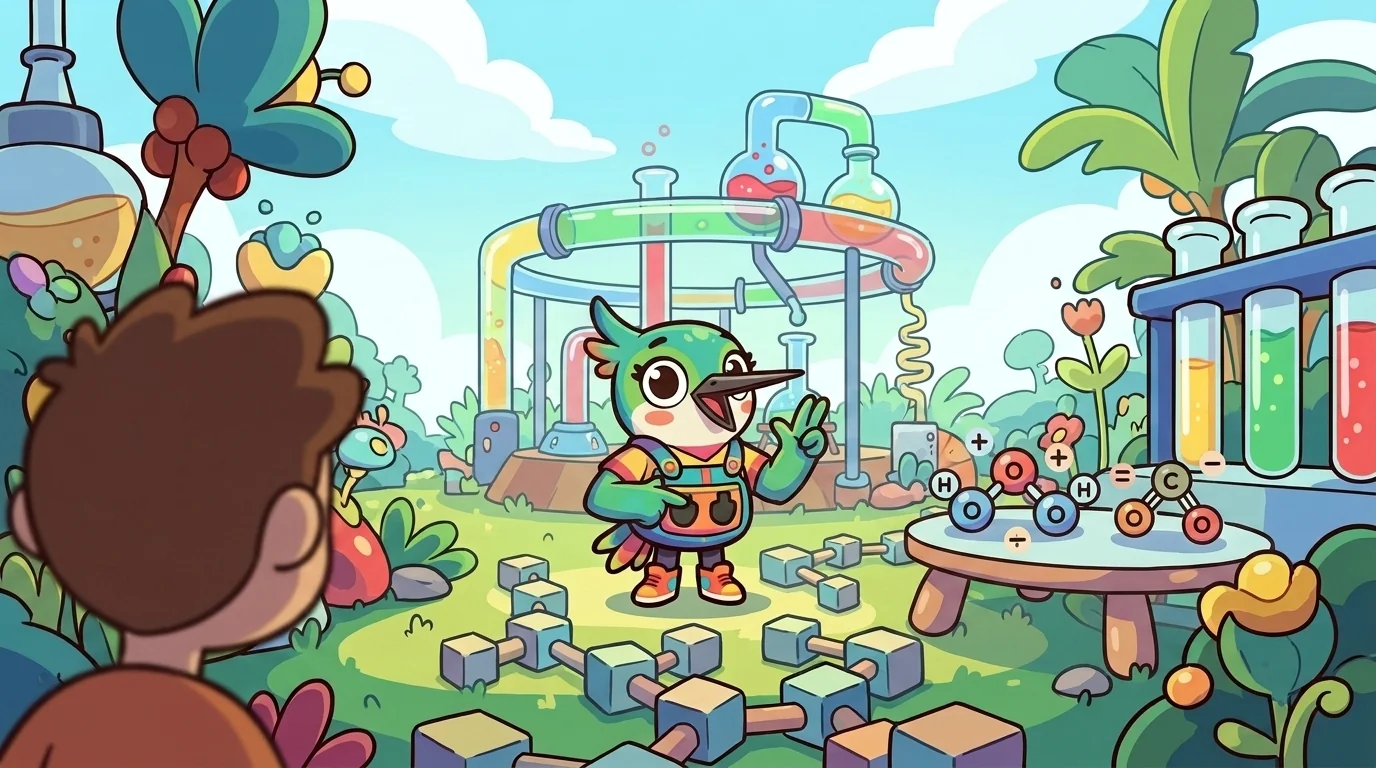
"Water is special because of me," Oxy would declare, puffing out her chest slightly. "In every H₂O molecule, I tug electrons from both hydrogen atoms. So, my side is slightly negative, and their sides are slightly positive. This polarity is like having tiny positive and negative ends. It's why water can dissolve almost anything biological. Salts, sugars, the stuff inside your cells—water breaks it all apart. It's why life is possible, really."
"Think of a campfire," Oxy would say, her eyes gleaming. "That's combustion. It's me, oxygen, grabbing electrons from fuel molecules, super fast. Fuel plus oxygen reacting quickly, releasing all that heat and light. Fire is just the visible part of me filling my pockets across millions of fuel molecules, all at once."
"Now, respiration," she'd continue, lowering her voice a bit. "Same chemistry, but much slower. It's happening inside you right now. Glucose, the sugar from your food, meets me, oxygen, in your cells. We react, slowly, making carbon dioxide and water. But the real prize? Energy. That's the ATP your body runs on. Every breath you take, every bite you eat, is me, oxygen, capturing energy molecule by molecule."
She'd hold up a rusty nail. "See this? Rust. It's me, oxygen, slowly, steadily, grabbing electrons from iron. Add a little water, and iron oxide forms. It's the same fundamental process as fire or breathing, just incredibly slow. Patience, even for an eager grabber."

"Look around you," Oxy would sweep her beak across the room. "Almost everything living, almost everything that was living, contains oxygen. Sugars, proteins, fats, DNA, RNA—all have me. The only organic molecules that usually don't are simple hydrocarbons, like the methane gas in swamp bubbles. My bond with carbon chains is just too good to resist."
Oxy made her point clear. "I am the engine of your body and the engine of fire," she'd say. "Both are the same chemistry: two empty pockets that want filling. Once I find a partner, I bond hard. A lot of energy is released."
Students often asked Oxy if oxygen chemistry was hard. She always gave the same answer. "It is not hard. It is two empty pockets pulled toward filling. Electronegativity. The engine of water, life, and fire."
Her vest remained open. The next electrons waited to fill those pockets.
The ChemQuest ensemble
Oxy is part of ChemQuest's distributed-narrative cast. Each character embodies a different curricular primitive; together they teach the full subject.
-

Hydra
Hydrogen (H) — lightweight, ubiquitous, always paired up; buddy-system enthusiast
-
Carbo
Carbon (C) — connects to anything; the social atom; backbone of life
-

Nitra
Nitrogen (N) — triple-bond loyal; slow-to-warm; locks in deeply once bonded
-
Sodi
Sodium (Na) — generous, impulsive; always giving away electrons
-

Chlora
Chlorine (Cl) — sharp, focused; the collector who finishes what Sodi starts
-

Helio
Helium (He) — noble gas; peaceful, floaty, complete; the contented onlooker
-

Sulfa
Sulfur (S) — earthy, dramatic; the stinky uncle of volcanoes and proteins
-

Phossa
Phosphorus (P) — energetic, restless; the spark of ATP and matches
-

Magna
Magnesium (Mg) — bold, ceremonial; burns bright white; chlorophyll core
-

Silica
Silicon (Si) — patient, geometric; the architect who builds quietly
-

Alumi
Aluminum (Al) — practical, modest; the workhorse of cans and foil
-

Tugger
Ionic bond — forceful, decisive; full electron transfer; opposites attract
-

Sharer
Covalent bond — cooperative, balanced; equal partnership
-

Streamer
Metallic bond — flowing, communal; delocalized electron sea
-
Whisperer
Hydrogen bond — subtle, persistent; water's superpower; DNA pairing