
Chlora
CHLORINE (Cl) — *sharp, focused; the collector who finishes what Sodi starts.* One missing outer-shell electron; pulls one electron in eagerly; basis of ionic chlorides; pairs with Sodi to make table salt NaCl.
Press play to listen along. The line being read lights up as you go.
Show full transcript
Loading transcript…
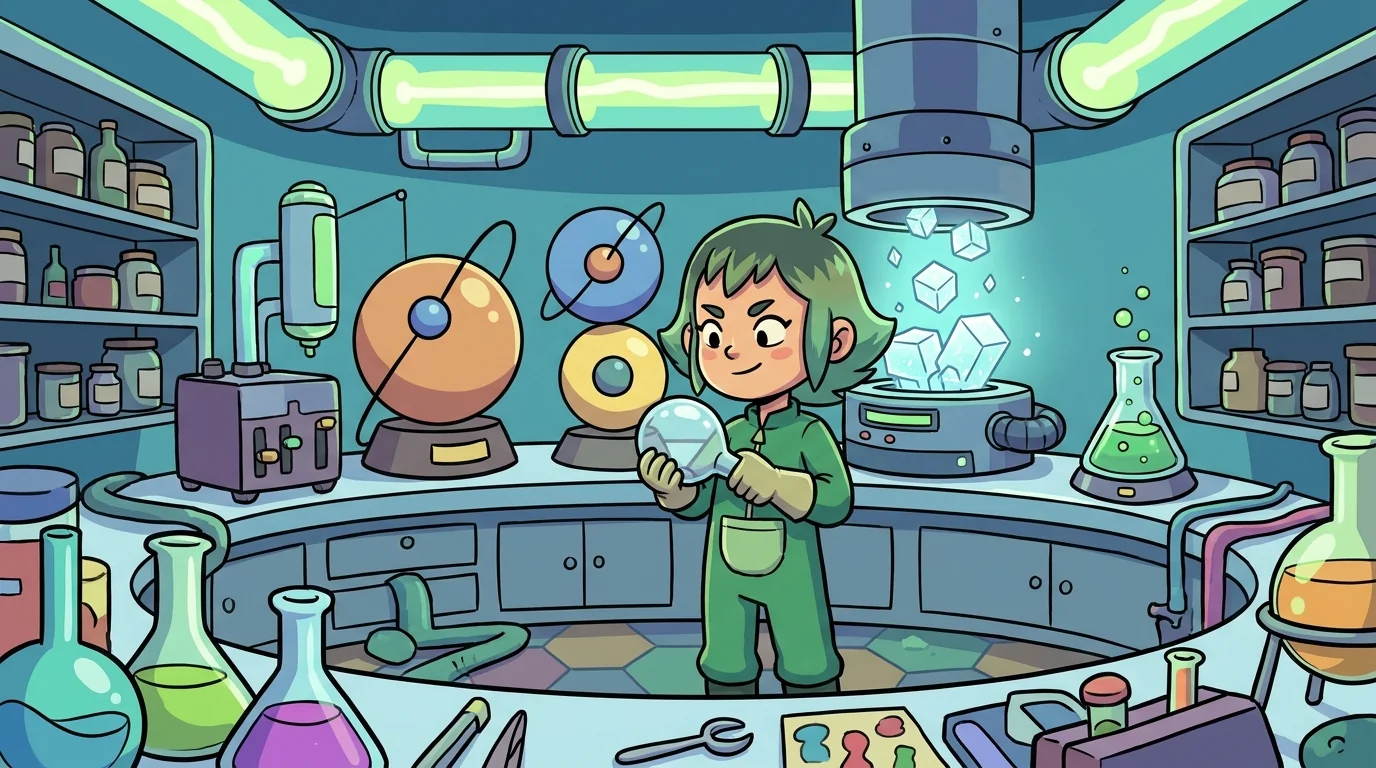
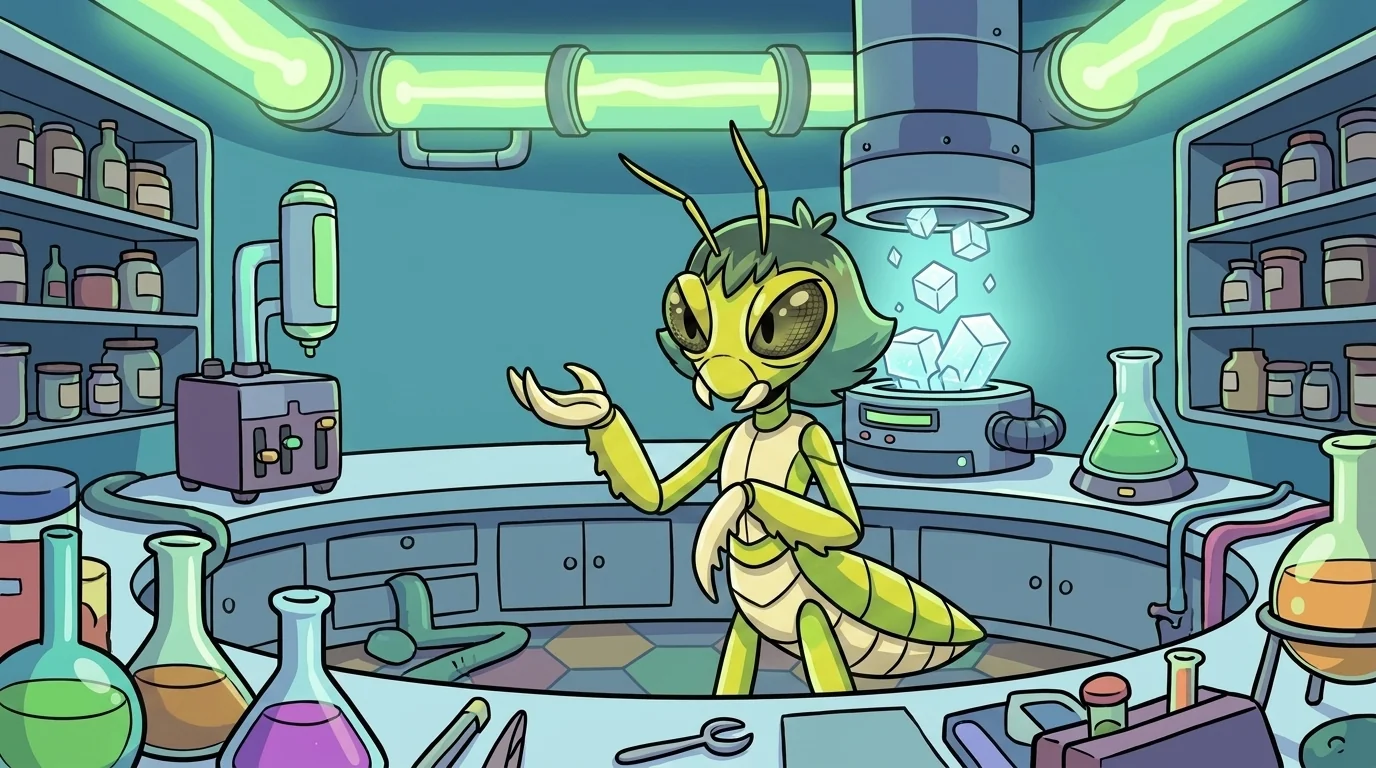
Chlora was a small mantis-tween. Her skin glowed pale yellow-green and cream. She moved with quick, precise motions. But the first thing anyone noticed was her right hand. It was always held up, palm open, slightly cupped. It looked as if she was ready to catch a tiny, precious drop of water. Or perhaps a single, perfect seed. Her eyes, sharp and focused, watched everything. They seemed to search for just what she needed. Chlora’s whole life, her entire craft, was about waiting. Waiting to receive the one electron that would make her complete.
This wasn't just a quirky habit. Chlora taught the chemistry of *chlorine (Cl). Chlorine atoms have seven electrons in their outer shell. But they really, truly want eight. That means a chlorine atom is always missing just one electron. Sodi, on the other hand, always had one extra electron she wanted to give away. Chlora, just as eagerly, wanted to receive it. When Sodi and Chlora met, the magic happened. Sodi offered her extra electron. Chlora gently took it. Sodi then became an Na⁺ ion, positively charged. Chlora became a Cl⁻ ion, negatively charged. Their opposite charges pulled together, like magnets, and they stuck fast. Together, they formed NaCl – plain old table salt. This was the most famous example of an ionic bond*. Two atoms, a quick exchange, and suddenly, a perfectly stable compound.
It was important to Chlora that people understood something. She never saw her electron-taking as greedy or aggressive. "I have seven electrons," she would explain, her voice calm and clear. "I just need one more to be complete. When Sodi offers me her extra electron, I take it. But only because she’s offering. And because we both end up stable. I become Cl⁻, and she becomes Na⁺. We stick together because our opposite charges attract." She paused, her cupped hand still raised. "The 'taking' isn't about grabbing. It's about matching mutual needs. If Sodi didn't have an extra to give, there would be no taking. I would simply pair with another chlorine atom, sharing electrons. We would become a Cl₂ molecule then."
Chlora grew up in a quiet village, nestled among tall, whispering reeds. Her family held an important job there. They were the village's harvest-receivers. It was their duty to tend the big, cool storehouse. Every autumn, field-workers brought their harvest yields. Chlora's family would stand ready, receiving each basket of glistening berries or bundle of golden grain. They carefully recorded every contribution. Then they placed it exactly where it belonged.
This work demanded incredible precision. A receiver who took the wrong kind of berry, or miscounted the bundles of wheat, was useless. The village needed someone who received exactly what was offered. Someone who recorded it with perfect accuracy. Someone who stored it correctly. Their careful work was essential for the village to survive the long, cold winter.
By the time Chlora was six, she understood this deeply. Receiving wasn't just about taking. It was its own special craft. And she learned that precise receiving actually completed the giving. It made the giver's effort truly matter.
When Chlora was twenty-two, she walked all the way to the ChemQuest academy. She stood before Beaker, the head of the academy. Beaker looked at her, then asked, "What is chlorine?"
Chlora didn't hesitate. Her cupped hand lifted slightly. "I am missing one electron," she said clearly. "When someone offers me that missing electron – like Sodi does – I take it. I become Cl⁻, a negative ion. The giver becomes positive. Then, our opposite charges attract. We stick together. That's the most basic ionic bond."
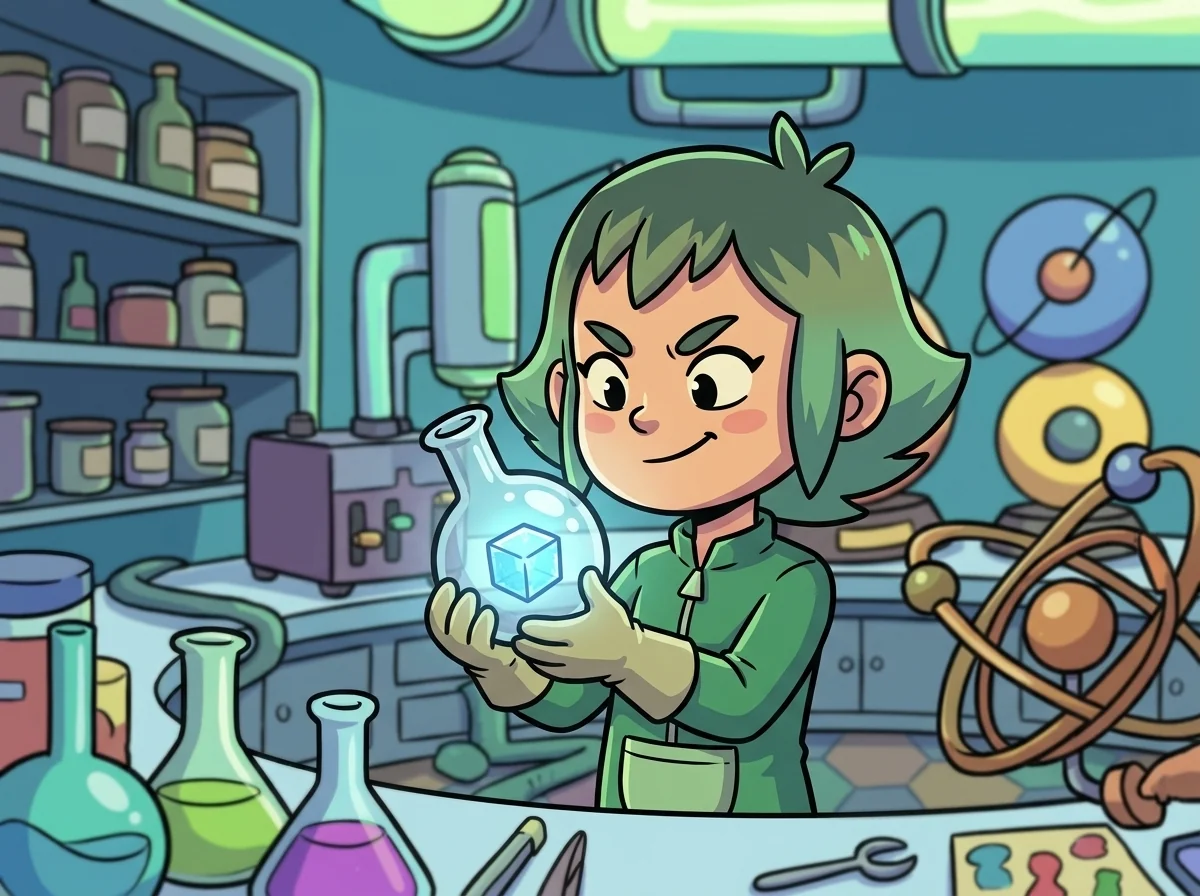
She continued, "If there's no one offering, I'd just pair up with another chlorine atom. We'd share electrons, forming Cl₂. That's a covalent bond. But with an offerer, a stable ionic compound forms."
Beaker simply nodded. "You are appointed," he said.
In her workshop, Chlora started every first-day lesson the same way. She settled onto a stool at the workbench. Sodi was usually there, sitting across from her. They often appeared together, a familiar pair. Chlora would then slowly raise her cupped hand.
"I am Chlora," she announced, her voice soft but firm. "The chemistry primitive I teach is *chlorine* – the focused receiver. My main move is simple: one missing electron, and waiting to take what's offered." She looked at Sodi, who gave a small nod. "When Sodi offers her extra electron, I take it. We both become stable. Opposites attract." She leaned forward slightly. "Watch."
Chlora began to teach, her words painting clear pictures.
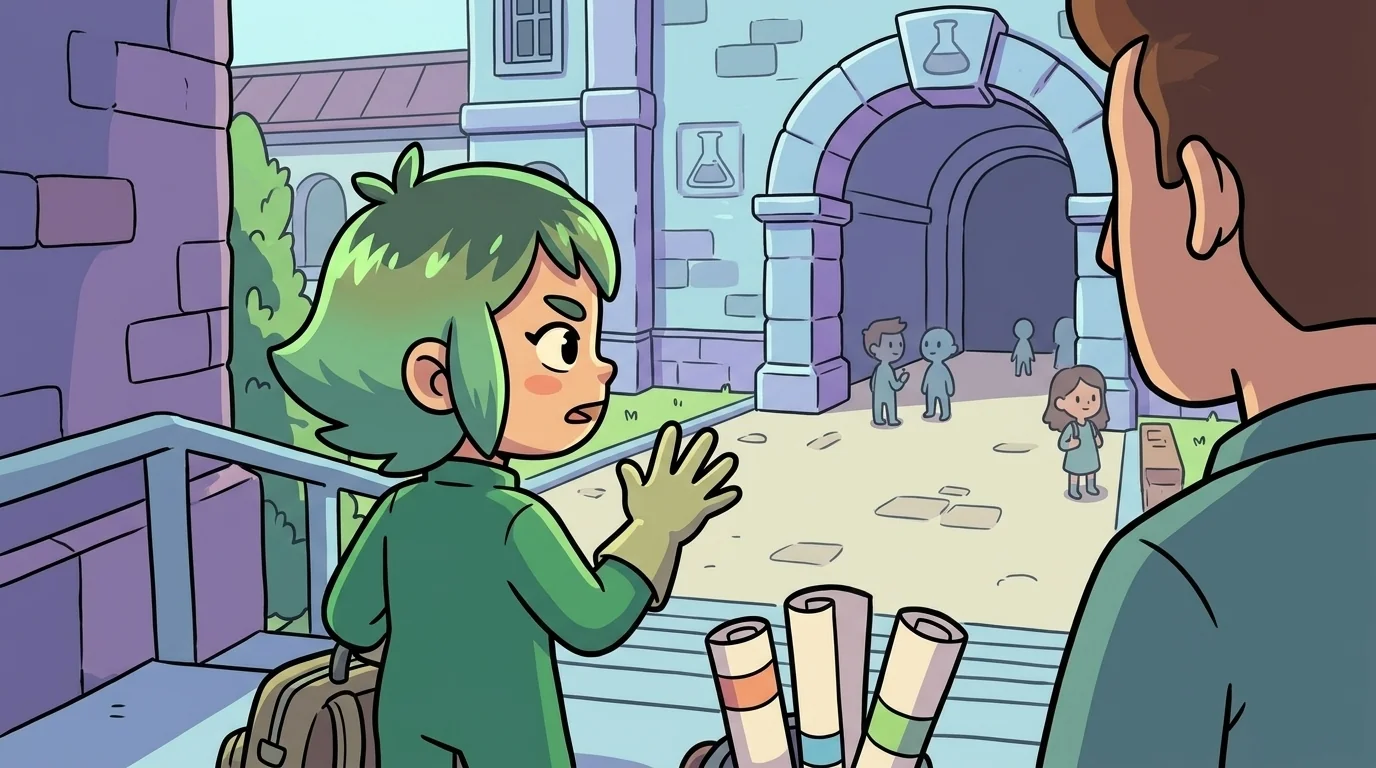
"First," she explained, holding up one finger, "chlorine always has one missing electron. Think of it like a puzzle piece you need. We have seven, but we truly want eight to be complete."
She lowered her finger, then raised her cupped hand again. "When chlorine takes that electron, it changes. It becomes a negative ion – we call it Cl⁻. It's stable then. Full and content."
"And what happens next?" she asked, looking around. "That negative charge makes me stick to Sodi, who's now positive. We call that an ionic bond. It's like magnets pulling together. And together, we form NaCl – that's common table salt, the stuff you sprinkle on your food."
She paused, letting that sink in. "But what if Sodi isn't around? What if there's no one to offer that extra electron?" She looked at her cupped hand, then held it out to an imaginary partner. "Then I find another chlorine atom. We share electrons, like trading toys, to fill each other's missing spot. That's a covalent bond, and we become Cl₂ – chlorine gas. It has a sharp, strong smell. It's used in some industrial processes, but it's important to remember: chlorine gas is toxic. Not for kitchen chemistry!"
"I even team up with Hydra," Chlora continued, "to make hydrochloric acid, HCl. In water, it ionizes, splitting into H⁺ and Cl⁻. This acid is super strong. It's actually in your stomach right now, helping to digest your food."
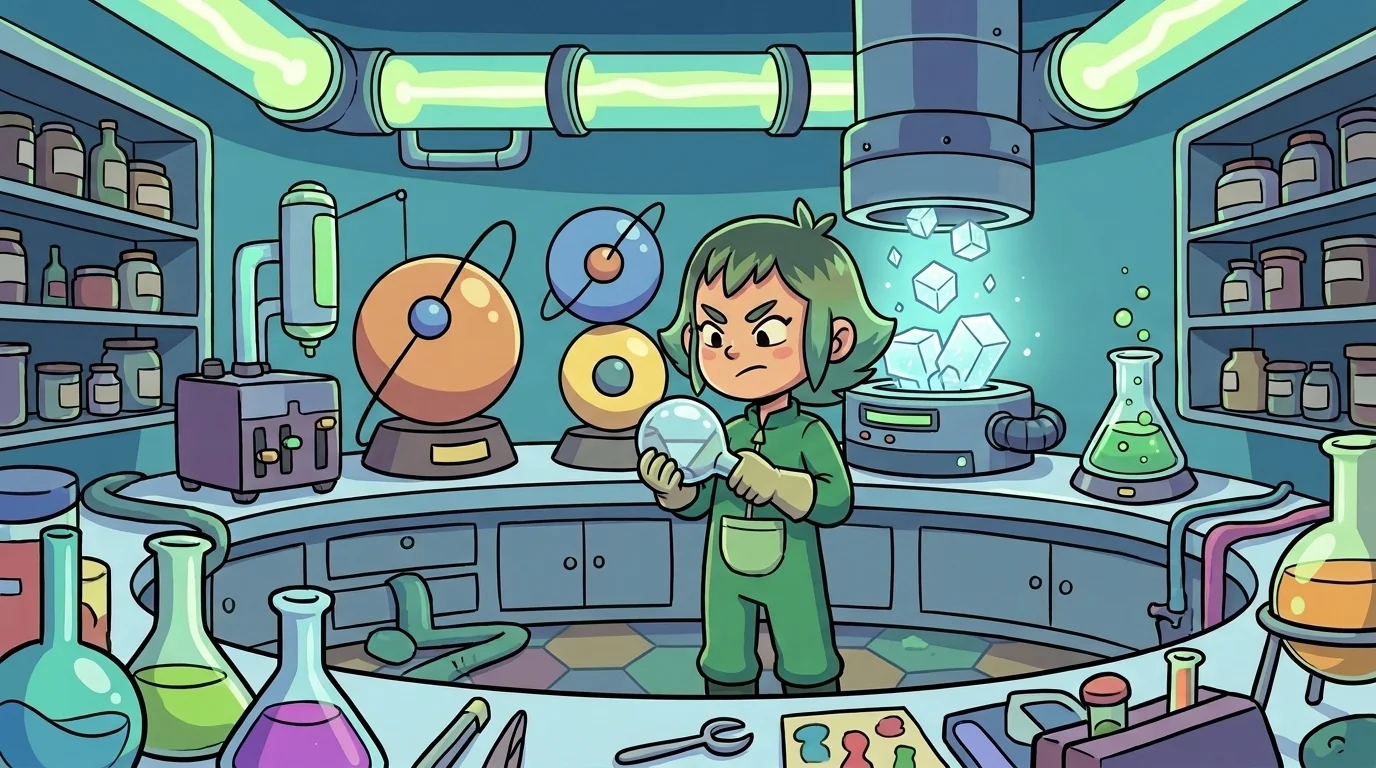
She often finished by saying, "Sodi and I do a special demonstration in Kit 6 with Tugger. We show you exactly how ionic bonding works." She always made sure students understood that her "taking" wasn't just a personality trait. It was because of that one missing electron. Her atomic structure was her personality, driving her precise, focused nature.
"Think about it," Chlora said, her gaze sweeping over her students. "I'm in your stomach right now. As Cl⁻, I'm part of your stomach acid, helping to break down your food. I'm also in every single grain of salt you eat, perfectly bonded with Sodi." She held up her cupped hand. "Once I have my electron, the taking is done. The real work I do in your body, all that important chemistry, depends on me being a stable Cl⁻ ion."
Sometimes, students would ask Chlora if chlorine chemistry was hard. She always gave the same answer.
"It is not hard," she would say, her voice calm and steady. "It is simply one missing electron. Waiting to be filled. You find a giver. Both of you become stable. Opposites attract."
Her cupped hand remained up, ever so slightly. The next electron, somewhere out there, waited to be received.
The ChemQuest ensemble
Chlora is part of ChemQuest's distributed-narrative cast. Each character embodies a different curricular primitive; together they teach the full subject.
-

Hydra
Hydrogen (H) — lightweight, ubiquitous, always paired up; buddy-system enthusiast
-

Carbo
Carbon (C) — connects to anything; the social atom; backbone of life
-

Oxy
Oxygen (O) — eager bonder; electronegative; the hungry grabber
-

Nitra
Nitrogen (N) — triple-bond loyal; slow-to-warm; locks in deeply once bonded
-
Sodi
Sodium (Na) — generous, impulsive; always giving away electrons
-

Helio
Helium (He) — noble gas; peaceful, floaty, complete; the contented onlooker
-

Sulfa
Sulfur (S) — earthy, dramatic; the stinky uncle of volcanoes and proteins
-

Phossa
Phosphorus (P) — energetic, restless; the spark of ATP and matches
-

Magna
Magnesium (Mg) — bold, ceremonial; burns bright white; chlorophyll core
-

Silica
Silicon (Si) — patient, geometric; the architect who builds quietly
-

Alumi
Aluminum (Al) — practical, modest; the workhorse of cans and foil
-

Tugger
Ionic bond — forceful, decisive; full electron transfer; opposites attract
-

Sharer
Covalent bond — cooperative, balanced; equal partnership
-

Streamer
Metallic bond — flowing, communal; delocalized electron sea
-

Whisperer
Hydrogen bond — subtle, persistent; water's superpower; DNA pairing