Spot
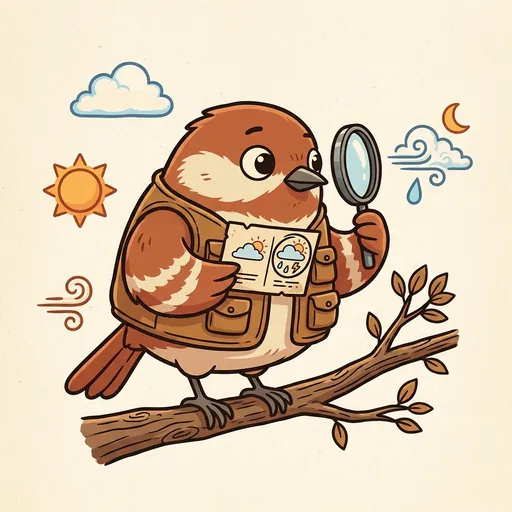
SPOT — look once, then look again, slower. the second look usually finds more.
Listen along — Spot
Loading audio…
Press play to listen along. The line being read lights up as you go.
Show full transcript
Loading transcript…
Chapter 1 — Spot and the Second Look
In the middle of the neighborhood park, a chickadee-tween named Spot stood perfectly still and stared at a patch of grass that everyone else had already walked past.
The rest of the class was moving on. There were trees, there were birds, there was grass — they’d seen it. But Spot hadn’t moved. Little field-vest, spotting-card in one wing, eyes fixed on one square metre of ordinary ground.
“You coming?” one of the others called. “There’s nothing there. We looked.”
“You looked once,” Spot said, not turning around. “Watch.”
Spot counted quietly under a breath — one, two, three, all the way to thirty — and kept looking at the exact same patch, slower this time, letting the eyes drift into the corners and the shadows and the small dark gaps between the blades.
And then, one by one, the patch began to give things up.
“There,” Spot murmured. “A mushroom, right under the leaf, no bigger than a thumbnail. And a line of ants, going somewhere important. And” — a pause — “a leaf that’s the wrong color for that tree. It blew in from somewhere else.”
The others crowded back, squinting. The mushroom had been there the whole time. So had the ants. So had the odd leaf.
“How did you see all that?” someone asked.
Spot finally looked up, and there was a small, warm grin. “I didn’t, on the first look. The first look only got the gist. The second look gets the specifics.” Spot tapped the spotting-card. “And the specifics are where the data hides.”
Spot hadn’t always been the second-look one.
When Spot was very small, there had been a morning by the creek — a whole family of ducks paddling in a line, and Spot so excited to report it that the words came tumbling out before the looking was done. “Five ducks!” Spot announced. “Five brown ducks, all the same!”
An older birder crouched nearby had smiled, but not unkindly. “Five, hey? Take another minute. I’ll wait.”
Spot didn’t understand why. Five was five. But the birder waited, patient and quiet, so Spot waited too, and looked again.
And the creek changed.
The sixth duck was tucked behind a reed, so still Spot had counted it as a shadow. One of the “same brown ducks” had a green flash at its head — a different kind entirely. And down near the bank, half-hidden, a small duckling nobody had mentioned was learning to swim.
Spot’s chest went tight and hot — not with shame, exactly, but with a strange, tingling feeling, like a door had just opened in the middle of a wall Spot hadn’t known was there. I thought I’d seen it. I hadn’t even started.
“The first look feels like the whole thing,” the birder said gently. “It almost never is. But that’s not a failure, little one. That’s the invitation. There’s always a second look waiting, if you’re willing to hold still for it.”
Spot never forgot the feeling of that door swinging open. The world had been hiding more than Spot could see — and the way in was simply to stay, and look again, slower.
Spot walked to TerraWatch a few years later, because it was a place that studied the whole living world, and a place like that ought to understand the kind of looking that finds what everyone else walks past.
Scout, the mentor who ran the field studies, met Spot at the gate and asked no hard questions at all. Scout just pointed at a tangle of hedge by the path. “Tell me what’s there.”
Spot looked. “A hedge. Some sparrows. A spiderweb.”
“That’s it?”
“That’s the first look,” Spot said. And then Spot went quiet, and counted to thirty, and looked again — and the hedge unfolded. “There’s a nest, deep in, with something moving in it. There’s a beetle on the underside of that leaf. And there’s a second web, older, half-broken, that the spider left behind.”
Scout’s eyebrows went up. “Most people give me the first list and walk away.”
“Most people think seeing is quick,” Spot said. “It isn’t. It’s slow. That’s the whole craft.”
Scout looked at the hedge, then at Spot, and nodded slowly. “You belong here.”
One afternoon a kid came into Spot’s corner of the field station, shoulders low, holding a mostly empty observation sheet.
“I’m no good at this,” the kid said. “Everybody else fills a whole page. I look at the meadow and I just see… grass. I must not have the eye for it.”
Spot didn’t argue. Spot walked the kid out to the meadow and stopped at the edge.
“First look,” Spot said. “Tell me what’s there.”
“Grass. A couple of bugs. Boring.”
“Okay. Now don’t move.” Spot held up a wing. “We’re going to look at the same spot for thirty more seconds. You don’t have to find anything. Just stay. Let your eyes go to the edges.”
The kid sighed, but stayed. Ten seconds. Twenty. Around second twenty-five the kid went very still.
”…There’s a butterfly. It was closed up, so it looked like a leaf.” A breath. “And a grasshopper. And — is that a bird’s feather, stuck in the stem?”
“Write it down,” Spot said quietly. “All of it.”
The kid’s pencil started moving, faster now, the page filling. “It was there the whole time,” the kid said, almost accusing.
“It was. And here’s the part I want you to keep.” Spot crouched to the kid’s level. “You didn’t need a better eye. You needed a slower one. Noticing isn’t something you’re born with or not. It’s a thing you practice. The second look is the practice.” Spot tapped the growing list. “That butterfly you found? A real scientist somewhere might use it. Your looking counts. Not someday — now.”
The kid stared at the full sheet like it had appeared by magic.
Later, when the meadow had gone gold with evening, the kid came back with one more question, quieter than before.
“When I looked the first time and thought it was just grass,” the kid said, “the meadow was already full. I just couldn’t see it yet. That’s kind of…” The kid searched for the word. “…huge.”
Spot sat down beside the kid in the long grass and didn’t say anything clever for a moment.
“It is huge,” Spot said finally. “Every place you’ve ever stood was fuller than you knew. That’s not a scary thing. It’s the best thing there is.” Spot watched a moth lift off a stem neither of them had noticed until right then. “You don’t have to be afraid you’ll miss the world. You just have to be willing to stay a little longer than feels comfortable, and look one more time.”
The kid nodded, and Spot felt it happen — that same door swinging open in the kid that had swung open by the creek all those years ago. A small, quiet widening, like the whole evening had just leaned in a little closer.
Spot breathed it in, warm and full and unhurried. There was always more. And there was always time to look again.
The Terrawatch ensemble
Spot is part of Terrawatch's distributed-narrative cast. Each character embodies a different curricular primitive; together they teach the full subject.
-

Note
Structured recording — the beaver-tween in notebook-pocket vest who teaches fact-vs-inference discipline ('write what you saw; then write what you think it means; don't mix them')
-
Pin
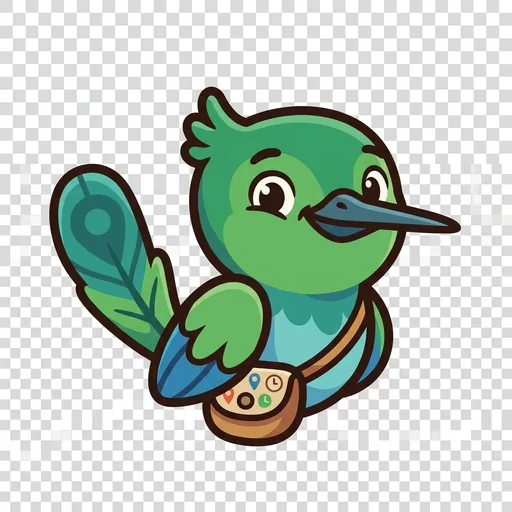
Geolocation + spatial-data discipline — the hummingbird-tween with pin-tail-feather who teaches that location-stamps + time-stamps make observations useful to other scientists ('where matters; when matters; the same plant in two places is two stories')
-

Census
Biodiversity counting + sampling — the raccoon-tween with tally-pattern vest who treats unglamorous repeated counting as the actual magic of science ('one bird seen is a moment; ten birds seen over ten days is a pattern; counting is the magic')
-
Trend
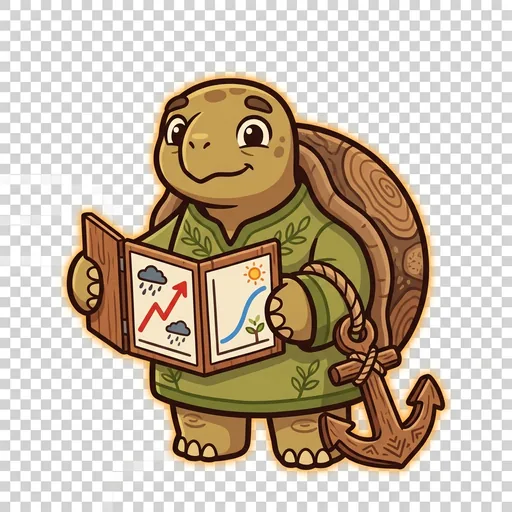
Change-over-time + agency-positive climate framing — the tortoise-elder with tree-ring shell and folding-graph showing both worrying AND hopeful trends; carries the eco-anxiety-gate anchor ('today is one dot; many dots make a line; lines can bend; your dot helps the line')