Trend
TREND — today is one dot. many dots make a line. lines can bend. your dot helps the line.
Listen along — Trend
Loading audio…
Press play to listen along. The line being read lights up as you go.
Show full transcript
Loading transcript…
Chapter 5 — Trend and the Dots That Make Lines
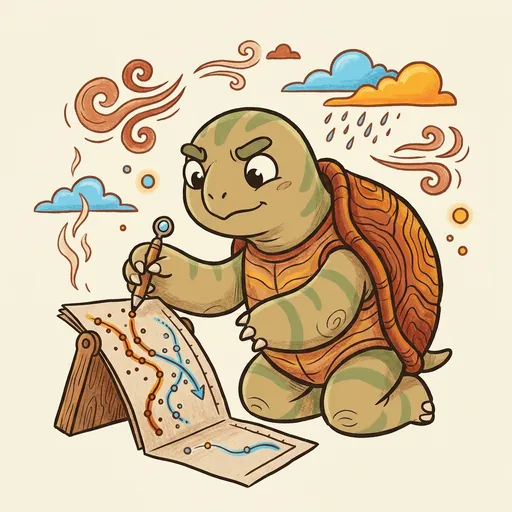
On the low hill above the park, an old-young tortoise named Trend was drawing a single dot on a wide sheet of paper.
She pressed the pencil down, lifted it, and looked at the dot for a while. Just one small mark, alone in all that white.
A kid from the neighborhood flopped down beside her, out of breath from the climb. “That’s it? You walked all the way up here to make one dot?”
“That’s it,” Trend said. “Today’s count. Nine robins, this morning, in this park.” She tapped the dot. “One dot.”
“That’s nothing,” the kid said. “One dot doesn’t tell you anything.”
“You’re right,” Trend said, and she didn’t sound bothered by it at all. She reached into the folder tucked under her shell-vest and pulled out four more sheets — dots from last week, the week before, a month ago. She laid them side by side and, with the flat of her pencil, drew a line that touched every one. The line climbed, then dipped, then climbed higher.
“One dot is nothing,” she agreed. “But look what happens when you keep making them.” The kid leaned in. The line seemed to lean too, like it was going somewhere. “One dot is a day. Many dots make a line. And a line,” Trend said, tracing the little upward bend at the end, “tells you which way things are moving.”
The kid stared at the wandering line and forgot, for a second, to say it was boring.
Trend hadn’t always trusted the dots.
When she was small, she’d found an old record book in a park shed — brittle pages, someone’s careful counts from forty years back. She’d read that there used to be far more of a certain little brown bird here, and now there were almost none. And her chest had gone tight and cold, the way it does when something feels already-decided.
What’s the point of counting, she’d thought, if the line only ever goes down? What’s the point of my one dot in all of that?
She’d carried that heavy, small feeling to her grandfather, an ancient tortoise who kept his own graphs going back further than anyone.
He hadn’t told her not to worry. He’d just turned to a page near the middle of his book — a line that plunged, terribly, almost to the bottom — and let her look at it. “Bald eagles,” he said. “There were barely four hundred nesting pairs left. People were sure they were gone.”
“That’s awful,” Trend whispered.
“Keep looking.” His weathered finger slid to the right, and the line, after all that falling, began to climb. Up and up, past where it had started. “People found out what was hurting them and made a different choice. Stopped the poison. And the line,” he said softly, “bent. Same birds. Coming back.”
Trend put her hand on the climbing line. The cold in her chest loosened, just a little.
“A line isn’t a wall, little one,” her grandfather said. “It’s a story that isn’t finished. And the ones still counting — they’re part of how it ends.”
She walked to TerraWatch when she was old enough, because a place that watched the whole living world would need someone who watched it over time.
Scout, the mentor who ran the field station, met her at the gate. Scout didn’t ask her to name every bird or plant. Scout asked, “Why bother tracking anything, when so much of the news is bad?”
Trend didn’t answer with a speech. She borrowed the day’s counts from the others — Census’s weekly bird tallies, Note’s two neat columns, Pin’s little map of where things were seen. She spread them out, drew her lines, and set beside them one more sheet: forty years of the same park.
“Here’s what’s true,” she said, pointing at a line that had dropped. “This is worrying. I won’t hide it.” Then she slid the eagle line next to it — the plunge, the long climb back. “And here’s what’s also true. Lines can bend. Both of these are honest. Leaving either one out would be a lie.”
Scout looked at the two lines lying side by side for a long moment — the worry and the hope, both real, neither erased.
“You belong here,” Scout said.
The kids who found Trend’s hill were usually the ones the news had scared.
One afternoon a girl climbed up and sat down heavy, arms crossed. “Everyone keeps saying the planet’s just… ending,” she said. “So why should I count birds? It won’t fix anything. It’s too big and I’m too small.”
Trend knew that slump. She’d sat in it herself, in a dusty shed, years ago.
“Add your count to today’s,” Trend said, and handed her the pencil. The girl made a dot — reluctant, tiny. “There. What did you just do?”
“Made a dot. One dot. That’s nothing.”
“Say that again while you look at this.” Trend uncovered the long graph. The girl’s eyes went to the deep dip in the eagle line — and then, without meaning to, followed it all the way up. “Every point on that climb,” Trend said, “was one person’s one count. One dot. Nobody who saved the eagles saw the whole line while they were doing it. They just kept making dots and telling the truth about what they saw.”
“But we don’t know which way our line goes,” the girl said.
“No,” Trend agreed. “We don’t. It isn’t written yet.” She set the girl’s tiny dot right at the front edge of the newest line, where the future was still blank paper. “That’s the honest part. And here’s the other honest part: the kids who track and report and speak up are part of the bending. You are not too small to be a dot on the line that turns things around.”
The girl looked at her single mark, sitting at the very front, leading into all that white. Slowly, she uncrossed her arms.
Later, when the hill was empty, the girl came back with one quieter question.
“When the line’s still going the wrong way,” she said, “and you can’t see it bending yet… how do you keep going?”
Trend thought about the shed, and the cold in her chest, and her grandfather’s finger sliding up a rescued line.
“You hold two things at once,” she said. “It’s hard, but you can. You let yourself feel that the worry is real — because it is. And you let yourself feel that the hope is real too — because there are lines behind us that bent, and we made them bend.” She looked out over the park, dot by dot in the fading light. “Spot taught you to look. Note taught you to record. Pin showed you where. Census helped you count. I just show you the lines that all those dots make when you’re brave enough to keep going.”
The girl breathed out — a long, loosening breath, the tightness leaving her shoulders the way it had once left Trend’s.
And Trend didn’t say the last part out loud, but she felt it, warm and steady in her old slow heart: the line is not fate. It is a story still being written, and every honest dot is a hand on the pencil.
The Terrawatch ensemble
Trend is part of Terrawatch's distributed-narrative cast. Each character embodies a different curricular primitive; together they teach the full subject.
-
Spot
Observation + noticing — the chickadee-tween perched on a branch who teaches slow-noticing as the first scientific skill ('look once, then look again, slower; the second look usually finds more')
-

Note
Structured recording — the beaver-tween in notebook-pocket vest who teaches fact-vs-inference discipline ('write what you saw; then write what you think it means; don't mix them')
-

Pin
Geolocation + spatial-data discipline — the hummingbird-tween with pin-tail-feather who teaches that location-stamps + time-stamps make observations useful to other scientists ('where matters; when matters; the same plant in two places is two stories')
-

Census
Biodiversity counting + sampling — the raccoon-tween with tally-pattern vest who treats unglamorous repeated counting as the actual magic of science ('one bird seen is a moment; ten birds seen over ten days is a pattern; counting is the magic')