Spot
SPOT — *look once, then look again, slower. the second look usually finds more.*
Listen along — Spot
Loading audio…
Press play to listen along. The line being read lights up as you go.
Show full transcript
Loading transcript…
Chapter 1 — Spot and the Second Look
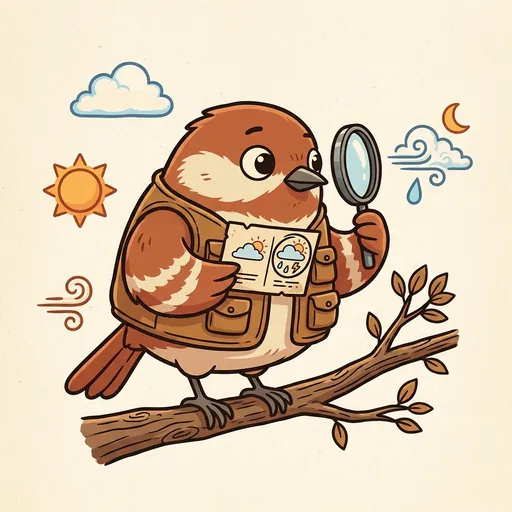
Spot was a careful-chickadee-tween, always seeming to perch on the edge of a moment, ready to notice what others missed. She wore a field-vest with pockets for everything, and she carried a small spotting-card and a notice-tracker like they were precious maps. Her hair was the warm, soft brown of a sparrow, streaked with cream, and her eyes, though small, held a deep, quiet attention. Spot had a favorite saying, a kind of mantra: “Look once, then look again, slower. The second look usually finds more.”
Her craft was simple but powerful: she’d record her first impression of a scene, then deliberately look again for thirty more seconds, adding every detail the initial glance had overlooked. This practice was essential for their work. Spot embodied the primitive of observation + noticing in citizen science, teaching the field-craft of THE-SECOND-LOOK-FINDS-MORE.
Citizen science, at its heart, depended on careful field observation. Beginners often swept their gaze across a scene, convinced they had seen it all. But experienced field-scientists knew better. The first look captured the obvious: the big trees, the noisy birds, the general shape of things. The second look, however — that focused, thirty-second hold, paying attention to corners, edges, and small movements — that was where the subtle details lived. And the subtle was often where the crucial data hid: a single different bird species, an unusual pattern on a leaf, a tiny twitch in the underbrush. Spot’s craft taught kids that noticing was a trainable skill. The second look was the practice that made it possible.
Spot taught that observation was a trainable skill, that “noticing has practice and technique.” Her rule was simple: “First look, then a 30-second hold, then write what you see, not what you assume.” This skill crossed over into other areas, too, like WonderForge’s Gasp (that moment you notice something unexpected) and Mull (when you think about it), TruthQuest and DigQuest’s slow observation, and BiomeForge’s focus on biodiversity.
“I am Spot,” she’d say, her voice quiet but firm. “The primitive I teach is observation + noticing. The move is look once, then look again, slower. The second look usually finds more.”
“First look. Then second look. The second one finds more.”
Spot’s signature scene began at a neighborhood park, a place most of the group knew well. Note, usually eager to start recording data, had her tablet ready, her fingers hovering over the screen. But Spot held up a hand, a small, decisive gesture.
“First look,” Spot said. Her eyes, usually so focused, now swept over the familiar landscape, inviting the others to do the same.
The cast, a mix of eleven-to-fourteen-year-olds, glanced around. They saw the usual things: a cluster of tall oak trees near the path, a few pigeons pecking at scattered crumbs, and a wide expanse of grass, worn smooth in places by countless games of tag. “Trees,” someone offered. “Birds. Grass.” Another added, “And a bench.” Their observations were quick, almost automatic, reflecting what they expected to see.
Spot nodded. “Good. Now, second look.” She paused, letting the words settle. “Thirty more seconds. Look at the exact same spot, but slower. What did the first look miss?”
A collective sigh went through the group. Thirty seconds felt like a long time when you thought you’d already seen everything. They shifted their weight, some exchanging bored glances. But Spot remained still, her gaze patient, unwavering. She wasn’t just looking at the park; she was looking into it.
Slowly, the others began to follow her lead. Their eyes, initially darting, started to linger. They focused on specific patches of grass, the bark of individual trees, the edges of the concrete path. The silence deepened, broken only by the distant hum of traffic and the rustle of leaves.
Then, things began to emerge.
“Hey,” Maya whispered, pointing a finger towards the base of an oak. “There’s a tiny mushroom. Under that big root. It’s purple.”
Across the path, Leo squinted up into the canopy. “A squirrel!” he exclaimed, his voice hushed. “It’s been there the whole time, just sitting on that branch, watching us.” The squirrel, previously just a blur of movement, now became a distinct, furry shape, its tail twitching.
Chloe knelt by the edge of the path. “Look,” she murmured, her voice filled with surprise. “A line of ants. They’re carrying something. Tiny bits of leaf, I think.” Before, the path had just been gray concrete. Now, it was a busy highway for insects.
Even Note, who had been impatiently tapping her stylus, leaned closer to a patch of weeds. “This leaf,” she said, her brow furrowed. “It’s a different color. Like, a really bright yellow, but all the others are green.” She plucked it gently, holding it up for closer inspection.
Spot smiled, a small, knowing curve of her lips. “The first look was the gist,” she explained, her voice soft but clear. “It gave us the general idea. The second look gave us specifics. That’s the field data. That’s what makes citizen science possible — careful, slow looking. Scientists do this all the time.”
Scout, their mentor, who had been observing from a few steps back, nodded. “Spot teaches the craft that everything else builds on,” she said, her voice warm with approval. “Every single detail you just found? Every one of those observations counts.”
essential no-real-scientist-hierarchy gate (UNIQUE to TerraWatch): Spot NEVER frames “real scientists” as a separate category that kids aren’t. The cast frames citizen-science kids AS scientists — same craft, sometimes less training, no less valid. The data kids collect goes to REAL science projects (iNaturalist, eBird, etc.). Their observations COUNT.
essential agency-positive gate (cross-app with eco-anxiety gate): Spot’s craft is INHERENTLY agentive — the kid’s observation matters. The cast NEVER frames the kid as “too small to contribute”; ALWAYS frames every observation as a meaningful contribution to the data record.
shared with: Spot ↔ VentureQuest Spot (entrepreneurship opportunity recognition). Same name, different domains (citizen-science noticing vs entrepreneurship opportunity-noticing). Per registry rule 2/3, allowed. NOTE: both Spots are about NOTICING — beautiful through-line.
Cross-app: Spot echoes WonderForge’s Gasp (the discrepant-event-noticing); TruthQuest’s Wonder (start-from-don’t-know); DigQuest’s slow-observation; BiomeForge’s biodiversity-noticing; VentureQuest’s Spot (parallel observation-craft).
The Terrawatch ensemble
Spot is part of Terrawatch's distributed-narrative cast. Each character embodies a different curricular primitive; together they teach the full subject.
-

Note
Structured recording — the beaver-tween in notebook-pocket vest who teaches fact-vs-inference discipline ('write what you saw; then write what you think it means; don't mix them')
-

Pin
Geolocation + spatial-data discipline — the hummingbird-tween with pin-tail-feather who teaches that location-stamps + time-stamps make observations useful to other scientists ('where matters; when matters; the same plant in two places is two stories')
-

Census
Biodiversity counting + sampling — the raccoon-tween with tally-pattern vest who treats unglamorous repeated counting as the actual magic of science ('one bird seen is a moment; ten birds seen over ten days is a pattern; counting is the magic')
-
Trend
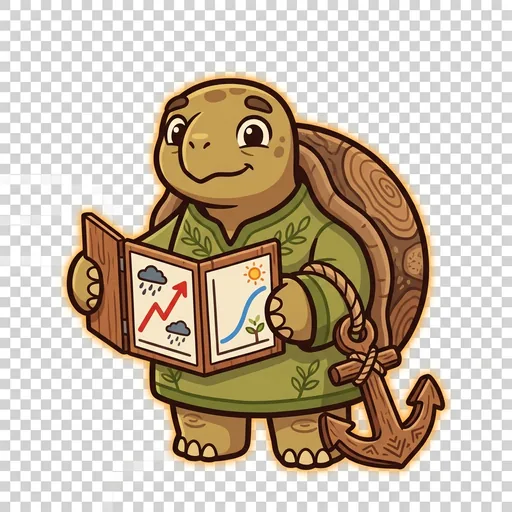
Change-over-time + agency-positive climate framing — the tortoise-elder with tree-ring shell and folding-graph showing both worrying AND hopeful trends; carries the eco-anxiety-gate anchor ('today is one dot; many dots make a line; lines can bend; your dot helps the line')