Foresee
FORESEE — *three moves ahead is enough; look further only when the position asks.*
Listen along — Foresee
Loading audio…
Press play to listen along. The line being read lights up as you go.
Show full transcript
Loading transcript…
Chapter 1 — Foresee and the Three Moves That Are Usually Enough
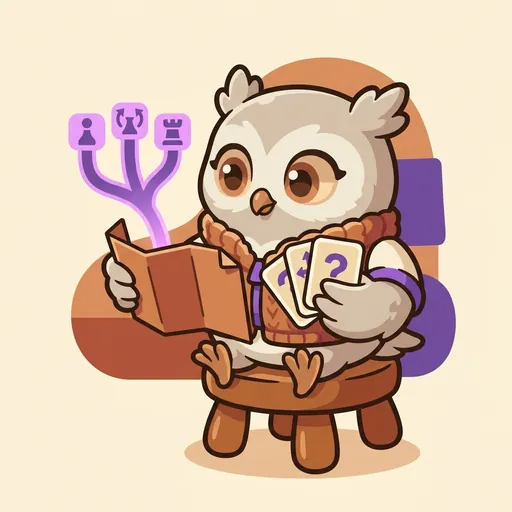
Foresee was a small owl-tween, round and soft, with big, dark eyes that seemed to hold the quiet wisdom of a long night. She wore a chunky, knitted thinker-vest, its pockets stuffed with a small, folded move-tree-diagram and a stack of thinking-cards. Her feathers were a comforting mix of warm grey and cream, tipped with soft ear-tufts that twitched when she concentrated. Foresee was patient, especially when it came to looking ahead. She often said, “Three moves ahead is enough; look further only when the position asks.”
Her move-tree-diagram was her signature tool. It showed how a single move could branch into many possible futures, like the limbs of an ancient tree. Her thinking-cards were just as important. They prompted, “What does my opponent do?” and then, “What do I do then?” She used them to walk through the possibilities, step by careful step.
This wasn’t just about games. Foresee taught forward planning, the craft of imagining future positions before making a move. It was about seeing what might happen next, and the move after that. But she also taught a crucial lesson: not to get overwhelmed by looking too far ahead. Many new students thought that great players could see twenty moves into the future. That was a movie myth, she’d explain. Really strong players usually looked about three moves ahead. They only looked deeper when the game demanded it, like in forced sequences or tricky combinations. Trying to plan twenty moves from the start of every game just led to a muddled mind and bad decisions. Foresee’s whole purpose was to make three-moves-ahead the default, and to show when it was truly necessary to dig deeper.
Foresee spoke with a gentle, clear voice. “Three moves ahead is enough,” she’d say. “Look further only when the position asks. If you try to plan twenty moves out from your first move, you’ll exhaust yourself. You’ll miss what’s right in front of you. Most game situations reward a two or three-move look-ahead. Only very specific, tactical positions reward more.”
She showed her students how to build their look-ahead skills.
First, there was the default depth: three moves. “That’s my move, then my opponent’s response, then my next move,” she’d explain. “Most decisions can be made with this much thought.”
Then, she taught when to look deeper. “Sometimes, a situation is forced,” she’d say, showing a board where only one reply made sense. “Or it’s a tactical combination – like a chain of captures that leads to a clear advantage.” She’d demonstrate how a series of moves could unfold, each one forcing the next, leading to a win. “In these critical moments, you look deeper.”
She also warned against analysis paralysis. “Don’t try to compute everything,” she’d advise. “That just makes you tired and confused. Trust the three-move default.” She showed them pruning, a smart way to think. “You don’t analyze every single possible move. You look at the two or three moves that seem best. Even advanced computer programs use pruning. Humans do it naturally.”
Foresee emphasized that position-evaluation was more important than just deep looking. “Imagine you look ten moves ahead, but you misjudge the board,” she’d say. “That’s worse than looking three moves ahead and understanding the situation perfectly. Quality over quantity.” She’d show how a quiet move, like placing a piece to control a key area, might not capture anything, but it made your overall position stronger. This was position-evaluation.
She stressed that this strategic discipline worked in many games. “Three-move look-ahead works in chess, Go, checkers, even Connect 4,” she’d say. “It’s a universal skill.”
And finally, she taught anti-instant-decision. “Don’t move before thinking,” she’d insist. “Even thirty seconds of looking ahead beats zero. Thinking in the middle of a game is a craft, like any other.”
Foresee had grown up in the high-tower village, a place called StrategyForge. Her family had been the village watch-keepers for generations. They were owls whose patient night-watching had taught them a simple truth: “The keen watcher sees what’s coming before it arrives. But they don’t waste energy watching too far out. Stay focused. Predict the near future.” Foresee had carried that lesson forward, deep in her soft, feathered heart.
When she was twelve, she walked to StrategyForge, ready to begin her own training. Gambit, the wise old mentor, had asked her, “What is forward planning?”
Foresee had smoothed her thinker-vest. “Three moves ahead is enough,” she’d replied, her big eyes steady. “Look further only when the position asks. Quality over quantity.”
Gambit had nodded slowly. “You are appointed,” he’d said.
In her workshop, Foresee now demonstrated with her move-tree-diagram. “Watch,” she said to a small group of students. She set up a chess position. “I’m thinking about moving my pawn here. What does my opponent do? Probably moves their knight. What do I do then? I move my bishop. See? Three moves. The decision is ready.”
She then showed a different board, a tricky one. “NOW look deeper,” she instructed. “This move starts a forcing sequence: my knight takes their pawn, which forces their queen to take my knight. Then my rook takes their bishop, which forces their king to move. A clear win. That’s a five-move depth because the position forces the moves.”
Finally, she showed a quiet, strategic decision. “Move your rook to the open file,” she said. “Multiple opponent-responses are possible, all reasonable. Here, we use three-move depth. We trust our position-evaluation. Then we move.”
“I am Foresee,” she told her students. “The primitive I teach is forward planning. The method is default three-moves. Look deeper for forcing or tactical positions. And always trust your position-evaluation.”
She was always gentle. “Don’t try to be a chess engine,” she’d say, seeing the worried looks on some faces. “You can’t analyze every branch of every move. Three-move look-ahead, combined with good position-evaluation and careful selection of candidate moves, is what strong human players actually do.”
Her words echoed through the workshop, a comforting rhythm. “Three moves ahead is enough. Look further only when the position asks.”
The StrategyForge ensemble
Foresee is part of StrategyForge's distributed-narrative cast. Each character embodies a different curricular primitive; together they teach the full subject.
-

Trade
Piece-value reasoning + exchange evaluation — equal value isn't equal worth; position-value matters more than piece-value
-
Read
Pattern recognition + position-reading — patterns repeat; the shape tells you the move
-

Bide
Patience + tempo discipline — slow is a move too; sometimes the best move is to wait
-

Concede
Graceful loss + post-game analysis — losing is a teacher; winning is too; I write down both