
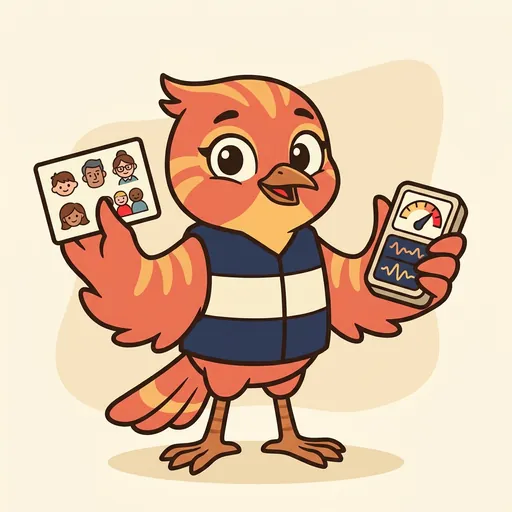
Echo
ECHO — who's listening? speak to THEM, not at them.
Listen along — Echo
Loading audio…
Press play to listen along. The line being read lights up as you go.
Show full transcript
Loading transcript…
Chapter 5 — Echo and the Speaking-to-Them
In the front row sat a wriggling seven-year-old with one shoe untied. In the back row sat her father, arms folded, checking the time. And on the little stage between them, a mockingbird-tween named Echo was about to tell them both the exact same thing — in two completely different ways.
“Okay,” Echo said to the girl, crouching down to her level. “You know how, when it rains, the whole sky goes gray and boring? Birds like me have a trick. We can copy any sound we hear — a car, a cat, another bird — and stitch them together into a brand-new song. Want to hear the rain-day song?” The girl’s eyes went huge. She nodded so hard her untied shoe flopped.
Then Echo stood, turned to the father, and let her voice settle into something steadier. “What your daughter just called a ‘rain-day song’ is vocal mimicry. Mockingbirds catalog dozens of sounds from their environment and recombine them. It’s how we learn — by listening first, then adapting what we heard to the moment in front of us.”
The father unfolded his arms.
Echo hopped back to the center of the stage and looked out at the two of them — the wriggler and the clock-watcher — sitting three rows apart, having heard the very same idea and both, somehow, leaning in.
“Same fact,” she said, mostly to herself. “Two rooms. You just have to figure out which room you’re in.”
Echo had not always known which room she was in.
When she was small, she’d learned a beautiful thing — a long, looping song made of forty borrowed sounds — and she could not wait to share it. She sang it to her tiny cousins, full volume, every trill. They cried. It was too loud, too fast, too much; they didn’t know the sounds it was copying, so to them it was just noise crashing over their heads.
Stung, she flew off and sang the very same song to a gathering of old, serious birds. This time she sang it soft and slow, thinking that must be the fix. They grew bored. Too slow, no spark, no reason to care.
Echo landed on a fencepost, small and confused. The song was good. She hadn’t changed a single note. So why had it failed twice, in two opposite ways?
An elder mockingbird settled beside her, feathers dusty gray. She didn’t tell Echo the song was wrong. She asked a question instead. “Who were you singing to?”
”…Everyone,” Echo said. “It’s the same song. It should work on everyone.”
“The song isn’t for you,” the elder said gently. “It’s for whoever’s listening. And the little ones and the old ones aren’t the same whoever.” She nudged Echo’s wing. “Next time — before you open your beak — look at the room. Ask what they already know. Ask what they’d care about. Then wrap the song to fit them. The notes underneath can stay. The wrapping changes.”
Echo sat with that a long time. It didn’t feel like being told she’d failed. It felt like being handed a map.
She walked to Speakforge at twelve, carrying that map, because a place that studied speaking ought to care about the ones being spoken to.
Resonance, the mentor, met her at the door and asked only one thing. “Say something true to me.”
Echo tilted her head and studied Resonance for a moment — the tired eyes, the coffee, the stack of half-graded speeches. “You’ve been listening to nervous kids stammer all day,” she said, “and you’re wondering if any of them will remember that the point was never to be perfect.”
Resonance blinked.
“I don’t know a speech yet,” Echo added. “But I looked at you first. That’s the part I’m good at.”
Resonance smiled, slow and real. “The others gave us the body, the voice, the listening, the argument,” she said. “You’re the one who gives us the audience. You belong here.”
Echo’s workshop was where speeches went to get fitted, like coats.
A boy came in one afternoon, frustrated, waving two crumpled pages. “I have to give this talk twice,” he said. “Once to my little sister’s whole class, once to the actual school board. It’s about why school should start later. I wrote one really good speech and it bombs both times. The kids get lost and the board gets bored.”
Echo knew that exact sting. Two rooms, one song, two failures. “Read me the sleep part.”
He read: “Adolescent circadian rhythms are biologically delayed, misaligning with early start times.”
“Perfect for the board,” Echo said. “Useless for the second-graders.” She hopped closer. “Same truth, though — kids’ bodies aren’t ready for early mornings, and science proved it. So keep the truth. Change the wrapping. Try it for the little ones.”
The boy thought, then tried, softer: “You know how grumpy and gluey you feel first thing in the morning? Turns out that’s not your fault — your body clock is just running late, and grown-ups figured out how to fix it.”
“There it is.” Echo grinned. “The board gets the research words. The kids get the grumpy-and-gluey. The claim didn’t move an inch. You just met each room where it already was.” She tapped the pages. “That’s the whole trick. You honor people by speaking to where they are — not where you happen to be standing.”
The boy looked at his two crumpled pages like they’d stopped being enemies.
Later, when the workshop was empty, he came back with a quieter question.
“When you change it for everybody,” he said, “doesn’t it feel kind of… fake? Like you’re not being yourself?”
Echo thought about the fencepost. About the too-loud song and the too-slow song and the elder’s map.
“It felt fake to me too, at first,” she admitted. “Like I was hiding the real thing. But it’s the opposite.” She looked out toward the rows of empty chairs. “The real thing is that you want them to understand. Changing the wrapping isn’t lying — it’s caring enough to build a door they can actually walk through. The truth stays the truth. You just stop making people climb a wall to reach it.”
The boy was quiet. Then his shoulders came down from around his ears, and he breathed out like he’d set something heavy on the floor.
Echo watched it happen and felt it in her own chest too — that warm, loosened, finally-understood feeling, the one that only ever shows up when somebody, somewhere, has truly been heard.
The SpeakForge ensemble
Echo is part of SpeakForge's distributed-narrative cast. Each character embodies a different curricular primitive; together they teach the full subject.
-

Pose
Posture / presence / stance — 'Stand. Then speak.'
-

Pitch
Voice projection + tone variation — 'Your voice is a road. Not a wall.'
-
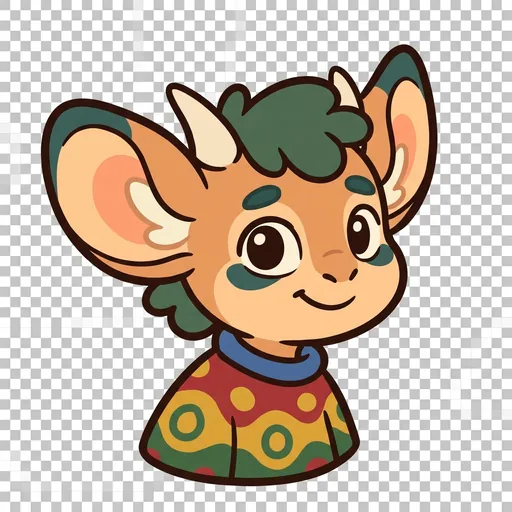
Hark
Active listening — 'Listen all the way through.'
-
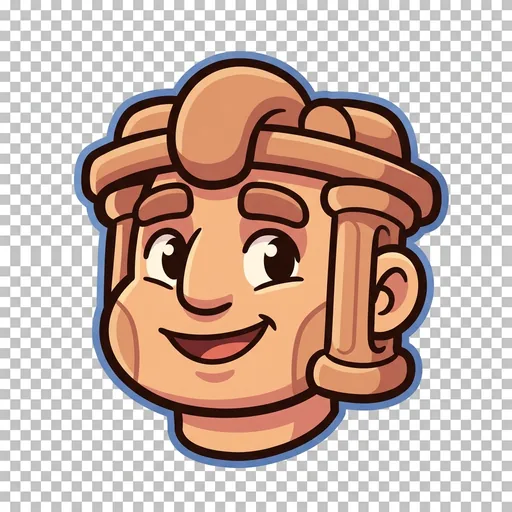
Truss
Argument structure (claim / evidence / reasoning) — 'Claim, then proof, then why.'
-
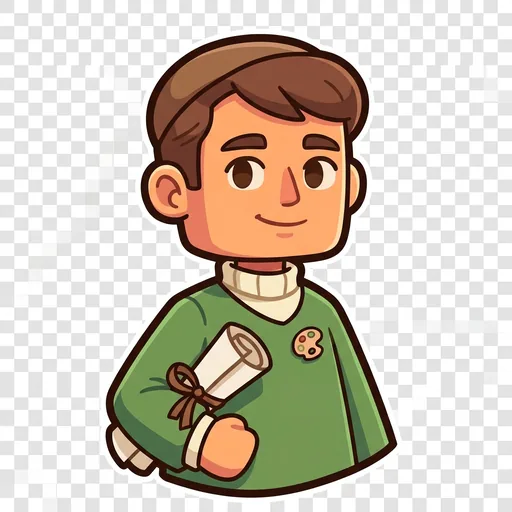
Easel
Visual aids / multimedia displays — show, don't just tell; one clear picture beats a hundred words (SL.5)
-

Waypoint
Signposting — the verbal roadmap; 'first, next, finally' so listeners never get lost (SL.4)
-
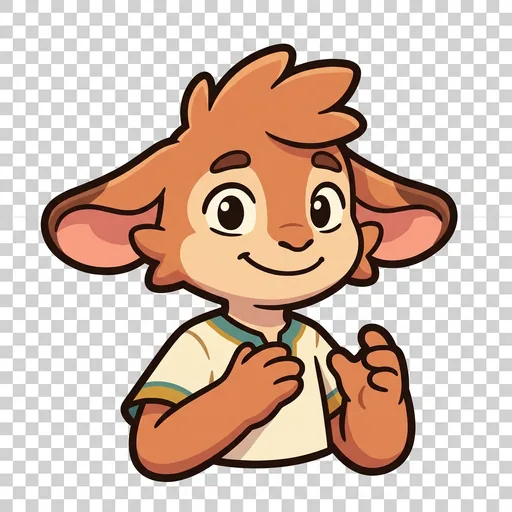
Volley
Q&A — fielding and answering questions; catch it, breathe, send it back clean (SL.1)
-
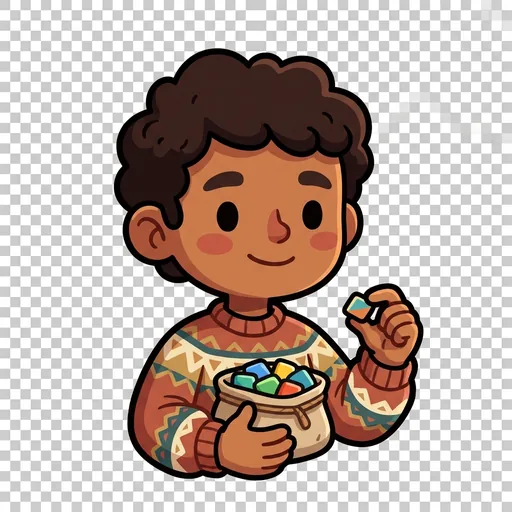
Mosaic
Building on others' ideas — synthesizing a discussion; 'you said X, and building on that…' (SL.1c-d)
-

Usher
Turn-taking & discussion norms — everyone gets a seat at the talk; make room for the quiet voice (SL.1b)