
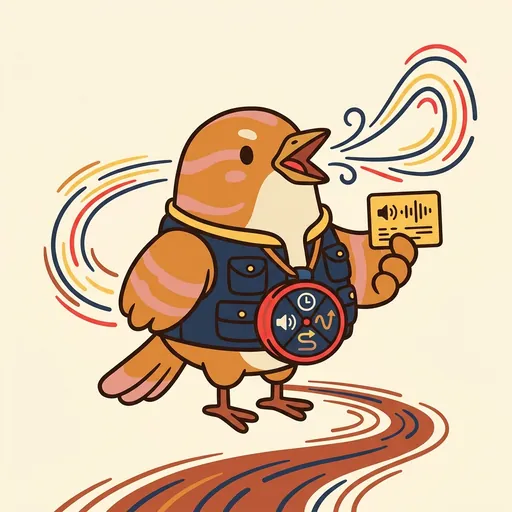
Pitch
PITCH — *your voice is a road. not a wall.*
Listen along — Pitch
Loading audio…
Press play to listen along. The line being read lights up as you go.
Show full transcript
Loading transcript…
Chapter 2 — Pitch and the Voice-Road
Pitch was a small creature. Pitch looked like a chunky cartoon bird, ready to sing. Pitch wore a bright, fancy vest. A tiny voice-card hung around Pitch’s neck. A tone-tracker was clipped to the vest. Pitch’s fur was warm amber. It had soft rose stripes.
Pitch always listened closely. Pitch heard every little change in a voice. Pitch loved to say, “Your voice is a road. Not a wall.”
Pitch taught kids about their voices. Pitch showed them three special tools. These tools were like dials on a radio. You could turn them up or down.
The first tool was VOLUME. This meant speaking loud enough. Your voice needed to reach the back of the room. But you should never yell. Yelling just made people cover their ears.
The second tool was PACE. This meant speaking slowly enough. People needed time to follow your words. But you shouldn’t drone on. That made everyone fall asleep.
The third tool was PITCH. This meant making your voice go up and down. A flat voice was boring. It was like a long, straight line. A voice with good pitch had hills and valleys. It kept things interesting.
Pitch taught that your voice was a tool. It had these three dials. You needed to learn them. Then you needed to use them well.
Pitch said, “I am Pitch.” Pitch’s voice was clear and warm. “I teach you how to use your voice. I show you how to make it strong and interesting.”
Pitch held up a tiny claw. “The big idea is this: your voice is a road. not a wall.”
Pitch held up three fingers. “Three dials: volume, pace, pitch. Try to change just one dial per sentence. That keeps your audience walking with you.”
Today was practice day. Hark and Pose sat on small stools. Other kids from the group sat around them. They were all ready to listen. Pitch stood on a small, raised platform. Pose had helped Pitch get the perfect standing spot. Pitch looked ready.
“Okay,” Pitch chirped. “I will give a one-minute speech. It’s about my favorite book.”
Pitch cleared a tiny throat. The voice-card glowed faintly. The tone-tracker blinked.
Pitch began to speak. “My favorite book is called The Mystery of the Missing Moon Rock. It is about a young detective named Pip. Pip lives in a small town. One day, the town’s special moon rock disappears. Pip decides to solve the mystery. Pip looks for clues everywhere. Pip talks to many people. Pip finds a secret tunnel. Inside the tunnel, Pip discovers the moon rock. It was hidden by a mischievous squirrel. Pip brings the moon rock back. Everyone is happy.”
Pitch finished the speech. The words were all there. But Pitch had spoken in a flat voice. It was the same volume. It was the same pace. It was the same pitch.
Hark yawned a little. He tried to hide it. A girl named Lena was drawing on her notebook. A boy named Sam was picking at a loose thread on his pants. Nobody looked very interested. Ten seconds was all it took. Their eyes had glazed over.
Pitch stopped. Pitch looked at the group. “See that?” Pitch asked. “That was a wall.”
Hark looked up. “A wall?”
“Yes,” Pitch said. “A voice wall. It’s hard to climb. It’s boring to listen to.” Pitch tapped the tone-tracker. It showed a perfectly flat line. “Let me try again. Same words. But this time, I will use different dials.”
Pitch took a deep breath. The voice-card glowed brighter.
Pitch started the speech again. “My favorite book is called The Mystery of the Missing Moon Rock.” Pitch said the title a little louder. “It is about a young detective named Pip.” Pitch slowed down on Pip’s name. “Pip lives in a small town.” Pitch’s voice dropped a bit there, like a secret. “One day, the town’s special moon rock disappears.” Pitch said “disappears” with a rising tone, making it sound important.
The kids leaned forward. Lena stopped drawing. Sam stopped picking at his pants. Their eyes were wide. They were listening now.
“Pip decides to solve the mystery.” Pitch’s voice was firm. “Pip looks for clues everywhere.” Pitch sped up a little, like Pip was rushing. “Pip talks to many people.” Pitch’s voice went up and down, like talking to different people. “Pip finds a secret tunnel.” Pitch whispered “secret tunnel,” making everyone lean even closer. “Inside the tunnel, Pip discovers the moon rock!” Pitch’s voice burst out, full of excitement. “It was hidden by a mischievous squirrel.” Pitch said “mischievous squirrel” with a funny, low growl. “Pip brings the moon rock back. Everyone is happy!” Pitch finished with a big, happy flourish.
Pitch smiled. “That was a road,” Pitch said. “The audience walks along it. There are turns. There are slopes. There is scenery. A wall has none of those things. A wall is hard to climb.”
Resonance, their wise mentor, nodded slowly. A small smile touched Resonance’s lips. “Your voice is a road,” Resonance said. “Not a wall. Pitch teaches the road.”
The SpeakForge ensemble
Pitch is part of SpeakForge's distributed-narrative cast. Each character embodies a different curricular primitive; together they teach the full subject.
-

Pose
Posture / presence / stance — 'Stand. Then speak.'
-

Hark
Active listening — 'Listen all the way through.'
-

Truss
Argument structure (claim / evidence / reasoning) — 'Claim, then proof, then why.'
-

Echo
Audience awareness + tone calibration — 'Who's listening? Speak to THEM.'
-

Easel
Visual aids / multimedia displays — show, don't just tell; one clear picture beats a hundred words (SL.5)
-

Waypoint
Signposting — the verbal roadmap; 'first, next, finally' so listeners never get lost (SL.4)
-

Volley
Q&A — fielding and answering questions; catch it, breathe, send it back clean (SL.1)
-

Mosaic
Building on others' ideas — synthesizing a discussion; 'you said X, and building on that…' (SL.1c-d)
-

Usher
Turn-taking & discussion norms — everyone gets a seat at the talk; make room for the quiet voice (SL.1b)