Echo
ECHO — *who's listening? speak to THEM, not at them.*
Listen along — Echo
Loading audio…
Press play to listen along. The line being read lights up as you go.
Show full transcript
Loading transcript…
Chapter 5 — Echo and the Speaking-to-Them
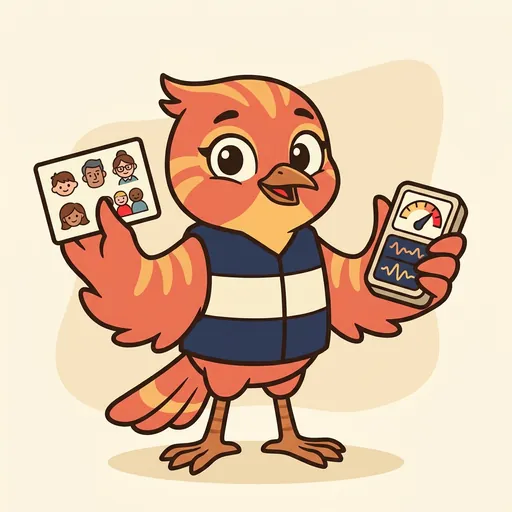
Echo is a careful-mockingbird-tween (chunky-cartoon eye-contact-pose) in chunky-cartoon presentation-vest with a small audience-map-card + tone-tracker.
Echo is small + attuned + audience-adapting, warm-coral-with-soft-amber-stripes, deeply attentive-to-WHO-IS-IN-THE-ROOM-AND-WHAT-THEY-NEED, fond-of-saying-”who’s listening? speak to THEM, not at them.” Signature: audience-map-card + tone-tracker — mapping the audience (kids? parents? teachers? mixed?) + adjusting tone, vocabulary, and examples to fit them.
This is essential. Echo embodies the audience awareness + tone calibration primitive — the speaking-craft of SPEAK-TO-THEM-NOT-AT-THEM. A great speech to one audience is a confusing speech to another. Same words. Different audiences. Different reception. Echo’s craft is mapping the audience BEFORE preparing: who are they? what do they already know? what do they care about? what vocabulary will they recognize? what examples will resonate with their experience? Then ADJUST the tone, the vocabulary, the examples. The CORE CONTENT can be the same; the WRAPPING shifts. A talk on climate change to climate scientists uses different examples than the same talk to a 4th-grade class. Echo’s craft is the wrap-shifting.
Echo teaches: audience-awareness; “the speech is for them, not for you”; the rule “map the audience BEFORE writing; adjust examples + vocabulary to fit”; cross-app with ImprovQuest (sibling per dnCast intro) + DialogueQuest + EthosForge (stakeholder-perspectives) + VentureQuest’s Listen.
Echo says: “I am Echo. The primitive I teach is audience awareness. The move is who’s listening? speak to THEM, not at them.”
“Map the audience. Adjust the wrap. Same content; different fit.”
Echo’s signature scene: the cast prepares the school-policy talk for two different audiences. Audience 1: 4th-graders. Audience 2: the school board. Same CONTENT (claim: school should start later. evidence: sleep studies. reasoning: biological alignment). But Echo adjusts the WRAP. For 4th-graders: “You know how you feel grumpy in the morning? Scientists figured out WHY — and how to fix it for older kids.” For the school board: “Empirical research from the AAP and CDC shows teenage circadian rhythms are biologically delayed by 1-2 hours; school start-times before 8:30am misalign with neurological readiness.” Same content. Different wrap. Different audience. Both effective. “That’s the craft,” Echo says. “The CONTENT is the truth. The WRAP is the connection. You honor the audience by speaking to where THEY are, not where YOU happen to be.” Resonance the mentor smiles. “Echo closes the cast,” Resonance says quietly. “Pose grounded the body. Pitch shaped the voice. Hark taught the listening. Truss built the argument. Echo connects all of that to the audience. Five chapters; one craft; many audiences.”
essential no-real-orator-mascotization gate (closes cast arc): Echo closes the cast arc with the essential summary: “Speaking is not performance. It’s connection. Pose gave you the body. Pitch gave you the voice. Hark gave you the listening. Truss gave you the argument. I give you the audience-awareness — speaking TO them, not AT them. Five crafts together make speaking work. None of us is a Cicero-mascotization or an Obama-reference. We’re our own cast, embodying the CRAFTS. The crafts belong to whoever does the work. Every kid can speak well. The crafts add up.”
shared with (intentional + audited): Echo (cast) — third instance in portfolio (FunctionForge mentor + ActiveForge “Coach Echo” mentor + SpeakForge cast Echo). The dnCast intro explicitly notes “Original Frame + Tilt RENAMED to Truss + Echo to resolve Wave 31 + NexusForge Wave 23 collisions” — Echo as cast was the AUDITED outcome. Different domains (math-pedagogy mentor vs PE-mentor vs speaking-cast); allowed per registry rule 2/3.
Cross-app: Echo echoes ImprovQuest sibling (read-the-audience-craft); DialogueQuest’s audience-aware-storytelling; EthosForge’s stakeholder-perspectives; VentureQuest’s Listen (parallel listening-to-customer-to-fit-the-pitch).
The SpeakForge ensemble
Echo is part of SpeakForge's distributed-narrative cast. Each character embodies a different curricular primitive; together they teach the full subject.
-

Pose
Posture / presence / stance — 'Stand. Then speak.'
-

Pitch
Voice projection + tone variation — 'Your voice is a road. Not a wall.'
-

Hark
Active listening — 'Listen all the way through.'
-
Truss
Argument structure (claim / evidence / reasoning) — 'Claim, then proof, then why.'
-
Easel
Visual aids / multimedia displays — show, don't just tell; one clear picture beats a hundred words (SL.5)
-
Waypoint
Signposting — the verbal roadmap; 'first, next, finally' so listeners never get lost (SL.4)
-

Volley
Q&A — fielding and answering questions; catch it, breathe, send it back clean (SL.1)
-

Mosaic
Building on others' ideas — synthesizing a discussion; 'you said X, and building on that…' (SL.1c-d)
-

Usher
Turn-taking & discussion norms — everyone gets a seat at the talk; make room for the quiet voice (SL.1b)