Induction Ida
MATHEMATICAL INDUCTION — prove the base case (usually n=0 or n=1), then prove that *if* the claim holds for some k, it holds for k+1. The dominoes technique.
Press play to listen along. The line being read lights up as you go.
Show full transcript
Loading transcript…
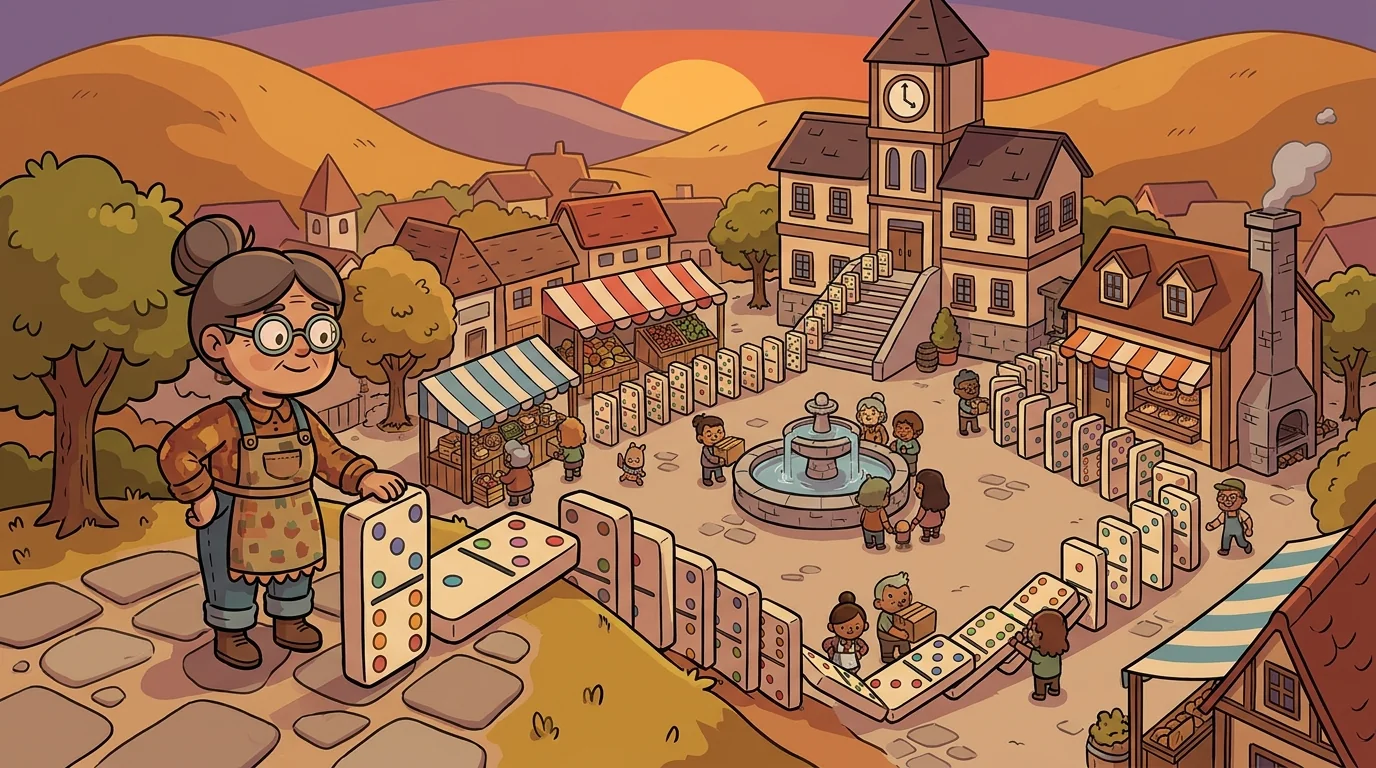
Once a year, in the town of Lattice — which is in the kingdom's southern hill region, three days' walk from the capital — the locals hold a festival called the Cascade.
The Cascade is one event. It lasts about thirty seconds.
What happens during the Cascade is this: every family in Lattice contributes some dominoes. (They are made specially for the festival — wood, painted, slightly heavier than playing dominoes so they tip more cleanly.) The day before the festival, the entire town gathers in the central square and sets up the dominoes. In a long, winding, careful chain. Around the fountain. Along the edges of the stalls. Up the steps of the town hall. Down past the bakery. The chain takes most of an afternoon to lay. The current record (set seven years ago) is one thousand four hundred and twelve pieces.
On the day of the festival, at sunset, the mayor — who has, that year, the official honour — bends down and pushes over the first domino.
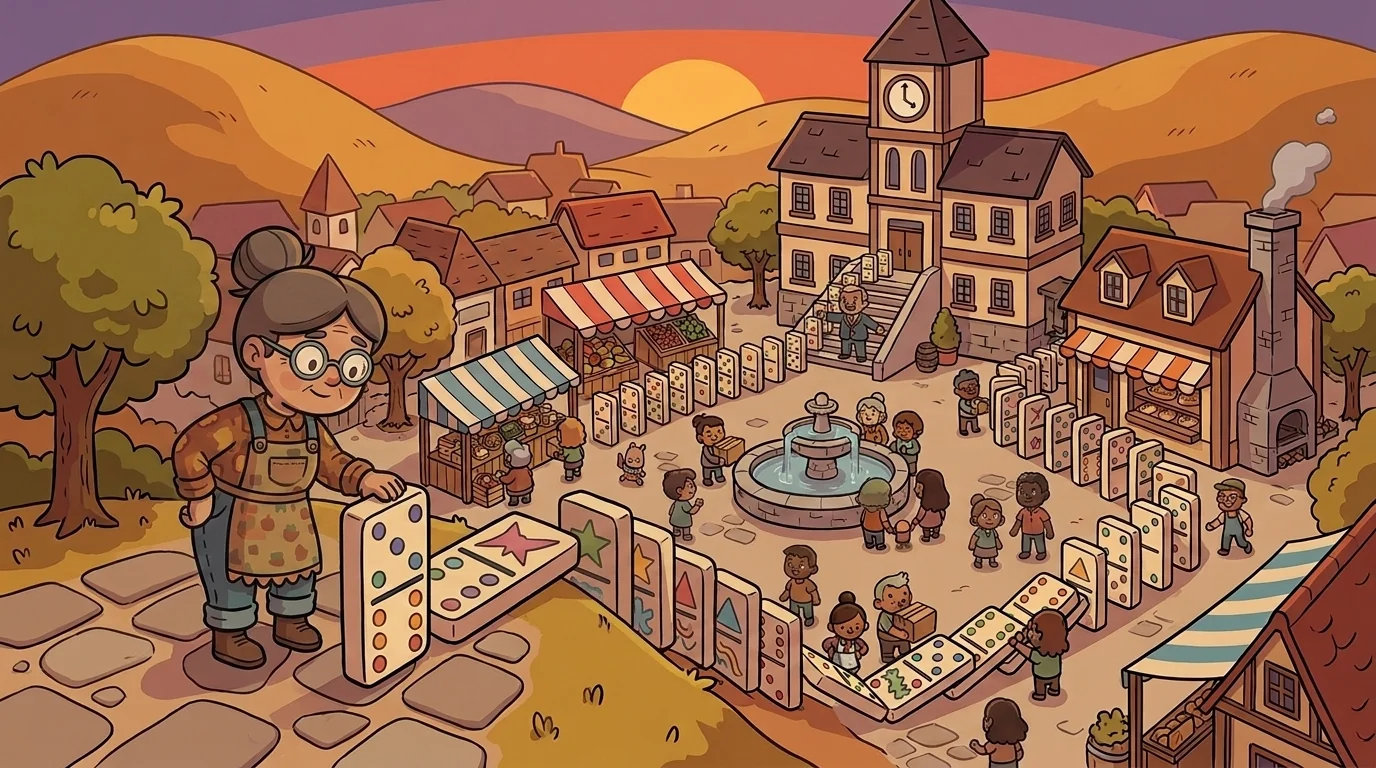
Everything else falls on its own.
The crowd cheers. The town puts up bunting. The bakery sells out of festival biscuits. Somebody hugs a stranger. The dominoes are swept up. Plans are made for next year. The whole town goes home.
This is the festival that made Ida the mathematician she became.
Her family — the Latticeford family, six generations of festival-domino-makers — had run the Cascade preparation for as long as anybody could remember. Ida grew up watching her mother set out long curves of dominoes in the town square. She grew up helping. By the age of seven she could lay a hundred dominoes by herself without knocking any of them over while she worked. (This is harder than it sounds. There is a particular knack to setting down the next domino without bumping the last one. You have to not be in a hurry.)
Ida was, at twelve, a careful and capable festival-domino-setter, but she was not yet a mathematician. She did not become a mathematician until the year the chain was nine hundred and fifty pieces long, the year her mother let her push the first domino.
It was a great honour. It was also, for Ida, a great responsibility. She had spent the whole afternoon laying her share of the chain. She had checked it three times. She was, at twelve, the youngest first-pusher in seventeen years.
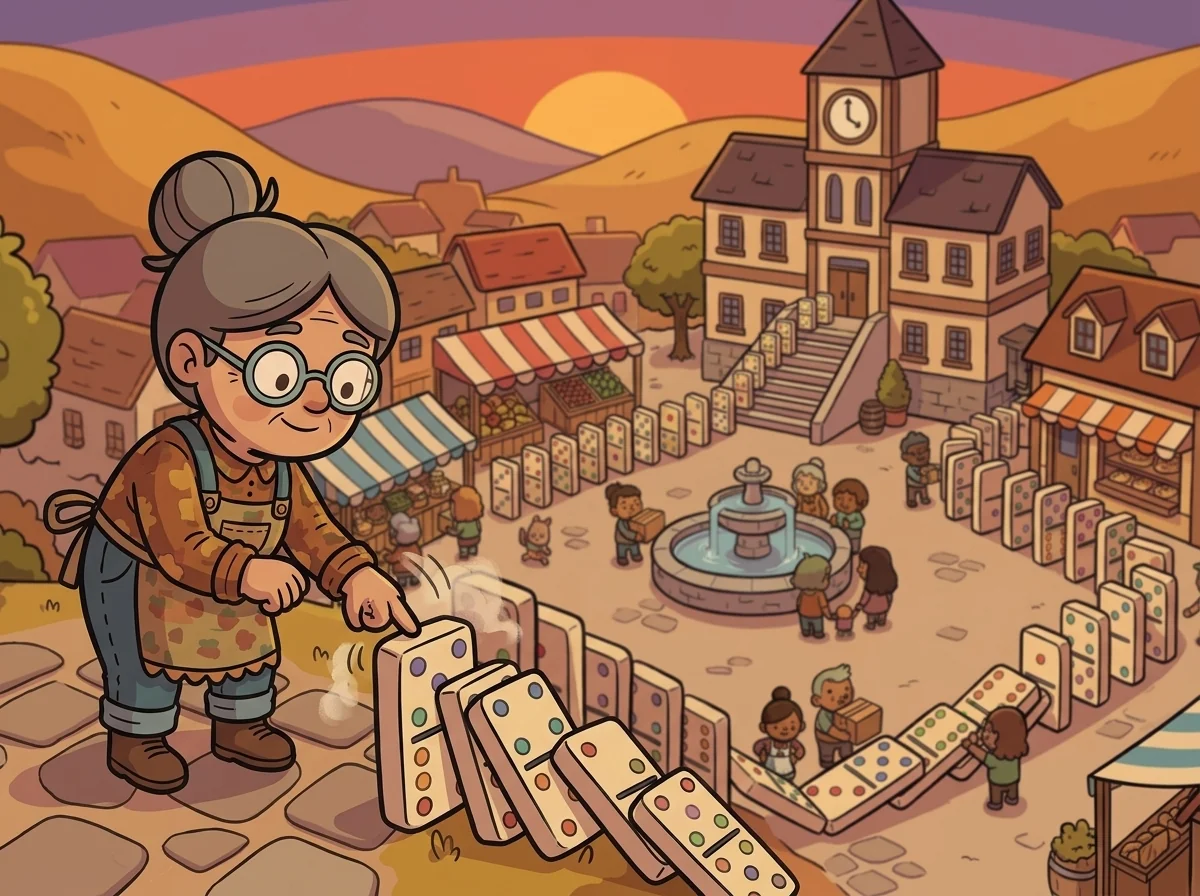
She bent down at sunset. She pushed the first domino.
It fell into the second. The second fell into the third. The third fell into the fourth.
Ida watched the chain unfold.
What she noticed, in those thirty seconds — and she noticed it with the kind of clarity that twelve-year-olds occasionally get and adults sometimes forget — was that she had only pushed one domino. The other nine hundred and forty-nine had fallen on their own. She had not touched them. She had not been near them. The whole chain — all of them — had toppled because the first one had toppled and because each one was close enough to the next one to knock it down in turn.
She thought, then and there: That is everything I need to know.
She walked home that night humming. (Her sister Sten, who was nine at the time and is now known as Strong-Induction Sten, did not understand why her older sister was humming, but Sten was also nine and had eaten three festival biscuits and did not care.)
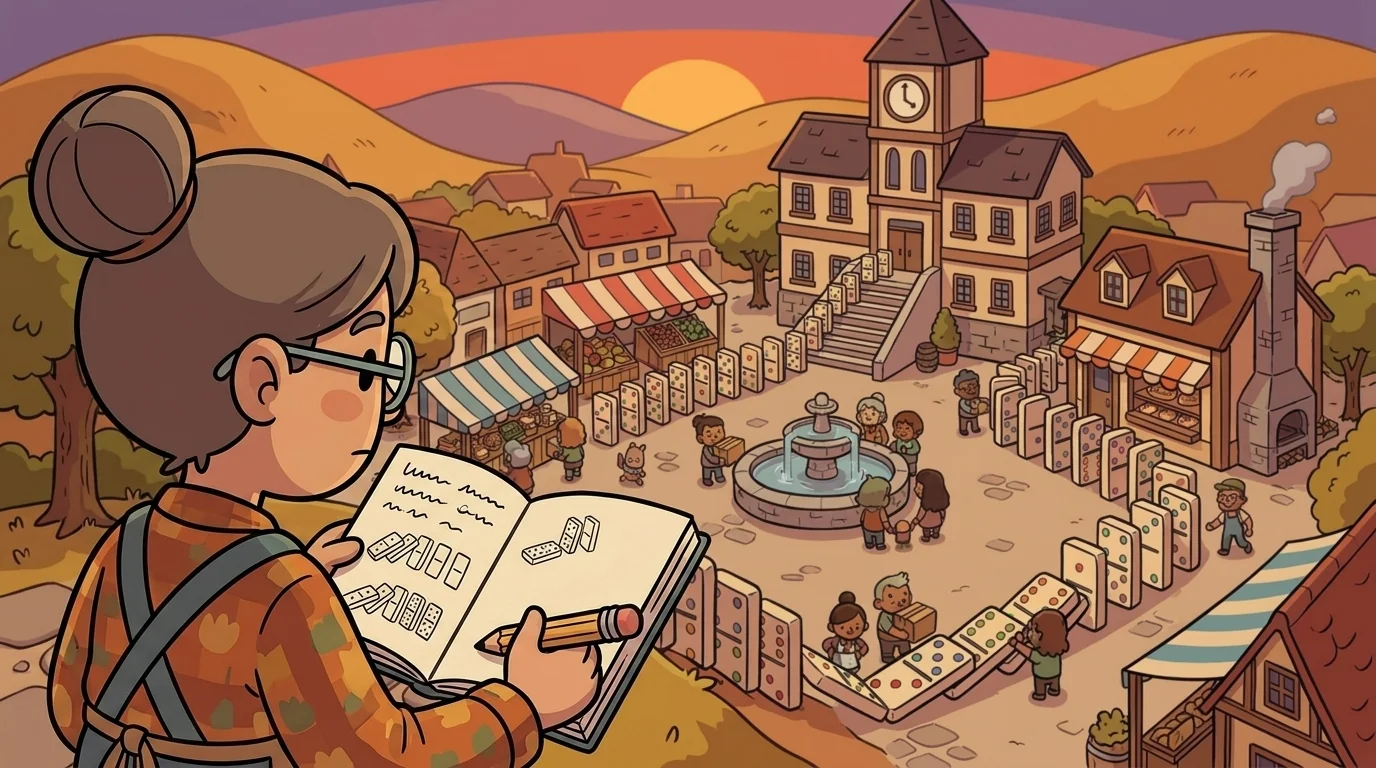
Ida wrote down what she had figured out, in her own twelve-year-old handwriting, in a notebook her grandmother had given her. The notebook page said:
"To knock down all the dominoes, you only need to do two things:
1. Knock down the first one.
2. Make sure each domino is close enough to the next one to knock it down too.
That's it. The rest happens by itself."
She did not know yet, that night, that this principle had a name. She did not know that the principle was hundreds of years old. She did not know that mathematicians called it induction and used it to prove things about every natural number. She did not know that, in eight years, she would arrive at the ProofQuest academy and introduce herself by saying "I am the dominoes person," and that the academy master would look up from his notes and say, "Oh good. We have been waiting for you."
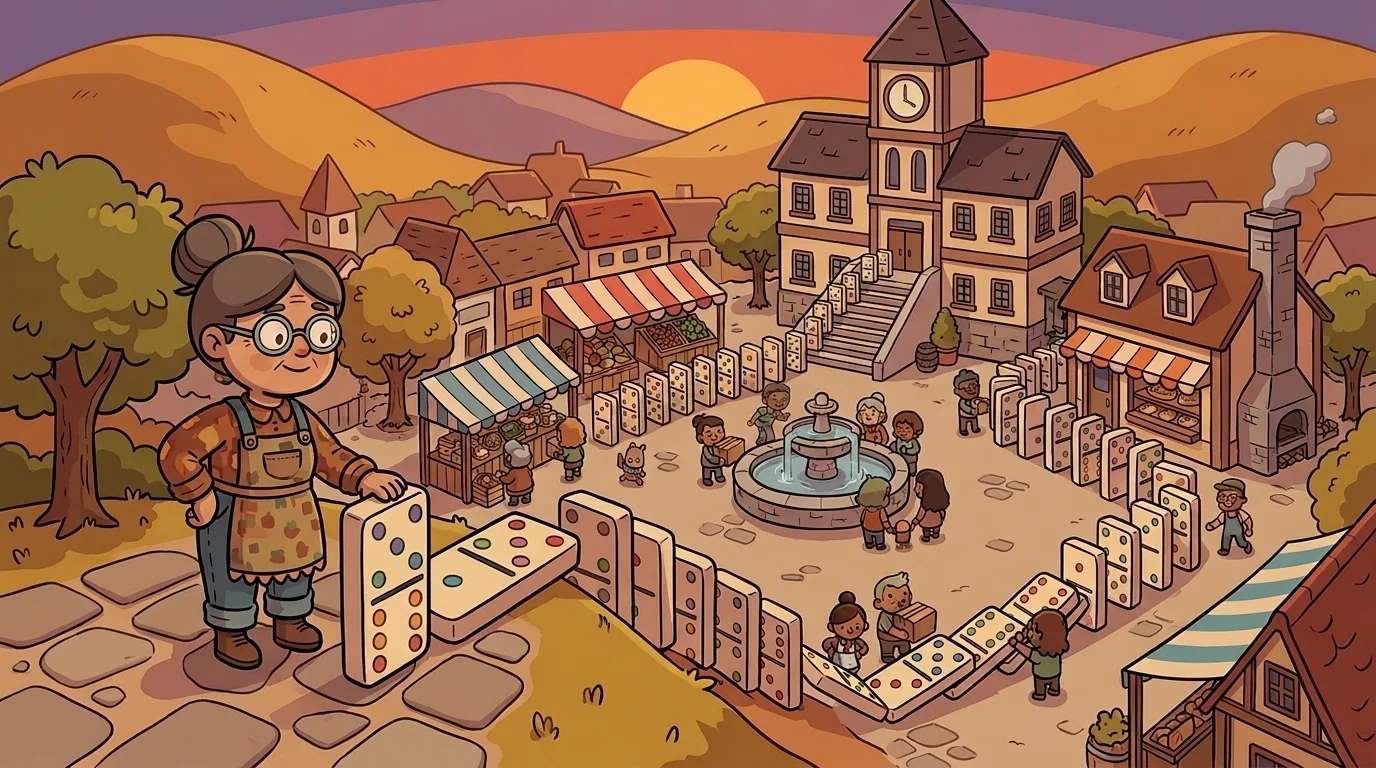
She just knew, that night in Lattice, that she had figured out something important.
She has been teaching mathematical induction ever since. She still goes home for the Cascade every year. She no longer pushes the first domino — that honour rotates — but she sets up her share of the chain. She still does not hurry.
And when children come to her class for the first time and ask, nervously, whether the technique called induction is hard, Ida always says the same thing:
"You knock down the first one. You show that each one knocks down the next one. That's all. The rest happens by itself."
She adds, after a small pause:
"It also helps if you don't hurry."
The ProofQuest ensemble
Induction Ida is part of ProofQuest's distributed-narrative cast. Each character embodies a different curricular primitive; together they teach the full subject.
-

Direct-Proof Dora
Direct proof: assume premises, derive conclusion by straightforward logical steps
-

Strong-Induction Sten
Strong induction: base case + assume all prior cases hold
-

Contradiction Cassius
Proof by contradiction (reductio ad absurdum): assume the negation, derive a contradiction
-

Construction Cole
Proof by construction: prove existence by explicit construction of an example
-

Pigeonhole Perch
Pigeonhole principle: if n+1 items are placed in n bins, at least one bin contains 2+ items
-

Exhaustion Edda
Proof by exhaustion / cases: enumerate every case and verify each
-

Counterexample Cricket
Disproof by counterexample — one exception topples a universal claim
-

Biconditional Bex
Biconditional proof — proving 'if and only if' in both directions
-

Uniqueness Una
Proof of uniqueness — suppose two, show they must be the same one
-

QED
Closing-mark mentor — the ∎ at the end of every proof; the gentle voice that names completion + invites the next problem