
Construction Cole
PROOF BY CONSTRUCTION — to show that something *exists*, build it. Don't prove existence abstractly; produce the actual example.
Press play to listen along. The line being read lights up as you go.
Show full transcript
Loading transcript…
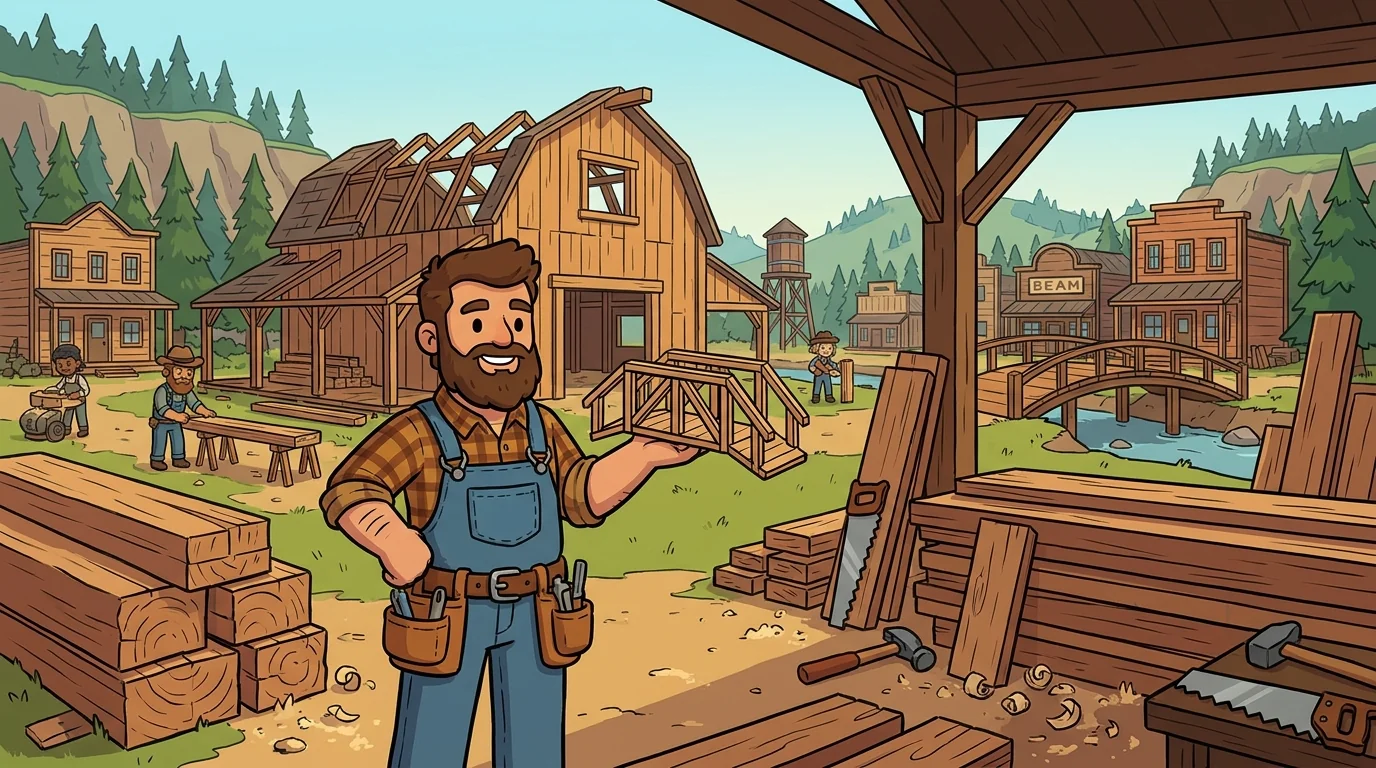
Cole is a carpenter. He should be introduced as a carpenter and not as a mathematician, because that is the order in which he became them, and Cole is firm about order.
He grew up in a western timber town called Beam. (Beam is, predictably, named for a kind of wood. The townspeople have, over generations, mostly stopped finding this funny.) Cole's family has been building things in Beam for nine generations. They build useful things: houses, barns, stalls, school benches, the occasional bridge when somebody asks for one. Cole's grandmother used to say that a Beam carpenter would rather build you a thing than describe one to you in writing. This was a family saying. It is also entirely true.
Cole apprenticed to his uncle at fifteen. He was, by twenty, a competent carpenter. By twenty-five he was a good one. He could look at a problem — I need a step here. I need a shelf there. I need a roof that does not leak — and he could build the answer. He did not draw plans first. He drew plans after, if at all. He preferred to build a small version, look at it, and then build the bigger version. He believed (and his uncle had taught him this) that you understand a thing when you've made one.
This is, in retrospect, a deeply mathematical attitude. Cole did not know it at the time.
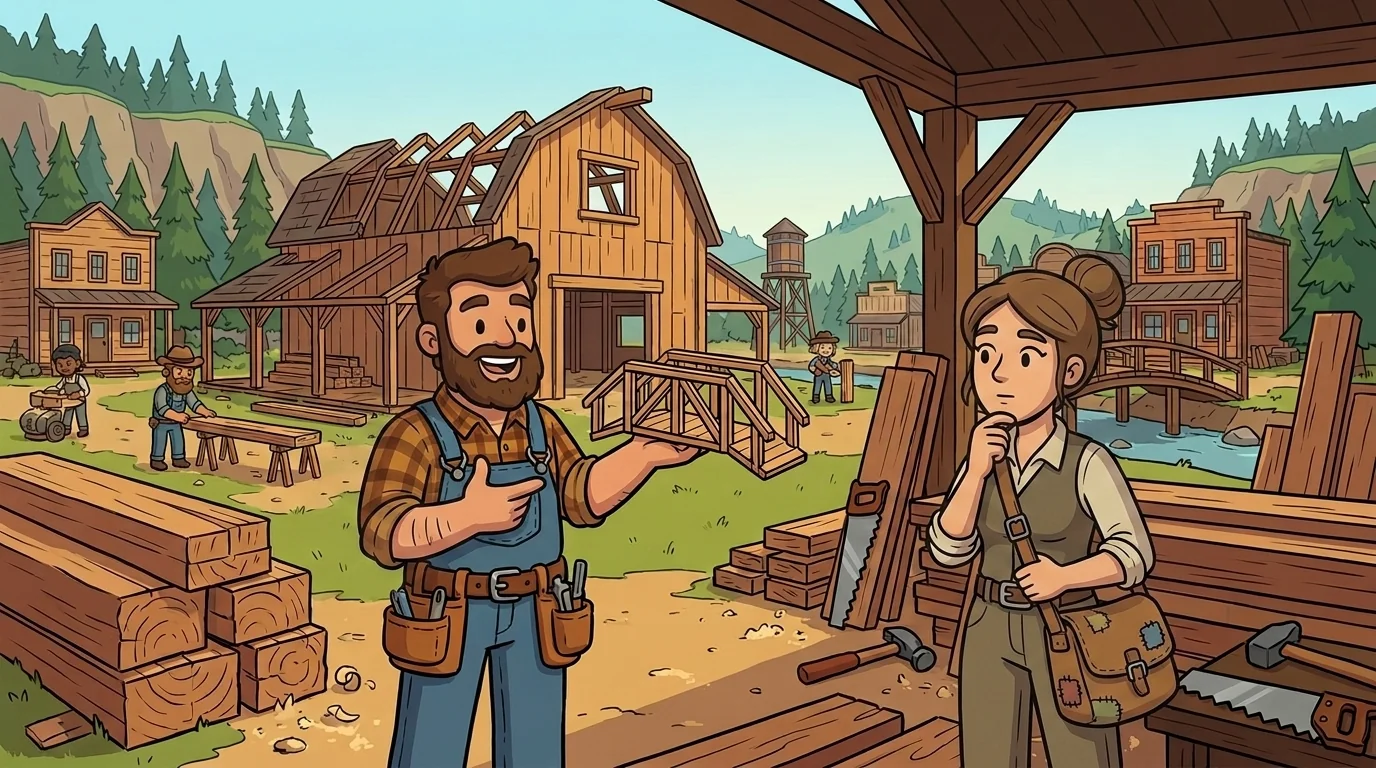
He learned it at twenty-eight, in a way that surprised him.
A travelling mathematician — a polite woman who was passing through Beam on her way south — stopped at Cole's workshop to ask if he could repair a damaged shoulder-bag strap. Cole could. He repaired it. They got to talking. The mathematician asked what kind of work Cole found most satisfying. Cole said: "The kind where I look at the problem and just make the thing."
The mathematician said: "Have you ever heard of proof by construction?"
Cole said: "No."
The mathematician explained. The technique is this: when you want to prove that something exists — that there is some number with a certain property, or some arrangement of pieces that works, or some geometric figure that meets a description — you do not have to argue abstractly that it must exist. You can simply produce one. You point at it and say: "There. That one. It works."
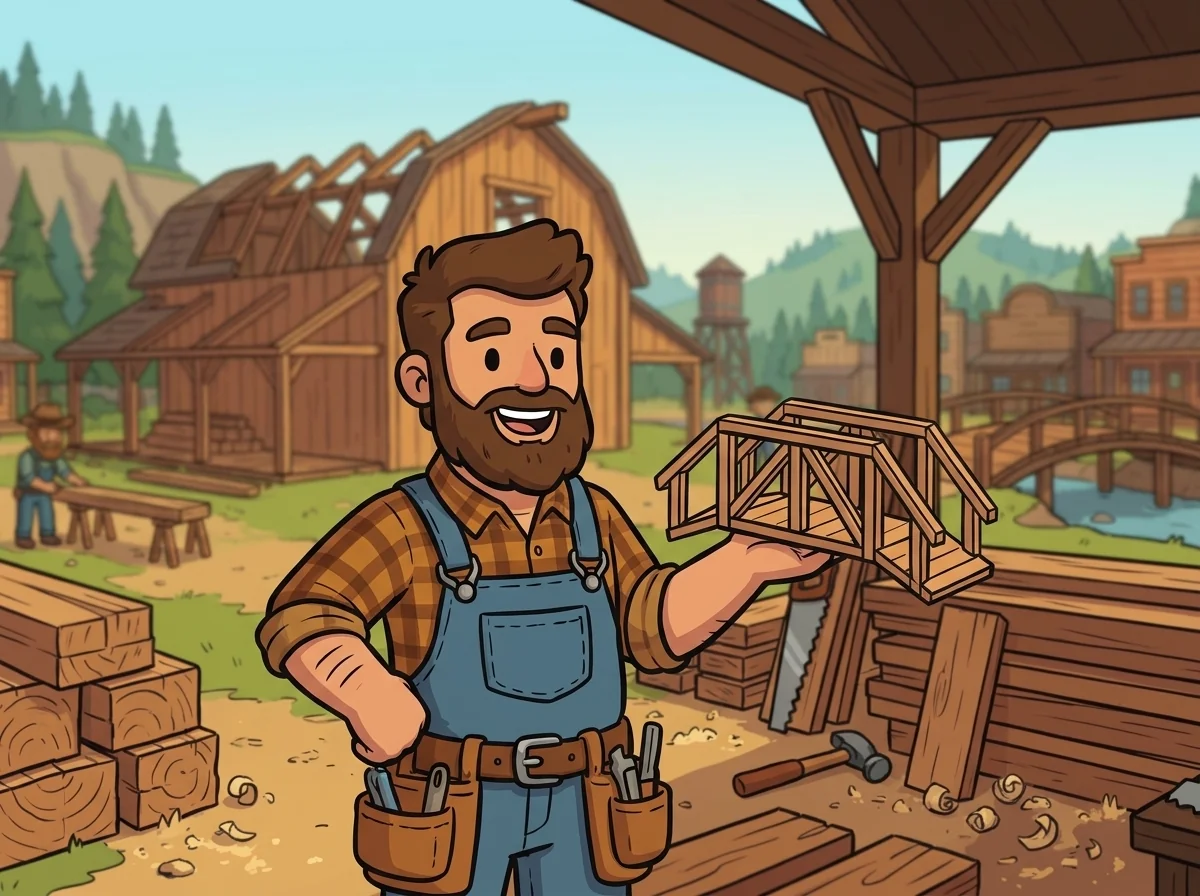
Cole listened. He thought about it. He laughed for a long time. He said: "That is the only kind of proof I have ever done."
The mathematician said: "There are mathematicians at the central university who would love to meet you."
Cole said: "I do not have time for the central university. I am making a barn."
The mathematician said: "Of course. Just thinking aloud."
She left. Cole finished the barn.
But the conversation stayed with him. He thought about it for the next two years while he built three more houses and one footbridge. He realised, slowly, that he had been constructing proofs in his daily work — every cabinet he built was a proof that a cabinet with these dimensions and these supports is possible. Every roof was a proof that a roof spanning this distance can be built. He had not thought of his work that way. But the mathematician had been right.
He wrote to the academy at age thirty. He asked if they ever needed teachers. The academy master wrote back the same week and said yes, we always do.
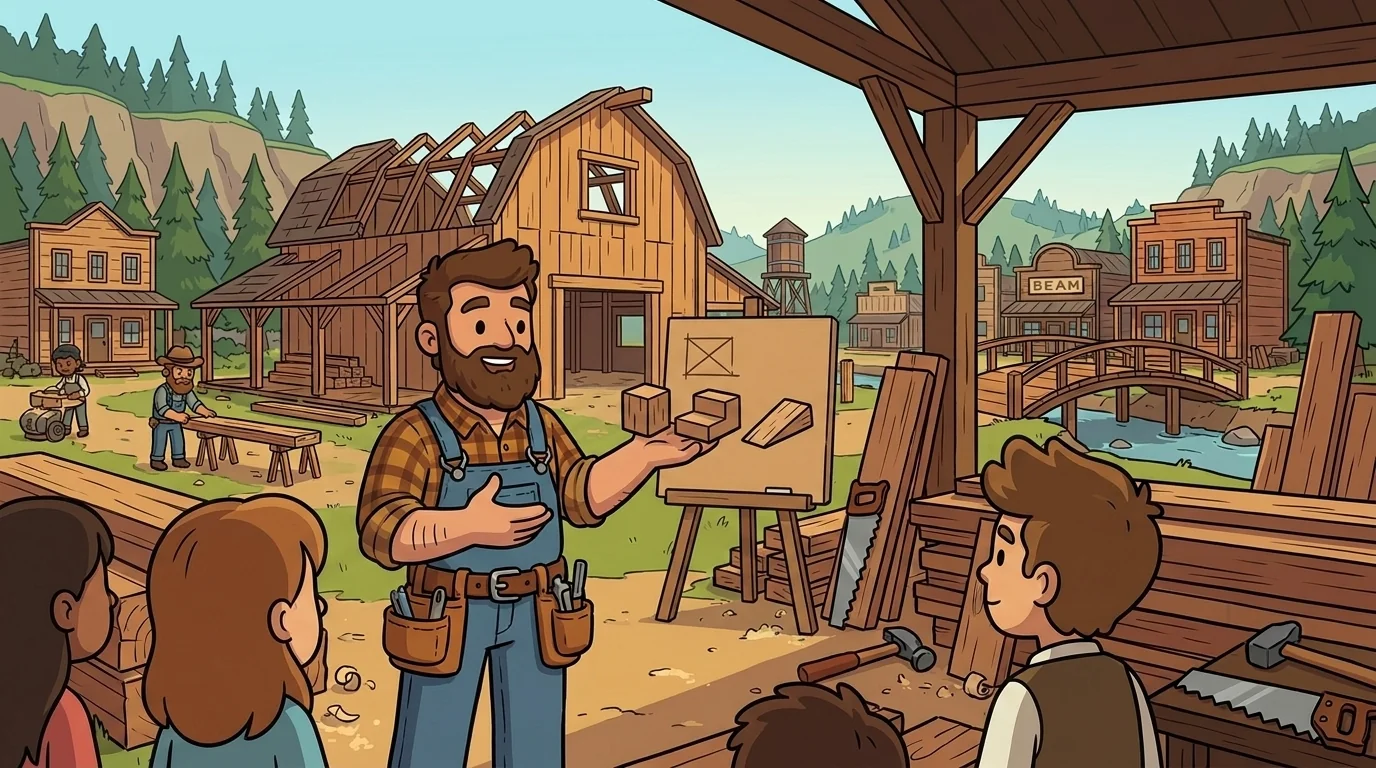
Cole arrived in the capital with three carved wooden objects in his bag — a small block, a small step, and a small wedge. He used them in his first class. He has been using them, or replacements, ever since.
His teaching style is simple. He says: "You want to prove this thing exists? Fine. Here is one. Look at it. Touch it. It exists."
He then walks the children through why the thing he made satisfies the claim. The proof, in Cole's classroom, is the object plus the explanation of why it works. Both halves are essential. Many children find this style unusually clear, which is exactly the effect Cole intended.
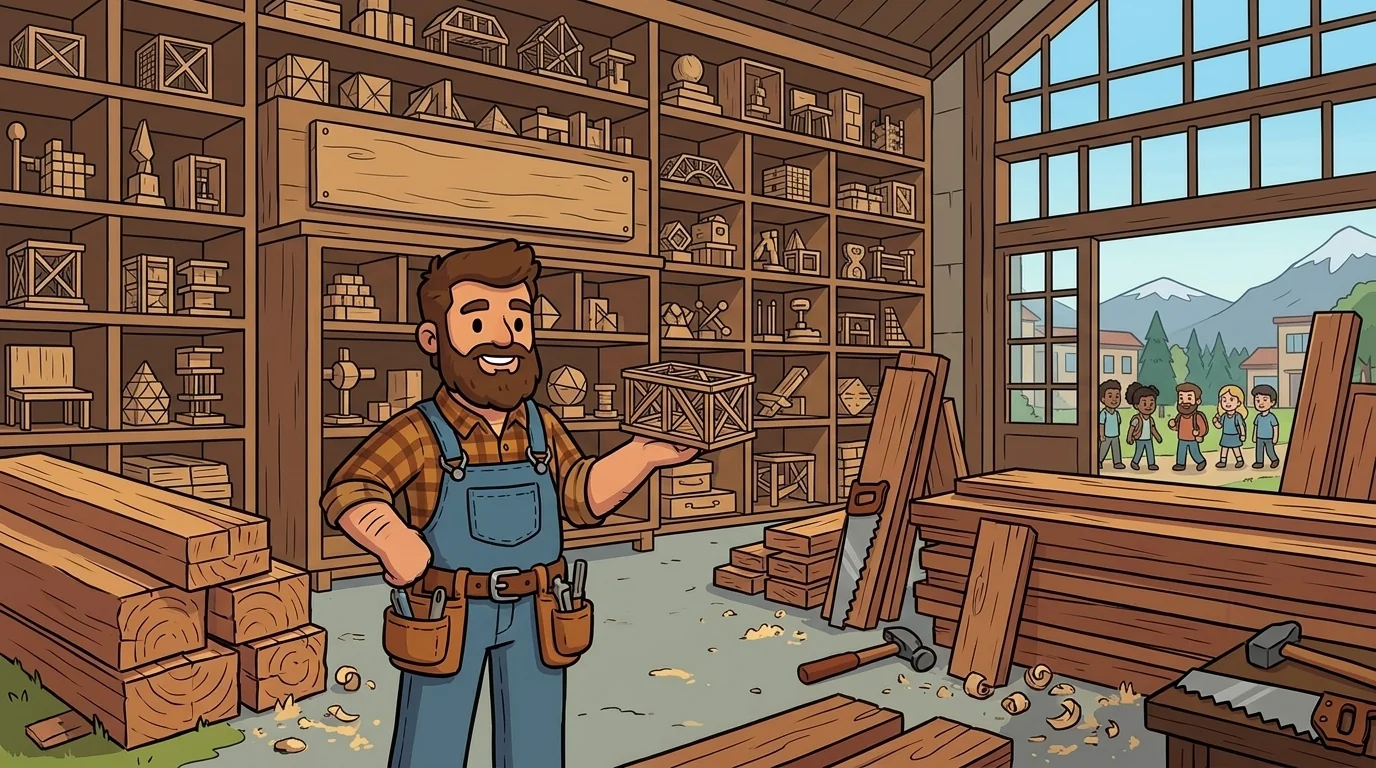
He has been at the academy for sixteen years now. He has built, by his own count, four hundred and thirty teaching objects. They are all kept in a large cupboard at the back of his classroom. The cupboard is labelled, in his own neat handwriting: Things That Exist.
He still takes a week off, every summer, to go back to Beam and build something. (Usually a step. He likes building steps. Steps are honest objects.) He returns to the academy each autumn with his hands slightly more callused and his patience slightly renewed.
If you ask Cole what he does, he will not say I am a mathematics teacher.
He will say: "I build things. Then I show people that they work."
And he will hand you a small wooden object and say: "Here. Look at this one."
The ProofQuest ensemble
Construction Cole is part of ProofQuest's distributed-narrative cast. Each character embodies a different curricular primitive; together they teach the full subject.
-

Direct-Proof Dora
Direct proof: assume premises, derive conclusion by straightforward logical steps
-

Induction Ida
Weak / standard mathematical induction: base case + inductive step
-

Strong-Induction Sten
Strong induction: base case + assume all prior cases hold
-

Contradiction Cassius
Proof by contradiction (reductio ad absurdum): assume the negation, derive a contradiction
-

Pigeonhole Perch
Pigeonhole principle: if n+1 items are placed in n bins, at least one bin contains 2+ items
-

Exhaustion Edda
Proof by exhaustion / cases: enumerate every case and verify each
-

Counterexample Cricket
Disproof by counterexample — one exception topples a universal claim
-

Biconditional Bex
Biconditional proof — proving 'if and only if' in both directions
-

Uniqueness Una
Proof of uniqueness — suppose two, show they must be the same one
-

QED
Closing-mark mentor — the ∎ at the end of every proof; the gentle voice that names completion + invites the next problem