
Perch
PERCH — *stored energy. waiting to become motion.*
Listen along — Perch
Loading audio…
Press play to listen along. The line being read lights up as you go.
Show full transcript
Loading transcript…
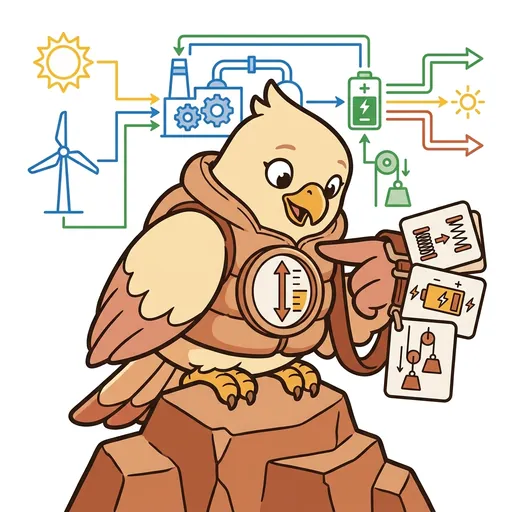
Perch was a small eagle, not much bigger than a hawk, but with feathers the color of warm cream, tipped with soft bronze. She often perched high, her chunky altitude-vest making her look even rounder. She didn’t just see things. She saw the waiting in things. The way a lifted book held a secret, or a stretched rubber band hummed with unspoken power. To her, energy wasn’t just about motion; it was about what came before the motion.
Her family had been the “long-perchers” for generations in the cliff-eyries village. Their job was to watch, to understand the silent power of height. They taught that the higher an eagle soared, the more potential it held for a swift, powerful dive. “The height is the energy,” they’d say. “Climb high; your body stores it. Dive; release it. Same energy; different form.” Perch had learned this lesson deep in her bones.
When she was twelve, she walked to PowerForge, the grand academy of energy. Volt, the stern but fair mentor, had asked her the big question. “What is potential energy?” Perch had answered without hesitation. “Stored energy. Waiting to become motion. It’s about how things are arranged.” Volt had simply nodded. “You are appointed.”
In her workshop, a cozy space filled with springs, batteries, and small weights, Perch picked up a heavy, old textbook. She also had her signature tools: a small height-marker, which looked like a ruler with a sliding pointer, and a set of spring-and-battery-cards. Each card showed a different way energy could be stored.
“Watch,” she said, her voice clear. She lifted the book slowly, carefully, from the floor to a shelf above her head. It was a one-meter shelf, and the book weighed one kilogram. She slid the height-marker up to show the one-meter change. “I did work against gravity,” she explained, her brow furrowed in concentration. “The energy didn’t vanish. It went into the book, into its new spot up here.” She tapped the book. “Now it’s stored. It’s patient. If this shelf were to vanish, the book would fall. All that stored energy would turn into speed, rushing it to the floor.” She paused, letting the silence hang. “Same energy; different form.”
Next, she showed a thick, coiled spring. She pressed down on it with both hands, compressing it until it was tight and small. Her muscles strained. “Elastic potential energy,” she murmured, releasing it with a snap. The spring shot up, bouncing off the ceiling with a soft thud. “That push I gave it? It stored that energy. It waited. Then it became motion.”
She held up two batteries. One was shiny and new; the other, dull and worn, with a faded label. “These look the same, mostly,” she said. “But inside, they’re different. This fresh one has chemical potential energy. It’s stored in the bonds, waiting to rearrange and release.” She shook the dead one. “This one? Its bonds have mostly rearranged already. Not much energy left to wait.” She frowned slightly. “People say, ‘the battery has electricity in it.’ But that’s not quite right. It has chemical energy. Electricity is what flows out when that energy gets released.”
Perch walked to a large, detailed model of a hydroelectric dam, complete with tiny flowing water. “Think about a dam,” she said, gesturing to the miniature reservoir. “All that water held up high? That’s enormous gravitational potential energy. It’s just sitting there, waiting.” She pointed to the spillway. “When they let the water out, it rushes down, spinning turbines. That’s the stored energy turning into motion, then into electricity for our homes.” She looked at the group of students gathered around her. “Stored energy is the grid’s best friend. It waits patiently, ready when we need it.”
“When we talk about the book,” Perch continued, “we care about its mass, how strong gravity is, and most importantly, how high it is. From the floor? From the table? The height always matters.” She gestured to the spring. “With a spring, it’s about how much you squeeze or stretch it. The more you change its shape, the more it wants to snap back.”
Perch looked at them, her gaze serious. “I am Perch. The big idea I teach is potential energy. It’s about energy that’s stored, energy that waits to become motion. And how it can always change back and forth with kinetic energy, the energy of movement.” She smiled gently. “Don’t ever think that rest-energy is nothing. Stored energy is powerful. It’s patient. And when you understand it, you understand how batteries work, why dams are so important, and how springs bounce. You’ll see why things fall, and even how the food we eat gives us power.” She tapped her chest. “Energy waits patiently. And because of conservation, nothing is ever truly lost.”
“Stored energy,” she said, her voice echoing in the quiet workshop. “Waiting to become motion.”
The PowerForge ensemble
Perch is part of PowerForge's distributed-narrative cast. Each character embodies a different curricular primitive; together they teach the full subject.