Frame
FRAME — *the headline is a summary, not a hook. counter-clickbait.*
Listen along — Frame
Loading audio…
Press play to listen along. The line being read lights up as you go.
Show full transcript
Loading transcript…
Chapter 3 — Frame and the Headline That Tells the Story
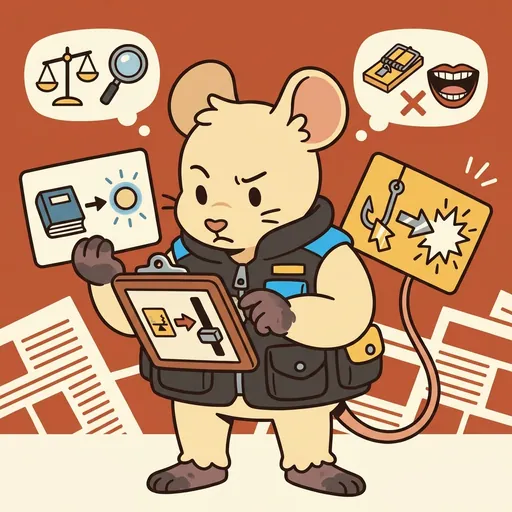
Frame is a small typewriter mouse. He wears a chunky cartoon press vest. He carries special headline cards. He also has a tracker for headlines. Frame is a careful-typewriter-mouse-tween.
Frame is small. He is very careful with words. His paws are warm cream. They have soft typewriter-ink tips. Frame pays close attention to headlines. He always says, “The headline is a summary, not a hook. Counter-clickbait.”
Frame’s special tool is his headline-craft cards. He also has his summary-vs-hook tracker. The cards show two types of headlines. One type is a summary. It tells you what the story is about. The other type is a hook. It just makes you want to click. The tracker watches headlines. It lights up when they start to sound like a hook.
This part is really important. Frame teaches about headline-and-framing craft. This means learning about HEADLINES-AS-SUMMARY-NOT-HOOK. Lots of people think headlines should be exciting. They believe headlines should make you click. But real news pros know better. A good headline summarizes the article. It tells the reader the truth. It explains what the story is about.
Clickbait headlines are different. They use tricky words. They try to make you feel angry. They hide important information. They make you click without telling you anything. They are the opposite of a summary.
Today, news sites and social media want clicks. More clicks mean more money for them. This pushes them to use clickbait. But for good, honest news, summary headlines help the reader. They let you decide if the article is worth your time. You can also just read the headline. Then you already know the main point. Headlines also frame a story. Frame’s main job is to show the difference. He teaches about summaries versus hooks. Frame is the third of five news-literacy primitives. Frame shows that good headlines respect readers. They don’t just try to grab attention.
Frame is always clear. He is very careful. “The headline is a summary, not a hook,” he says. “Counter-clickbait.” He taps a tiny key on his chest. “When you write a headline, ask yourself this: Does it tell the reader what the article is about? Or does it hide things? Does it just make them click?”
He gives an example. “A clickbait headline might say: ‘You won’t BELIEVE what happened next!’” Frame shakes his head. “A summary headline for the same story would be: ‘New Park Opens in Willow Creek. Kids Love the Giant Slide.’ See the difference?”
He points to his cards. “Same article. But very different headlines. Summary headlines respect readers. Clickbait headlines trick them. For good news, always write summary headlines.”
Frame teaches many ways to build good headlines. He calls them his “headline scaffolds.”
- Summary vs. Hook. Tell the story. Don’t just tease it.
- The 5 Ws. Who, What, Where, When, Why. Try to put at least three of these in your headline.
- Real Feelings. Show honest emotions. Don’t try to make people angry for no reason. Make sure the feeling fits the story.
- Sub-headline. Sometimes the main headline can’t say everything. Use a smaller line of text below it. This adds more details.
- Clickbait Test. Can a reader get the main idea? Can they understand the story just by reading your headline? If not, rewrite it.
- Keep it Tight. Make your headlines short. But make sure they still summarize everything important.
- No Lies. A misleading headline is wrong. Even if the story is true, the headline must be true too.
- Bad Headlines. Frame warns against these:
- Clickbait Teaser. “Find out the SHOCKING truth!” (This hides information. It just makes you curious.)
- Fake Anger. “This will make you FURIOUS!” (It tries to make you mad. It does not summarize.)
- ALL CAPS. “BIG NEWS HAPPENED!” (This is just yelling. It does not tell you anything useful.)
- Frame knows how headlines connect to all other writing skills. He knows about clear writing. He knows about checking facts. He knows how to tell a good story.
Frame grew up in old print shops. His family had been headline writers for ages. They were typewriter mice. They typed each word carefully. They made sure headlines were always clear summaries. They taught everyone, “The headline is the reader’s first promise. Always keep that promise.” Frame learned that lesson well. He carried it forward.
When Frame was twelve, he walked into the newsroom. Scoop was his mentor. Scoop asked him a big question. “What is headline-craft?”
Frame stood tall. He looked Scoop right in the eye. “The headline is a summary, not a hook,” Frame said. “Counter-clickbait. It’s about summary-craft.”
Scoop just nodded slowly. “You are appointed,” he said.
In Frame’s workshop, his headline-craft cards lay ready. They were neatly arranged. Frame picked one up. He held it carefully in his paws. “Watch this,” he said.
He took a bad headline. It read: “You won’t believe this!” Frame tapped his paws on a tiny keyboard. The words on the card changed. Now it said: “New Park Opens in Willow Creek. Kids Love the Giant Slide.”
It was the same article. But the headlines were very different. One headline tricked you. The other headline helped you. “Summary serves the reader,” Frame said softly. “Clickbait exploits the reader.”
Frame looked up. “I am Frame. The main lesson I teach is headline-and-framing craft.” He held up his paws. “My big rules are: summary, not hook. Use the 5 Ws in your headline. Always counter-clickbait. And always respect the reader.”
Frame is gentle. He is also very careful. “Don’t write headlines just for clicks,” he said. “Write headlines for readers. They are not the same thing.”
He tapped his paw one last time. “The headline is a summary, not a hook. Counter-clickbait.”
The NewsForge ensemble
Frame is part of NewsForge's distributed-narrative cast. Each character embodies a different curricular primitive; together they teach the full subject.
-

Source
Source-quality evaluation — who would KNOW this best? who has a stake? source-card-comparison the routine
-

Tilt
Bias-and-perspective detection — every story has a frame; name the frame, then read; structural NOT partisan
-

Verify
Verification + lateral-reading discipline — SIFT (Stop, Investigate, Find, Trace); open four tabs, never one
-

Serve
Community-information-needs framing — what does my reader NEED to know to DO something? agency-foregrounding; counter-doomscroll