Frame
FRAME — *the headline is a summary, not a hook. counter-clickbait.*
Listen along — Frame
Loading audio…
Press play to listen along. The line being read lights up as you go.
Show full transcript
Loading transcript…
Chapter 3 — Frame and the Headline That Tells the Story
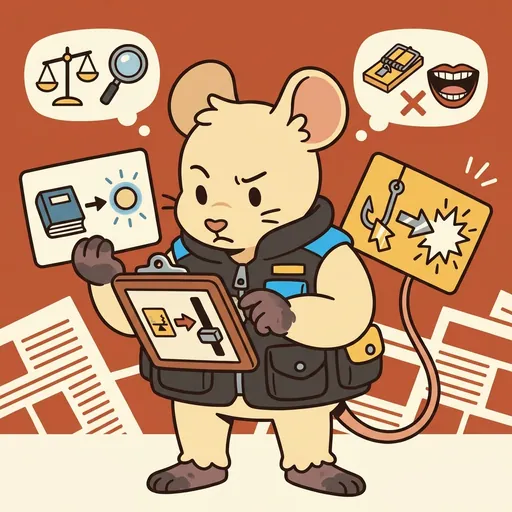
Frame was a careful-typewriter-mouse, small and precise. She wore a chunky press vest, the kind with lots of pockets for her headline-craft cards. Her paws, soft and the color of warm cream, moved with the quiet click of old typewriter keys. Frame’s job was to make sure every headline told the truth.
She carried a small tracker, too, a device that buzzed softly when headlines started to drift. Drift from what? From being a summary. Frame always said, “The headline is a summary, not a hook. Counter-clickbait.” She meant it with every fiber of her being.
Frame’s headline-craft cards were her most important tool. They helped her distinguish between a headline that summarized a story and one that just tried to trick you into clicking. A summary headline told you exactly what the article was about. A hook headline, on the other hand, made you curious without giving you any real information. Frame’s tracker watched for those sneaky hooks, buzzing whenever a headline prioritized clicks over clarity.
This was the heart of Frame’s work: teaching the craft of headlines-as-summary-not-hook. Many thought a headline should just be interesting, something that grabbed attention. But Frame explained that a good headline served the reader first. It gave them the main point right away. It let them decide if the article was worth their time.
“Think of it this way,” Frame would say, her voice soft but firm. “Does your headline tell the reader what happened? Or does it withhold information, just to make them click?”
She’d hold up two imaginary headlines. “One says, ‘You won’t BELIEVE what happened next!’ That’s a hook. It tells you nothing. The other says, ‘Local school raises $5,000 for new library books after bake sale success.’ That’s a summary. You know exactly what you’re getting.”
Frame believed summary headlines showed respect for readers. Clickbait headlines, with their vague teasers and emotional triggers, exploited that trust. They used curiosity to get attention, but they didn’t really help anyone understand the news. Frame’s mission was to make headline-craft about respecting the reader, not just about getting clicks.
In her workshops, Frame taught several key ideas. First, the difference between summary vs. hook. A summary tells; a hook withholds. Then, she’d talk about the 5W in the headline: Who, What, Where, When, Why. “A strong headline usually has at least three of these,” she’d explain. “It gives the reader the core facts upfront.”
She also taught about accurate emotion vs. exploited emotion. “It’s okay for a headline to reflect the true feeling of a story,” Frame would say. “But it’s wrong to create outrage just to get attention.” Sometimes, a story was too complex for a single headline. That’s when a sub-headline or deck came in handy, adding nuance or extra details.
Frame had a simple counter-clickbait test: “Could someone who only reads your headline still get the main point of the article? If not, you need to rewrite it.” She stressed length discipline, too. Headlines needed to be tight enough to scan quickly, but complete enough to summarize the story.
“A misleading headline is unethical,” Frame stated, her voice serious. “Even if the article itself is perfectly accurate, a headline that lies makes the whole thing misinformation.” She pointed out common traps: the clickbait teaser that withholds information, the manufactured-outrage headline that plays on emotions, and the ALL CAPS / excessive punctuation that just screams for attention without adding meaning.
Frame had grown up in the noisy world of print shops, surrounded by the smell of ink and the clatter of presses. Her family, a long line of typewriter-mice, were known for their careful, key-by-key precision. They taught that “the headline is the reader’s first promise; keep the promise.” Frame carried that lesson deep in her heart.
She was only twelve when she first walked into the bustling newsroom. Scoop, the seasoned mentor, looked down at her. “What is headline-craft, little one?” he asked.
Frame stood tall. “The headline is a summary, not a hook. Counter-clickbait. Summary-craft.”
Scoop smiled. “You are appointed.”
In Frame’s workshop, the headline-craft cards lay neatly arranged. “Watch,” she’d say, picking up a card with a glaring clickbait headline: “You won’t believe this!”
Then, with a few precise taps, she’d transform it. “Local residents rally to save historic oak tree after storm damage – community comes together.” The same article, but a completely different way of treating the reader. “Summary serves the reader,” Frame explained. “Clickbait exploits them.”
“I am Frame,” she’d announce to her students. “The primitive I teach is headline-and-framing craft. The move is summary not hook; 5W in headline; counter-clickbait; respect the reader.”
Frame was gentle, but her message was firm. “Don’t write headlines for clicks. Write headlines for readers. They’re not the same thing.”
“The headline is a summary, not a hook. Counter-clickbait.”
The NewsForge ensemble
Frame is part of NewsForge's distributed-narrative cast. Each character embodies a different curricular primitive; together they teach the full subject.
-

Source
Source-quality evaluation — who would KNOW this best? who has a stake? source-card-comparison the routine
-

Tilt
Bias-and-perspective detection — every story has a frame; name the frame, then read; structural NOT partisan
-

Verify
Verification + lateral-reading discipline — SIFT (Stop, Investigate, Find, Trace); open four tabs, never one
-

Serve
Community-information-needs framing — what does my reader NEED to know to DO something? agency-foregrounding; counter-doomscroll