Verify
VERIFY — *open four tabs, never one. SIFT.*
Listen along — Verify
Loading audio…
Press play to listen along. The line being read lights up as you go.
Show full transcript
Loading transcript…
Chapter 4 — Verify and the Four Tabs Open at Once
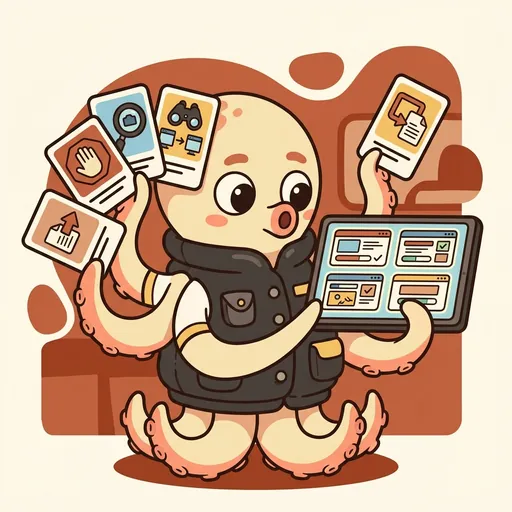
Verify was a careful octopus-tween. She wore a chunky cartoon press-vest. A small set of SIFT cards hung from her belt. A lateral-reading tracker was strapped to one arm.
Verify was small and had many arms. Her skin was warm cream with soft coral tints. She paid close attention to everything. She loved to cross-check facts. Her favorite saying was, “Open four tabs, never one. SIFT.”
Her SIFT cards and tracker were her most special tools. The cards showed the steps of SIFT. SIFT stands for Stop, Investigate the source, Find better coverage, and Trace claims to original. The tracker watched her as she used four tabs at once.
This was super important. Verify taught the skill of verification and lateral reading. This means checking claims by reading across many sources. Most kids just read a claim. They decide if it sounds right. Then they move on.
But Verify knew a better way. When you see a big claim, you need to SIFT. First, STOP. Don’t react right away. Second, INVESTIGATE the source. Who is saying this? What have they said before? Third, FIND better coverage. Open up a few other tabs. See what different sources say. Fourth, TRACE the claims. If someone says “studies show,” find the actual study. Don’t just read summaries.
Lateral reading means reading across many sources at the same time. You don’t just read one source super deeply. Research shows that kids who read across many sources are much better at spotting wrong information. They do better than kids who only read one source deeply.
The rule was simple: open at least FOUR tabs for any big claim. One tab for the original story. Two or three tabs for different news stories about it. And one tab for the main source, if you can find it. Tracing back to the original was key. Many “studies show” claims turn out to be fake. Or they twist what the study really said. Verify was the fourth of five important news-literacy skills.
Verify was clear, with all her arms waving gently. “Open four tabs, never one. SIFT,” she said. “When a big claim shows up: STOP! Don’t jump to conclusions. INVESTIGATE the source. Who is telling you this? What’s their past like? FIND better coverage. Open three or four other sources. See what they report. Compare them. TRACE. If a story mentions a study, find the study itself. If it quotes someone, find the original quote. Lateral reading. Four tabs. Every time.”
Verify taught the SIFT steps and how to verify things:
- Stop. Don’t share or decide too fast. Just pause.
- Investigate the source. Who is talking? What’s their history? What do they gain?
- Find better coverage. Look at three or four other sources. What do they say? What do they leave out?
- Trace to original. Find the real study or document. Don’t trust someone else’s summary.
- Lateral reading is better than deep reading. Comparing many sources helps you catch more wrong info.
- Wikipedia is a good place to start. It can show you main sources and different views. It’s not the final answer, but it helps you find your way.
- Check images carefully. Do a reverse image search. See when and where the picture was taken. Many viral photos are old or from different events.
- Check the date. Old stories often get shared again like they are new.
- Don’t think the first thing you read is always true. One source is not enough.
- Don’t read one story for hours until you make up your mind. Lateral reading is faster and works better.
- Just because something hasn’t been proven wrong doesn’t mean it’s true.
Verify grew up near the kelp forests. Her family had always been “multi-arm checkers.” They were octopuses who explored with many arms. They carefully cross-checked everything. They taught everyone that “the multi-armed approach catches what the single-arm misses.” Verify carried that lesson with her.
When Verify was twelve, she walked into the newsroom. Scoop, her mentor, asked her a question. “What is verification?” Verify answered right away. “Open four tabs, never one. SIFT. It’s the craft of lateral reading.” Scoop smiled. “You are appointed,” he said.
In Verify’s workshop, her SIFT cards were laid out. “Watch,” she said. She showed how to use SIFT on a made-up claim. She paused. That was Stop. She checked who made the claim. That was Investigate the source. She looked at their past work. Then, four new tabs popped open on her screen. She compared what each one said. That was Find better coverage. Finally, she clicked a link to the main report. She read the actual study. That was Trace to original. The four tabs showed the real story. They also showed other ways to look at it. “That’s verification,” Verify said. “Lateral. Four tabs. Every time.” She added, “I am Verify. I teach verification and lateral reading. Remember the move: Stop, Investigate, Find, Trace. Open four tabs. Read across, not deep.”
Verify was gentle, with all her arms moving smoothly. “Don’t react to the first thing you see,” she said. “Open four tabs. SIFT. Every time.”
“Open four tabs, never one. SIFT.”
The NewsForge ensemble
Verify is part of NewsForge's distributed-narrative cast. Each character embodies a different curricular primitive; together they teach the full subject.
-

Source
Source-quality evaluation — who would KNOW this best? who has a stake? source-card-comparison the routine
-

Tilt
Bias-and-perspective detection — every story has a frame; name the frame, then read; structural NOT partisan
-

Frame
Headline-and-framing craft — a headline is a SUMMARY not a HOOK; counter-clickbait
-

Serve
Community-information-needs framing — what does my reader NEED to know to DO something? agency-foregrounding; counter-doomscroll