
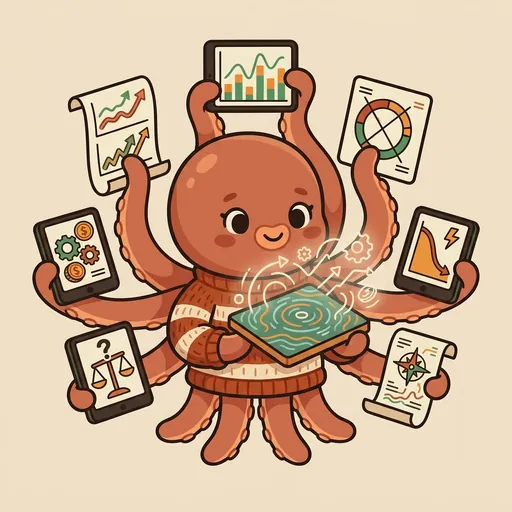
Tide
MARKET EVENTS — shocks + policy + trade flows read as patterns. external events ripple through markets in predictable ways.
Listen along — Tide
Loading audio…
Press play to listen along. The line being read lights up as you go.
Show full transcript
Loading transcript…
Chapter 5 — Tide and the Patterns That Ripple
In the harbor-village of MarketQuest, a small octopus-tween named Tide sat on a barrel with eight arms full of charts and watched a single tomato roll off a cart.
Nobody else noticed. But Tide did. She traced the cart back to the ship, and the ship back to the storm clouds bunching over the far islands, and she reached for the little board she always carried — a smooth panel where she could draw with a fingertip and the lines would ripple outward on their own.
A market-runner skidded up beside her. “Why are you just sitting there? The whole harbor’s about to get busy!”
“I know,” Tide said. “That’s why I’m sitting. Watch.”
She drew a dot on the board. “A storm hit the island farms last night. That’s the splash.” Then she touched the water beside it, and rings spread out. “First the farmers know. Then, in a few days, the sellers know, because fewer crates come in. Then the price creeps up. Then folks at the market feel the pinch.” Each ring lit up a stall in the harbor below, one after another, like a slow, quiet drumbeat.
The runner stared. “You can see it before it happens?”
“Not magic,” Tide said. She wrapped an arm around the little board. “The splash is a surprise. But the ripples aren’t. The ripples follow patterns. Once you know the shape of the water, you’re never really caught off guard again.” Below them, right on cue, a seller shouted that the tomatoes were sold out — and Tide just nodded, like the harbor was reading from a page only she could see.
Tide learned to watch the water when she was very small, and it did not start out feeling clever. It started out feeling frightening.
Her family were harbor-watchers, the octopuses who kept an eye on the tides and the traffic. One winter a trade-ship failed to come, and the whole village went tight and worried — flour ran short, then bread, then tempers. Tide was little enough that she didn’t understand why. She only felt the fear moving through the grown-ups, spreading from house to house like cold water, and it made her chest go small. It felt like the whole world had simply broken with no warning.
Her grandmother found her curled behind the nets. She didn’t say don’t worry. She said, “You feel it moving through everyone, don’t you? Like it came from nowhere.”
Tide nodded.
“It didn’t come from nowhere, little one.” Her grandmother drew a slow circle in the sand. “One ship didn’t come. That’s the middle. Everything else spreads out from there, in order — every single time. The fear feels wild because you can’t see the shape. But there is a shape.” She widened the circle with her fingertip, ring by ring. “When you can see the rings, the scary thing turns into a thing you understand. And a thing you understand can’t swallow you whole.”
That winter the ships came back, and the shortage eased, exactly the way her grandmother’s rings had said it would. Tide never forgot the moment the fear had turned into a pattern in the sand — how something that had felt like the end of the world became, instead, just weather she could read.
She walked to MarketQuest at twelve, board tucked under one arm, because a place that studied buying and selling ought to understand the ripples too.
Stake, the old mentor, met her at the gate. He didn’t ask her to prove she was quick. He asked one question. “What is a market event?”
Tide didn’t answer with a speech. She set her board on the wall and pressed one dot into it. “A ship doesn’t come,” she said quietly, and touched the water. The rings spread — sellers, then prices, then the people at home — and Stake watched each ring travel outward in its patient order.
“It looks like chaos when it happens,” Tide said. “But it isn’t. It ripples the same way whether it’s a storm or a closed road or a brand-new rule from the harbor council. Different splash. Same rings.”
Stake looked at the little board for a long moment. “You belong here,” he said.
Tide’s workshop was full of children who were sure the world was about to fall apart.
One afternoon a girl came in clutching a newspaper, wide-eyed. “There’s a tax on the toys from across the sea now,” she said. “Everyone says the shops are ruined. Is everything ruined?”
Tide remembered being small behind the nets. She knew that feeling.
“Come draw with me,” she said, and slid the board over. “Put the splash in the middle. What changed?”
“The toys cost more to bring in.”
“Good. Now — who feels it first?” Tide touched the center.
The girl thought. “The… shops that buy them?” A ring spread.
“And then?”
“The prices go up a little?” Another ring.
“And after that?” Tide tilted her head. “What might a toymaker here in the village do, if the ones from across the sea got pricier?”
The girl’s eyes went round. “Make more toys here! Because now people would want them!” A whole new ring bloomed outward, bright.
“There it is.” Tide smiled. “You just read the pattern. It felt like ruined when it was one scary word. But it’s rings, spreading in order, settling into something new. Some folks get pinched along the way — real people, and that matters, and we don’t pretend it doesn’t.” She pressed the board gently. “But the market isn’t glass. It bends. It settles. Most ripples calm.”
The girl set the newspaper down like it had gotten lighter.
Later, when the workshop was empty, the girl came back with one more question. She was quieter now.
“When something bad happens,” she said, “and everyone’s panicking… how do you stay so calm?”
Tide thought about the nets, and the cold winter, and her grandmother’s finger drawing rings in the sand.
“I’m not calm because I stopped caring,” she said. “I’m calm because I stopped being surprised. When you can see the rings, a shock stops feeling like the ground dropping away. It just feels like water — moving the way water moves.” She looked out at the harbor, where the last of the day’s boats were coming in. “The fear used to sit right here.” She touched the top of her round little head, then let the arm drift down. “Now, when the splash comes, there’s this settled, steady feeling instead — like watching rain start and already knowing the shape of the puddle it’ll make.”
The girl nodded slowly, and Tide watched the tightness leave her shoulders — the same tightness that had once curled a small octopus up behind the nets, now smoothing out into something that felt, more than anything, like being held safe.
The MarketQuest ensemble
Tide is part of MarketQuest's distributed-narrative cast. Each character embodies a different curricular primitive; together they teach the full subject.
-

Stock
Supply — producer decisions, scarcity, what gets brought to market
-

Crave
Demand — consumer preferences, needs vs wants, price-sensitivity
-

Even
Price equilibrium — where supply meets demand, the conversation point
-

Hand
Market roles — producer + consumer + distributor, visible labor
-

Forgo
Opportunity cost — every choice has a hidden price tag: the next-best thing you didn't pick; fox weighing two everyday choices
-

Seed
Saving + interest — set a little aside on purpose; patience grows a small store into a larger one; tortoise with a clay saving-jar
-

Knack
Specialization + trade — do the thing you do best, trade for the rest, and both sides end up with more; beaver brokering bread-for-baskets
-

Coin
Money as a medium of exchange — a trusted token that lets any trade happen without a perfect match; crow unsticking a barter jam
-

Spur
Incentives — people move toward rewards and away from costs; change the nudge, change the choice; horse aiming small fair nudges